
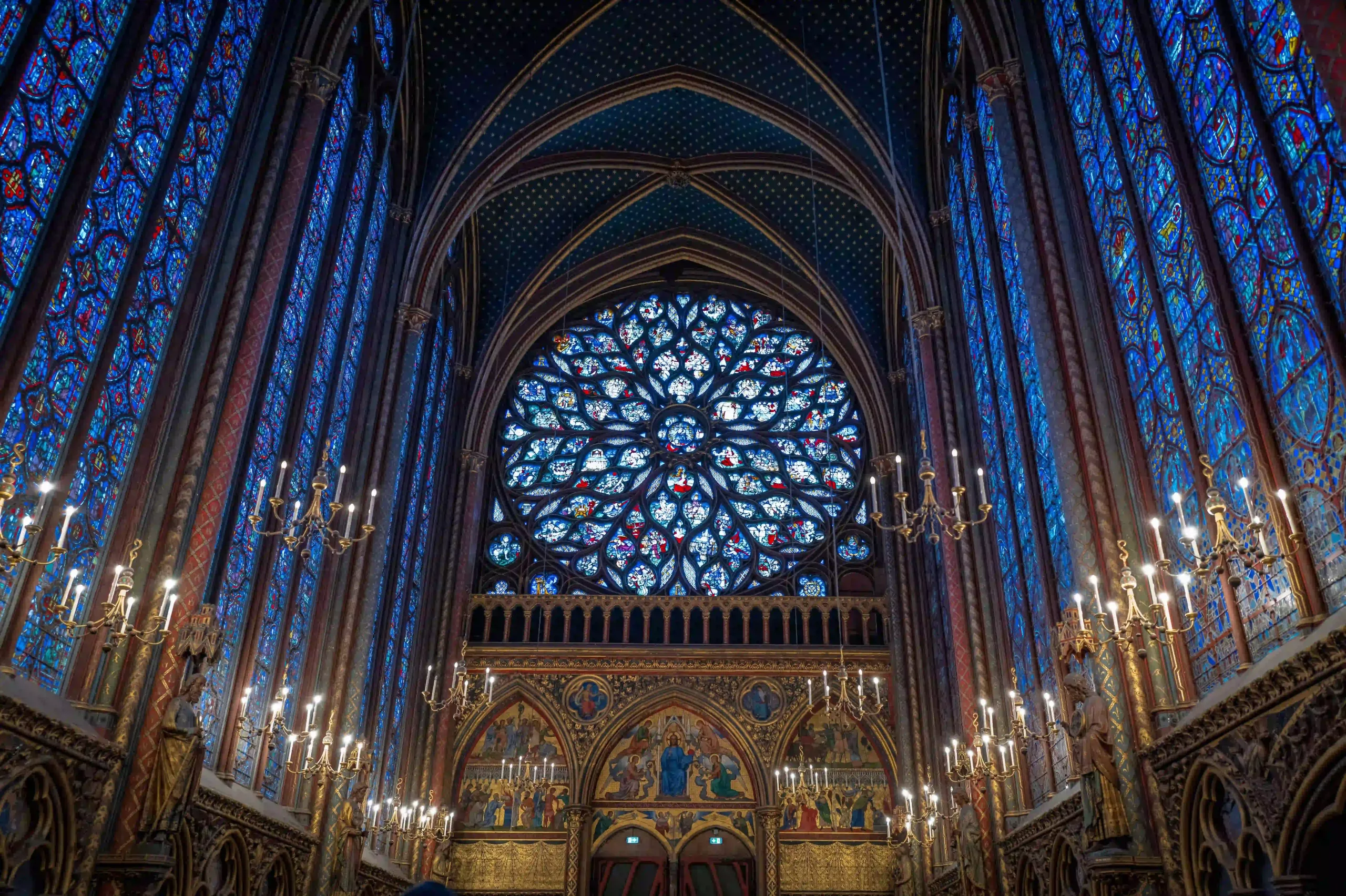
Immerse yourself in Sainte-Chapelle and the Conciergerie with a guided tour of Sainte-Chapelle and the Conciergerie organized by GTS, is to offer yourself the privilege of a discovery under the guidance of an expert lecturer. From the technical mastery of Pierre de Montreuil, a renowned architect credited with the design of the upper chapel between 1242 and 1248, to the restoration undertaken by Eugène Viollet-le-Duc in the mid-19th century, every stone, every Gothic stained-glass window, and every remnant of this legendary island of the City is revealed in its historical, artistic, and symbolic dimension. The mission of GTS it's not limited to describing the radiating Gothic architecture: it consists of bringing to life the limestone of Saint-Maximin, restoring the original polychromy of the capitals painted in ochre and lapis lazuli blue, and explaining the importance of the Crown of Thorns. preserved since 1239 at the Sainte-Chapelle before being transferred to Notre-Dame de Paris, and to recreate the atmosphere of the medieval court where Louis IX, future Saint Louis, displayed his sacred treasures. Through a continuous narrative, punctuated by precise dates—April 26, 1248, for the consecration of the Sainte-Chapelle, 1304, for the completion of the vaults in the great hall of the Palais de la Cité—and rigorously identified materials, the GTS guide-lecturer sets a vivid scene, where light manifests as raw material and memory can be read on the ancient walls.
Visit Sainte-Chapelle and the Conciergerie: two jewels of the Île de la Cité
The Île de la Cité, the royal cradle of Paris
Even before the Seine drew the natural enclosure of the capital around it, the Île de la Cité was already a crossroads of trade and power. As early as the end of the 1st century AD, a Roman castellum rose on this hill, using Lutetia stone quarried nearby. Under the Merovingian dynasty, the site hosted a royal palace, of which a few peristyles and mosaic remnants are still visible in the basements today. Its elevation to a political center was confirmed at the end of the 10th century when Hugh Capet established his palace on this islet. The new Capetian regime, eager to symbolize its legitimacy, enlarged and redeveloped the Palais de la Cité: the Salle des Gens d'Armes was built under Philip IV the Fair between 1300 and 1314, using Saint-Leu stone for its pointed arches and a solid oak beamed ceiling, while master glassmakers installed large windows to illuminate the medieval hall.
When Louis IX decided in 1239 to give the Christian world a sanctuary worthy of housing the Crown of Thorns and a fragment of the True Cross, it was naturally within this palace that the Sainte-Chapelle was born. Built in less than seven years under the supervision of architect Pierre de Montreuil, it rises on a rectangular plan, 36.5 meters long by 11.5 meters wide, with an innovative structure where the walls thin out to become a network of limestone colonnettes. This technical daring ushered in the Radiant Gothic style, which would set a precedent throughout medieval Europe. Visitors, alongside a GTS guide-lecturer, discover how each element of the edifice—from the sexpartite vault of the lower chapel to the rib vaults and lancet windows of the upper chapel—responds to a logic that is both functional and symbolic, offering a jewel box of light to 1,113 stained-glass panels that translate the history of the people of Israel and the life of Christ into colorful images. The Gothic stained-glass windows, the famous rose window, and the decorated keystone form an ornamental program of rare coherence, which only an expert guide-lecturer can help decipher in its full symbolic depth.
The Sainte-Chapelle and the Conciergerie: A Shared History within the Capetian Palace
The same 13th-century construction site that gave rise to Sainte-Chapelle also undertook the renovation of neighboring buildings, including the Conciergerie, which today retains its distinctive silhouette, made of crenellated towers and Reims limestone walls combined with red sandstone for the strength of its foundations. While the upper chapel, completed in 1248, became the exclusive sanctuary of the Crown of Thorns, the lower chapel, dedicated to palace officials, was adorned with barrel vaults and frescoes in cinnabar and azure pigments, restored under the direction of Eugène Viollet-le-Duc in 1846. The palatial complex remained closely linked until the 14th century, when Charles V moved the royal residence to Vincennes and the Conciergerie specialized in justice and state prisons. Yet, even after its transformation into a detention center during the French Revolution, it retained an architectural kinship with Sainte-Chapelle: the great hall, the Salle des Gens d'Armes, and the dungeons evoke tragic events, particularly the dark hours of the revolutionary prison where Marie Antoinette awaited her trial before the Revolutionary Tribunal. The GTS guided tour, throughout the Guided tour Sainte-Chapelle, highlights these connections and breaks, always linking the two parts of the same palace, whose stones tell of Capetian power, relics of the Passion, and the upheavals of history. A route designed for the whole family, with a duration adapted to each season.
The Sainte-Chapelle: Masterpiece of Rayonnant Gothic
Louis IX and the Construction of the Sainte-Chapelle: A Jewel Box for the Relics of the Passion
In 1238, Louis IX, King of France and future saint canonized in 1297, learned that he could acquire the Crown of Thorns, preserved for centuries in Constantinople as Christianity's most precious treasure. The Latin Emperor Baldwin II, riddled with debt, agreed to cede the relic in exchange for the considerable sum of 135,000 Tours pounds – nearly double the annual budget of the Kingdom of France. The transaction, negotiated by Dominican friars sent as envoys, was concluded in 1239. Louis IX personally went to meet the relic, barefoot and in a penitent's shirt, first to Sens, then to Paris, thus giving this event an unprecedented political and spiritual dimension.
The decision to build a sanctuary worthy of this relic was immediately apparent. Rather than enlarge Notre-Dame Cathedral, Louis IX chose to erect a new kind of palatine chapel within the Palais de la Cité itself, accessible from his royal apartments through a direct passageway. The construction was entrusted to Pierre de Montreuil, a master builder already working on the south facade of Notre-Dame de Paris and on the Abbey of Saint-Denis. The foundation stone was laid around 1242, and the consecration took place on April 26, 1248, just a few weeks before the king’s departure for the Seventh Crusade. The speed of construction—less than six years—demonstrates the scale of the resources mobilized and the king's desire to have a perfect setting for the relics of the Passion.
In addition to the Crown of Thorns, Louis IX gradually acquired other fragments of the Passion: a piece of the True Cross, the sponge from Golgotha, the iron of the Holy Lance, and several other relics gathered in Gothic goldsmith reliquaries inlaid with precious stones. These sacred objects were exhibited during major public showings in the upper chapel, transforming the Île de la Cité into a major pilgrimage site for all of medieval Christendom. Today, the Crown of Thorns is kept at Notre-Dame de Paris, where it was transferred after the French Revolution—but it was the Sainte-Chapelle that, for five centuries, was its setting of stone and light. The GTS tour guide precisely retraces this exceptional destiny, restoring to each visitor the sacred and political dimension of this unique monument in the world.
Pierre de Montreuil and Radiating Gothic Architecture: Stone, Light, and Stained Glass Windows
Pierre de Montreuil is one of the greatest master builders of 13th-century France. Trained in the workshops of the Île-de-France, he worked simultaneously on several major construction sites — the Chapel of the Virgin at Saint-Germain-des-Prés, the refectory of Saint-Martin-des-Champs, the south facade of Notre-Dame de Paris — before being entrusted with the construction of the Sainte-Chapelle around 1242. His genius lies in a radical intuition: if the function of a wall is to support a vault, then anything not strictly necessary for that function can be eliminated, lightened, or replaced by glass. It is this logic, taken to its extreme, that gave birth to Rayonnant Gothic, of which the Sainte-Chapelle remains the most accomplished expression to this day.
The structure of the edifice rests upon a system of small limestone columns from Saint-Maximin connected by external flying buttresses, which transfer the thrust of the vaults outwards and entirely free up the interior walls. These walls, reduced to their bare essentials, are nothing more than thin stone piers between which 15-meter-high lancet windows are set in the upper chapel. Never before had a building dared to dissolve the boundary between interior and exterior, between stone and light, to such an extent. The ribbed vaults, pinnacles, and painted and gilded keystones contribute to this impression of structural lightness that makes the upper chapel a space suspended between earth and sky.
The original polychromy, restored during successive interventions by Jean-Baptiste-Antoine Lassus and Eugène Viollet-le-Duc between 1840 and 1867, reveals an interior of astonishing chromatic density. The capitals are painted with yellow ocher and lapis lazuli blue, the vault ribs are highlighted with vermilion red and gold, and the bases are punctuated with medallions alternating gilded fleurs-de-lis on an azure background and castles of Castile, recalling Louis IX's maternal origins. Far from being a mere transparent setting, the Sainte-Chapelle is a total work where architecture, painting, and stained glass form a single visual language, which the GTS guided tour speaker deciphers for visitors with the precision of an art historian and the sensitivity of a storyteller. The light, filtered through 1,113 panels of colored glass, changes according to the time of day and season, making each guided tour of the Sainte-Chapelle a unique and irreplaceable experience.
The lower chapel: colors, vaults, and sculpted decoration
Often overshadowed by the prestige of the upper chapel, the lower chapel nevertheless deserves sustained attention. Dedicated to the Virgin Mary and reserved for palace officers and servants, it occupies the lower level of the building, just a few steps from the inner courtyard. Its more modest ceiling height – approximately 6.60 meters compared to 20.50 meters for the upper chapel – creates a radically different atmosphere, more prayerful, more intimate, almost subterranean. The segmental arches, supported by sixteen cylindrical pillars with capitals delicately carved with grape leaves and foliage, create a horizontal space that contrasts with the vertical dynamism of the upper level.
The painted decoration of the lower chapel is one of the best-preserved medieval polychrome ensembles in France. The original pigments—cinnabar for the reds, azurite for the blues, malachite for the greens, and lead white for the light backgrounds—were identified during analyses conducted by the laboratory of the France Museums Research and Restoration Center. Restorations directed by Eugène Viollet-le-Duc starting in 1846 restored the polychromy of the pillars and vaults, relying on original traces and revealing a remarkably coherent decorative program: gilded fleurs-de-lis, castles of Castile, scattered stars on a midnight blue background, and hagiographic medallions alternate across all architectural supports.
The eight stained-glass windows of the lower chapel, less spectacular than those on the upper floor, nevertheless depict scenes from the Old Testament and the life of Saint Louis with a narrative precision that testifies to the skill of mid-13th-century Parisian workshops. The western portal, framed by archivolts sculpted with musician angels and prophets, gives access to a narthex whose star-studded ceiling reprises the cosmological theme of the night sky, introducing the celestial symbolism that structures the entire building right from the entrance. It is precisely in these details that the Sainte-Chapelle guided tour takes on its full meaning: without the expert eye of the GTS guide-lecturer, the richness of this discreet yet extremely sophisticated decor escapes most visitors who pass through the lower chapel without perceiving its depth. Families, school groups, and individual visitors invariably leave with the feeling of having discovered a monument within a monument.
The upper chapel: the fifteen stained glass windows and the large rose window
Crossing the threshold of the upper chapel is a breathtaking experience. After the spiral staircase connecting the two levels of the building, visitors suddenly emerge into a space where stone seems to have vanished, absorbed by fifteen 15-meter-high stained-glass windows that envelop the entire nave in a colored light of unparalleled intensity in European Gothic architecture. The total glazed surface area reaches 618 square meters, or two-thirds of the total wall surface – a ratio that remains an absolute record for a medieval building to this day. The 1,113 pictorial scenes that make up this iconographic program constitute the greatest illuminated bible of the Western Middle Ages, narrated not on parchment but on glass.
The fifteen stained-glass windows are to be read from left to right and from bottom to top, according to a theological program developed under the supervision of the royal chapel's theologians. The ten choir windows, the oldest and best-preserved, illustrate episodes from the Old Testament—Genesis, Exodus, Numbers, Deuteronomy, Joshua, Judges—while the nave windows address the life of Saint John the Evangelist, the life of the Virgin Mary, the Book of Ezekiel, and the Passion of Christ narratives. The fifteenth window, dedicated to the relics of the Sainte-Chapelle and the history of Louis IX, occupies an axial position that confirms the autobiographical and dynastic dimension of the iconographic program.
The large western rose window, added between 1485 and 1498 during the reign of Charles VIII, crowns this ensemble with flamboyant virtuosity, delicately contrasting with the radiant rigor of the 13th-century stained glass. Its 89 compartments depict scenes from the Apocalypse of Saint John, arranged in concentric circles around a Christ in Majesty surrounded by the four Evangelists. The evening light, filtering through this rose window in the late afternoon, projects a kaleidoscope of purple, golden, and azure hues onto the floor of the upper chapel, with intensity varying with the seasons—reaching its peak on autumn days when the low-angle sun amplifies the depth of the blues and reds. It is to capture these variations in light that the GTS guide-lecturer advises visiting the Sainte-Chapelle at different times of day and in different seasons, as each light reveals a new interpretation of the iconographic program and an unprecedented color palette.
The Relics of the Passion: the Crown of Thorns and the Fragment of the True Cross
The Crown of Thorns is the centerpiece of the treasure of Sainte-Chapelle, and it is for it, before any other architectural or dynastic consideration, that Louis IX undertakes the construction of the edifice. Woven from reeds from the Middle East according to the oldest Byzantine sources, it has been preserved since the 4th century in Jerusalem, then in Constantinople, where it became the tangible symbol of Christian sovereignty over the Holy Land. When Baldwin II ceded it to Louis IX in 1239, the transaction was not merely for an object of devotion: it transferred spiritual legitimacy to the Capetian crown, placing Paris on par with the new Jerusalem and Louis IX as the new king-priest, guardian of the Passion of Christ.
The fragment of the True Cross, acquired shortly after the Crown of Thorns, reinforces this exceptional treasure. Presented in a reliquary shaped like a goldsmith's cross, set with precious stones—rubies, sapphires, emeralds, and pearls—it is displayed during major public showings that gather crowds of pilgrims from all over medieval Europe. To these two major relics are gradually added other treasures: the iron of the Holy Lance that pierced Christ's side, the sponge from Golgotha soaked in vinegar, a fragment of the shroud, part of the reed of mockery, and several bones of saints recognized by the Church. Together, they constitute the most precious treasure of Western Christendom, surpassing in symbolic value those of Rome and Cologne.
The French Revolution dispersed this exceptional treasure. The relics were transferred to the National Library in 1791, and the reliquaries were melted down to supply the Republic's coffers. The Crown of Thorns, spared from melting due to its organic nature, was entrusted to the care of the Bishopric of Paris and finally deposited at Notre-Dame de Paris. Since the cathedral's reopening in December 2024, it has been kept in a contemporary reliquary designed by architect Sylvain Dubuisson—a three-meter-high vertical structure made of cedarwood, Carrara marble, and bronze thorns, installed in the axial chapel. It is presented for the veneration of the faithful every Friday from 3:00 PM to 6:30 PM—with a solemn ceremony on the first Friday of every month—as well as on Good Friday. The GTS tour guide retraces this extraordinary destiny for his visitors, restoring the Sainte-Chapelle to its original dimension as a sanctuary for the relics of the Passion—a dimension that only an expert guided tour allows one to fully grasp, as the history of these sacred objects is inseparable from that of the building which was conceived to house them.
The Conciergerie: From Royal Palace to Revolutionary Prison
The Palais de la Cité under the Capetians: Philip IV the Fair and the Great Hall
For nearly four centuries, the Palais de la Cité was the administrative and judicial heart of the Kingdom of France. From the reign of Hugh Capet at the end of the 10th century, the Île de la Cité concentrated essential royal functions: the royal residence, the kingdom's treasury, the crown's archives, and the seat of justice. It was under Philip IV the Fair, between 1296 and 1314, that the palace underwent its most spectacular transformation. The king, eager to assert Capetian power against the papacy and the great feudal lords, undertook an architectural program of unprecedented ambition, with the great hall as its centerpiece.
The great hall, completed around 1313, measures 70 meters in length by 27 meters in width—dimensions that make it the largest covered Gothic hall in medieval Europe. Its broken barrel vault, supported by a double row of limestone pillars from Saint-Leu, shelters two parallel naves separated by a central colonnade. The side walls, pierced by tall mullioned windows, allow abundant light to enter, illuminating the statues of the Kings of France arranged in a row on consoles—a sculptural program of which only a few fragments remain today at the Musée de Cluny. The solid oak-paneled roof structure, with beams reaching 18 meters in span, is in itself a masterpiece of medieval carpentry, demonstrating the skill of Parisian woodworkers in the early 14th century.
Under Philip IV the Fair, the palace was not only the royal residence but also housed the major institutions of the nascent kingdom: the Parliament of Paris, a sovereign court of justice whose members sat in the great hall's adjoining chamber, the Chamber of Accounts, responsible for overseeing royal finances, and the Chancellery, keeper of the seals and official documents. It was within this monumental setting that the major affairs of the reign unfolded—the trial of the Templars between 1307 and 1314, the dispute with Boniface VIII, and the first fiscal ordinances. The GTS tour guide reconstructs for its visitors the daily life of this vanished medieval palace, of which the Conciergerie today preserves the most remarkable vestiges, true fragments of a royal France submerged by centuries and revolutions.
The Hall of the Men-at-Arms: Medieval Civil Architecture in All Its Power
The Salle des Gens d'Armes is one of the most striking examples of Gothic civil architecture in France. Built between 1300 and 1315 under Philip IV the Fair, it occupies the lower level of the Conciergerie and covers an area of nearly 1,800 square meters, making it the largest preserved Gothic civil hall in Europe. Four parallel naves, separated by three rows of cylindrical pillars made of Saint-Leu limestone, support a rib vault whose ribs fall onto finely sculpted acanthus leaf capitals. The ceiling height, approximately 8.50 meters, lends the whole a sense of quiet power, far from the vertical thrust of Gothic cathedrals, but with a solidity and architectural coherence perfectly suited to its palatial function.
The Salle des Gens d'Armes (Hall of the Soldiers) takes its name from the soldiers and officers of the royal guard who occupied it daily. This is where the ordinary life of the palace took place—collective meals for the crown's servants, meetings for junior officers, and the organization of rounds and guards. Four large, monumental fireplaces, two of which still exist today in their original state, heated this immense space during the long Parisian winters. Their sculpted stone mantels, adorned with fleurs-de-lis and Capetian heraldic motifs, bear witness to the care taken even in the palace's service areas. A central fountain, supplied by a lead pipe system, allowed occupants to quench their thirst and perform ritual ablutions before meals.
When Charles V transferred the royal residence to the Louvre in 1358, and then to Vincennes, the Hall of the Men-at-Arms gradually lost its palatial function. It was progressively transformed into a communal kitchen, then into a waiting room for the court, before becoming, during the French Revolution, a detention room where up to 1,200 prisoners were crammed in conditions of extreme promiscuity. The prisoners slept on the stone floor, separated from the guards by simple wrought-iron grilles. It was in this space that most of the condemned by the Revolutionary Tribunal passed through before their transfer to the guillotine. The GTS guide reconstructs these different superimposed layers of history for his visitors, making the Hall of the Men-at-Arms an exceptional place of memory where Capetian grandeur and revolutionary tragedy can be read simultaneously on the same limestone walls, worn by seven centuries of human presence.
The Conciergerie Prison: Marie Antoinette, the Expiatory Chapel, and Revolutionary Memory
The transformation of the Conciergerie into a state prison began gradually from the 14th century, when the palace lost its function as a royal residence. But it was the French Revolution that permanently cemented the tragic fate of this building in stone and in collective memory. Between 1792 and 1794, the Conciergerie became the anteroom to the guillotine — the last place of detention for those condemned by the Revolutionary Tribunal before their transfer to the Place de la Révolution, now the Place de la Concorde. It is estimated that around 2,700 prisoners passed through during this period, including the most emblematic figures of the Ancien Régime and the Revolution itself: Georges Danton, Maximilien de Robespierre, Antoine Lavoisier, André Chénier, and Queen Marie Antoinette.
Marie Antoinette was imprisoned in the Conciergerie on August 2, 1793, after being transferred from the Temple, where she had been held with the royal family since August 1792. Her cell, initially a guardroom divided by a wooden partition, measured barely 11 square meters. Two gendarmes watched over her constantly, separated from the queen by a simple screen. The detention conditions, severe but not without some considerations obtained from the jailers by royalists, allowed her to receive a few visitors and to correspond discreetly with the outside. The so-called "Carnation" escape attempt, organized in September 1793, narrowly failed. Tried by the Revolutionary Tribunal on October 14 and 15, 1793, Marie Antoinette was sentenced to death and guillotined on October 16, 1793, at noon. The cell she occupied has today been recreated and is open to visitors, transformed under the Restoration into an expiatory chapel in memory of the queen.
The Conciergerie also holds the memory of the Girondins, of Charlotte Corday—who assassinated Marat on July 13, 1793, and was guillotined four days later—as well as members of the Committee of Public Safety themselves swept away by the Terror they had established. Robespierre spent the night of 9-10 Thermidor, Year II—that is, July 27-28, 1794—there, wounded in the jaw under circumstances still debated by historians, before being guillotined the next day in the Place de la Révolution. This tragic irony of history—executioners becoming victims in turn of the very mechanism they had put in place—constitutes one of the most striking narrative threads that the GTS guide unwinds for his visitors, transforming a guided tour of Sainte-Chapelle and the Conciergerie into a true lesson in living history, where every stone, every cell, and every name etched in collective memory resonates with a disturbing relevance.
19th Century Restoration: Viollet-le-Duc and the Restitution of the Medieval Palace
When Eugène Viollet-le-Duc undertook the restoration of the Conciergerie and the Sainte-Chapelle starting in 1840, both monuments were in an advanced state of disrepair. The French Revolution had left deep scars: heraldic sculptures had been hammered, fleurs-de-lis scraped off, and royal statues broken. The Sainte-Chapelle, successively transformed into a judicial archive depot and then a hayloft, had its stained-glass windows plastered over to protect the archives from light. The medieval polychromy of the capitals and ribs, buried under successive layers of whitewash, had nearly disappeared forever. The Conciergerie, for its part, bore the stigmata of its prison use: blackened walls, chaotic partitions, and bricked-up openings.
Viollet-le-Duc, assisted by Jean-Baptiste-Antoine Lassus for the Sainte-Chapelle, adopted a restoration method that would become influential and fuel lively theoretical debates until the 20th century. His guiding principle, explained in his famous *Dictionnaire raisonné de l’architecture française du XIe au XVIe siècle* (Dictionary of French Architecture from the 11th to the 16th Century), published between 1854 and 1868, consists of restoring the edifice to a complete state that perhaps never existed at any given moment. For the Sainte-Chapelle, this meant reconstructing the original polychromy from traces still visible beneath layers of whitewash, replacing deteriorated stained glass with faithful copies made by the Gérente and Lusson workshops, and restoring the exterior pinnacles and flying buttresses according to preserved medieval models. For the Conciergerie, the work involved clearing out medieval halls buried under successive additions and restoring the facades along the Seine to their presumed 14th-century appearance.
Viollet-le-Duc's restorations were severely criticized by his contemporaries, particularly by John Ruskin, who advocated a radically opposite approach based on preserving authentic traces rather than hypothetical restitution. These debates, far from being purely academic, have concrete resonance for today's visitor: a significant part of what they admire in the Sainte-Chapelle and the Conciergerie is the result of 19th-century interpretation rather than the work of medieval master builders. It is precisely this complexity—the superposition of eras, intentions, and interpretations—that the GTS tour guide strives to unravel for visitors, offering a nuanced and honest understanding of monuments whose beauty owes as much to medieval genius as to the restorative vision of the 19th century. An interpretation impossible without expert guidance, which radically transforms the experience of the Sainte-Chapelle and Conciergerie guided tour.
Sainte-Chapelle and Conciergerie Guided Tour: What a tour guide reveals
Reading the stained glass of Sainte-Chapelle: an iconographic program of 1,113 scenes
The stained-glass windows of Sainte-Chapelle are not mere adornments—they are a Bible in glass, a theological program of unparalleled coherence and ambition in Western medieval art. Understanding this program requires a dual knowledge, both scriptural and iconographic, which only an expert guide can convey in a lively and accessible manner. The 1,113 scenes spread across the fifteen stained-glass windows follow a precise reading logic: from left to right, from bottom to top, from north to south, each register articulates with its neighboring registers according to a system of typological correspondences between the Old and New Testaments that medieval theologians called *figura*—the prefiguration of the New by the Old.
The Genesis stained glass window, the first on the left upon entering the upper chapel, illustrates the creation of the world and the fall of Adam and Eve with remarkable narrative precision: each medallion, approximately 45 centimeters in diameter, contains an independent scene framed by scrolls and heraldic flowers painted in grisaille on a colored glass background. The blues, dominant throughout the entire program, are obtained by adding cobalt oxide to the molten glass – a technique mastered by Parisian workshops in the 13th century with a sophistication that would not be equaled until the Renaissance. The reds, particularly intense in the choir windows, result from the addition of copper or manganese oxide, according to a recipe whose subtle variations explain the differences in hue observed from one window to another.
The Relics window, the fifteenth and final in the program, occupies an axial position in the upper chapel and marks the narrative culmination of the ensemble. It illustrates the story of Louis IX's acquisition of the Crown of Thorns, its transport from Constantinople to Paris, and its deposition in the Sainte-Chapelle during the consecration on April 26, 1248. This is the only window in the program to depict events contemporary with its construction—a deliberate choice that places Louis IX within the lineage of the great biblical figures illustrated by the other fourteen windows and legitimizes his devotion as a founding act of a new Capetian Jerusalem. Without the commentary of the GTS guide, this political and theological dimension of the iconographic program completely escapes the uninitiated visitor, reducing the windows to a dazzling light show, certainly, but one devoid of its narrative and symbolic depth.
The Conciergerie Prison: Marie Antoinette, the Expiatory Chapel, and Revolutionary Memory
The Conciergerie holds spaces that an ordinary visit doesn't always allow one to fully grasp in all their historical and architectural complexity. The four towers flanking the façade on the Seine—the Clock Tower, Caesar's Tower, the Silver Tower, and the Bonbec Tower—are the oldest remnants of the Capetian palace, predating even the major transformations by Philip IV the Fair. The Bonbec Tower, whose name, according to popular tradition, evokes confessions extracted from prisoners through torture—«bonbec» literally meaning "good beak," one that talks—houses vaulted rooms on its lower levels whose limestone walls still bear the sealed iron rings that were used to chain detainees. The Silver Tower, which owed its name to the royal treasury it housed under the Capetians, offers a striking view of the Seine and the Pont au Change from its battlements.
The dungeons of the Conciergerie are a poignant testament to the conditions of detention during the French Revolution. Three categories of cells coexisted according to the wealth of the detainees: the "pistoles," individual cells rented at exorbitant prices to wealthy prisoners who could have their own furniture and food brought to them; the "chambrettes," collective dormitories where detainees of medium standing were crammed onto straw mattresses; and "la paille" (the straw), a large common room where the most destitute slept directly on the stone floor, without blankets or straw. This economic hierarchy within the revolutionary prison itself constitutes one of the period's most striking ironies – liberty, equality, and fraternity stopping at the gates of the Conciergerie dungeons. The GTS guide recreates these distinctions with precision, breathing life into realities that the walls alone do not adequately convey.
Marie Antoinette's cell, recreated as an expiatory chapel by Louis XVIII during the Restoration, is the most visited section of the Conciergerie. It contains a few authentic objects from the Revolutionary period—a crucifix, a prie-dieu, a reproduction of the queen's will written on the night of October 15-16, 1793—as well as a reconstruction of the spartan furniture that originally furnished the cell. Adjacent to this chapel, the women's corridor—a long, vaulted gallery where female prisoners awaited their appearance before the Revolutionary Tribunal—evokes through its bareness and length the silent procession of those who marched to their deaths. It is in these spaces, imbued with raw emotion and a still-vivid collective memory, that the guided tour of Sainte-Chapelle and the Conciergerie with GTS takes on its full dimension: not a simple tourist route, but an intimate confrontation with the great tragedies of French history, guided by a lecturer capable of transforming each stone, each iron ring, and each name etched in collective memory into a living and moving narrative.
Light as Matter: Visiting Sainte-Chapelle According to Season and Time
Light is the primary material of the Sainte-Chapelle—before the stone, before the glass, before the gold of the capitals. Pierre de Montreuil understood this from the very design of the edifice: radiant Gothic architecture is not a structure that welcomes light, it is a structure that manufactures it, filters it, colors it, and distributes it according to a precise geography dictated by the orientation of the edifice and the position of the sun throughout the hours and seasons. The Sainte-Chapelle is oriented according to the traditional liturgical axis, with the choir facing east and the facade facing west—which determines a luminous choreography of exceptional richness that only the attentive visitor, guided by an expert lecturer, can truly grasp in all its subtlety.
In the morning, the eastern light streams through the choir's stained-glass windows, bathing the scenes from Genesis and Exodus in a cold, bluish clarity that accentuates the depth of the blues and makes the blood-reds of the Christological medallions glow. As the sun climbs toward its zenith, the light diffuses more uniformly throughout all fifteen stained-glass windows, revealing the chromatic coherence of the iconographic program as a whole—the copper-oxide greens responding to the cobalt blues, the golds of the painted backgrounds and grisaille radiating from the upper registers. The afternoon marks the most spectacular moment of the Sainte-Chapelle's daily light show: the declining western sun strikes the great Flamboyant rose window of Charles VIII head-on, projecting a kaleidoscope of crimson, gold, and carmine hues onto the stone floor and choir walls, their intensity shifting minute by minute with the sun's course.
The seasons further amplify these variations in light. In winter, the sun low on the horizon penetrates deeper into the upper chapel's nave, creating dramatic backlighting effects that summer visitors never experience. In spring and autumn, Paris's changeable skies—alternating between clear spells and clouds—produce rapid light variations that literally make the stained glass windows pulsate, as if the 1,113 scenes in the iconographic program came to life under the effect of the changing light. In summer, the more vertical and whiter zenithal light reveals more of the architectural details—the painted keystones, the polychrome capitals, the Saint-Maximin limestone columns—sometimes at the expense of the chromatic depth of the stained glass. This is why GTS tour guide always advises visitors to carefully choose the time and season for their Sainte-Chapelle guided tour, knowing that each light reveals a different building—and that knowledge of these variations is one of the secrets that only an expert shares during a Sainte-Chapelle guided tour.
Sainte-Chapelle and Conciergerie Guided Tour: A Tailor-Made Experience with GTS
The Île de la Cité is not a territory you simply pass through; it's a territory you decipher. Its two major monuments, Sainte-Chapelle and the Conciergerie, belong to such different emotional and intellectual registers – one celebrating light, faith, and Capetian royal power, the other bearing the weight of justice, prison, and revolutionary tragedy – that an unaccompanied visit risks missing the essence, reducing two masterpieces to a mere succession of rooms and stained-glass windows with no apparent connection. It is precisely to link these two worlds, to reveal their profound historical and architectural coherence, that GTS has designed a guided tour of Sainte-Chapelle and the Conciergerie conceived as a continuous narrative, where each space prepares for the next and each architectural detail finds its resonance in the overall history of the Capetian palace.
The GTS guide-lecturer tailors the tour to the profile of each group – families with children, individual visitors, professional groups, foreign delegations, clients of Parisian luxury hotels and high-end conciergeries. For families, the narrative naturally adapts to the presence of younger children, bringing historical figures to life – King Louis IX walking barefoot in a penitent's tunic to carry the Crown of Thorns to Notre Dame, Marie Antoinette awaiting her trial in her eleven-square-meter cell – with a narrative precision that touches children as much as the adults accompanying them. For American and English-speaking visitors, the GTS guide-lecturer delivers the narrative in English with a fluency and cultural precision that transforms the visit into a true bridge between French medieval history and Anglo-Saxon sensibilities – notably evoking the links between the Crown of Thorns and Western Christian tradition, or between the revolutionary prison and the great democratic revolutions of the 18th century.
GTS also provides complete logistics management—transportation in a private vehicle from the hotel, itinerary planning, and coordination with the National Monuments Centre services, which manage Sainte-Chapelle and the Conciergerie. The client only needs to be carried away by the guide's narrative, freed from all organizational constraints. This bespoke cultural concierge service, offered to Parisian luxury hotels and high-end travel agencies worldwide, is one of GTS's signatures—the assurance that every visitor, whether a Parisian aesthete or an American traveler discovering Paris for the first time, leaves the Île de la Cité with the feeling of having had a unique, irreplaceable experience, deeply rooted in France's collective memory.
Conclusion: Contact GTS for a guided tour of Sainte-Chapelle and Conciergerie
The Île de la Cité is not just a district of Paris—it is the original heart of a civilization, the place where stone was harnessed for the sacred and the powerful with a boldness and mastery that still defy comprehension today. The Sainte-Chapelle and the Conciergerie are its most eloquent witnesses: one raising its stained-glass windows of colored light towards the sky like a prayer of stone and glass addressed to eternity, the other carrying within its thick walls and dark dungeons the memory of the glories and tragedies that shaped modern France. Between these two monuments, between the upper chapel bathed in azure and purple and the hall of the king's guard with its heavy vaults, between Saint Louis's Crown of Thorns and Marie Antoinette's cell, lies the entire history of a country, a monarchy, a revolution—and a certain idea of beauty as the supreme form of power.
Entrusting this discovery to a GTS guide-lecturer means leaving nothing to chance. It means deciding that the light in the upper chapel will be not just a dazzling spectacle but a revelation—that of an iconographic program of 1,113 scenes carefully orchestrated by the theologians of the Capetian court. It means deciding that the walls of the Conciergerie will not just be cold stones but talkative witnesses, bearing the names of Charlotte Corday, André Chénier, Georges Danton, and Marie-Antoinette. It means choosing depth over surface, understanding over contemplation, a living narrative over a silent tour. GTS has been offering this experience for years to the most discerning travelers—families seeking a living transmission of history, American and English-speaking travelers eager to understand France in all its complexity, clients of Parisian palaces and high-end concierges for whom every hour spent in Paris must be an unforgettable one.
The Guides Tourisme Services takes care of the entire experience: private vehicle transport from your hotel, organization of the itinerary on the Île de la Cité, selection of the tour guide best suited to your group and language, and duration adapted according to your wishes and the age of the participants. Whether it's a two-hour visit or an extended tour according to your wishes, GTS adapts each itinerary to the uniqueness of its visitors with the precision and attention of a prestigious host who knows their guests deserve the best of Paris. To design your custom guided tour of Sainte-Chapelle and Conciergerie, contact the GTS concierge today—because some discoveries are not meant to be made alone, and the Île de la Cité is among them.
FAQ: Sainte-Chapelle and Conciergerie Guided Tour
How long does a guided tour of Sainte-Chapelle and the Conciergerie last?
The Sainte-Chapelle and Conciergerie guided tour offered by GTS lasts approximately two hours. This duration is flexible depending on the group's profile and interests — a family wishing to linger on the stained glass windows of the upper chapel or a group of revolutionary history enthusiasts eager to delve deeper into the Reign of Terror at the Conciergerie can request an extended tour. The GTS licensed tour guide adapts the pace and depth of the narrative to the wishes of its visitors, ensuring a tailor-made experience rather than a timed circuit.
In what order should I visit Sainte-Chapelle and the Conciergerie?
Many visitors choose to start with the Conciergerie—diving into the dark history of the revolutionary prison first—before finishing with Sainte-Chapelle, whose luminous stained-glass windows provide a striking visual and emotional conclusion.
What is the difference between the upper chapel and the lower chapel of Sainte-Chapelle?
Sainte-Chapelle is composed of two superimposed levels with radically different functions and atmospheres. The lower chapel, dedicated to the Virgin Mary and reserved for palace officials, is a more intimate space, with segmental arches adorned with polychrome frescoes in cinnabar and azure pigments. The upper chapel, an exclusive sanctuary reserved for the king and the Capetian court, is the most spectacular space – its fifteen 15-meter-high stained-glass windows literally dissolve the walls into 618 square meters of colored glass, creating an unparalleled effect of luminous suspension in European Gothic architecture.With expert guidance, most visitors pass through the lower chapel without perceiving its richness, eager to ascend to the upper chapel—a dimension that only a discerning eye can fully reveal during a guided tour of Sainte-Chapelle.
Can we visit the Sainte-Chapelle and the Conciergerie in English?
Yes — GTS offers its Sainte-Chapelle and Conciergerie guided tours in all foreign languages, including English. GTS's English-speaking tour guides are specifically trained to adapt their narrative to the cultural sensitivities of American and British visitors, building natural bridges between French medieval history and major Anglo-Saxon cultural traditions. The English version of the tour notably incorporates references to the Crown of Thorns, the stained glass windows of the upper chapel, and Marie Antoinette's role in international collective memory.
How to book a guided tour of Sainte-Chapelle and the Conciergerie with GTS?
Bookings are made directly with GTS, available seven days a week, twenty-four hours a day. GTS will provide a personalized quote as soon as possible, taking into account the number of participants, desired language, duration, and any additional services. — private vehicle transport from the hotel, itinerary extended to other monuments on the Île de la Cité, custom tours for Parisian palaces and high-end travel agencies. Contact GTS via the contact form or by phone to design your Île de la Cité experience.