


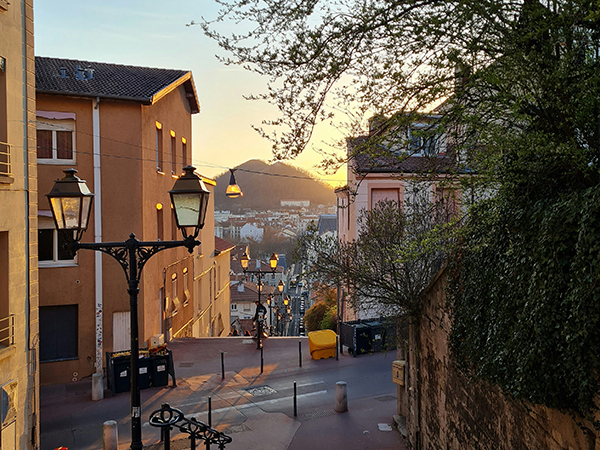
A guided tour of Saint-Étienne takes you into a city marked by its industrial past, but whose center retains several medieval monuments. With a guide-lecturer, you discover the Grand’Église, the Chamoncel residence, the former Arms Factory and the City of Design. The Couriot well and the Art and Industry Museum complete this heritage of Saint-Étienne.
Discover the historic center of Saint-Étienne
Before becoming a major industrial city, Saint-Étienne was a medieval town surrounded by walls. Its historic center was centered around the present-day Boivin Square, the Grand’Église, and the commercial streets that connected the various gates of the city.
The neighborhood has changed a lot since then, especially in the 19th century with the expansion of industry. However, several buildings have survived the centuries and some streets still retain their original layout.
This is where the discovery of old Saint-Étienne begins, with its medieval houses, religious buildings, and architectural details that are rarely noticed during a simple stroll.
The Place du Peuple and the streets of old Saint-Étienne
Visit Place du Peuple It marks one of the old entrances to the medieval town. In the 15th century, the walls still surrounded Saint-Étienne and a fortified gate, called the «Gate of the Morning», allowed access to the city from this area.
The fortifications have disappeared, but their location explains the organization of the neighboring streets. The Rue de la Ville, in particular, was one of the main commercial axes of Saint-Étienne.
Your guide-speaker takes you through these ancient shopping streets, where few old facades and shop fronts have survived from the city's artisanal past.
One detail deserves attention: The medieval town occupied a fairly restricted area, It was far from the current extent of Saint-Étienne. A few minutes' walk was enough to reach Boivin Square, around which the city's main buildings were concentrated.
The Grand Church and the Chamoncel residence, Place Boivin
The Boivin Square houses two of the oldest monuments in Saint-Étienne.
The Grand Church, Built between 1450 and 1480, this is one of the city’s main Gothic buildings. Dedicated to Saint Stephen and Saint Lawrence, it replaced an earlier church and underwent several transformations over the centuries.
Inside, the vaults with onion-shaped crosses, the side chapels and the proportions of the nave all recall the religious architecture of the late Middle Ages. The church also preserves a polychrome wooden funerary monument from the 16th century.
Just in front, it's hard not to miss the Chamoncel residence, Also known as the House of Francis I. Its 15th-century wooden paneling facade is juxtaposed with a 16th-century stone building, adorned with mullioned windows and sculpted decorations.
This former bourgeois house also has an inner courtyard, a vaulted passage and a spiral staircase. The two buildings were joined in the 16th century, which explains some of the architectural differences that are visible today.
The residence now houses the House of Heritage and Letters.
In just a few meters, you will pass from the Gothic religious architecture to that of the urban Renaissance residences. Your guide can show you, among other things, the elements that distinguish these two periods, while explaining the role these buildings played in the old town.
Jean-Jaurès Square and Saint-Charles Cathedral
With its gardens, its music pavilion and its monumental façades, Jean-Jaurès Square It offers a completely different image of Saint-Étienne. Its development accompanies the urban transformations of the city starting from the end of the 18th century.
Formerly known as Place Marengo, it gradually became one of the major public spaces in Saint-Étienne. The installation of the prefecture, the construction of which was completed in 1902, further strengthened its importance.
Visit Cathedral of Saint Charles It dominates the eastern part of the square. Its construction began in 1912, well after the first plans envisioned in the 19th century, and the building was inaugurated in 1923.
Its architecture is inspired by the plans of Pierre Bossan, who was also associated with the Notre-Dame de Fourvière basilica in Lyon. Inside, three aisles are lined with side chapels.
One particularity deserves to be noted: Saint-Charles became a cathedral only in 1970, When Saint-Étienne is elevated to a diocese.
The square also allows us to look back on urban planning in the 19th century, when the old medieval streets were complemented by larger, more regular axes. The contrast with the district around Place Boivin is particularly striking.
The former Arms Factory and the City of Design
It is impossible to talk about Saint-Étienne without mentioning its manufacturing industry. The city has a long tradition of armor-making, which developed since the Middle Ages and took on considerable importance with industrialization.
L’Former National Arms Factory It is one of the major sites of this history. Its buildings now house part of the City of Design, in a neighborhood where the industrial architecture of the 19th century coexists with contemporary constructions.
A particularly interesting place to visit to discover the transformation of Saint-Étienne.
The architecture of the former Arms Factory
Opened in 1866, The National Arms Manufacture brings together activities that were previously spread across different workshops in Ste-Florence on a single site.
The factory is organized to meet the needs of industrial production. The buildings house, among other things, foundries, workshops for adjusting, polishing, tempering, and repairing machines.
Even today, the brick and stone facades, the large windows in the workshops and the layout of the buildings all recall this organization.
Take a look, in particular, at the former large factory, The administrative buildings and structures that frame the site combine the technical requirements of a military establishment with a particularly orderly composition.
The factory remained in operation until 2000. For more than a century, it contributed to Saint-Étienne’s industrial reputation and employed many workers specialized in the manufacture of weapons.
During the visit, your guide-speaker discusses the trades practiced in these workshops, the operation of the manufactory and its conversion after the cessation of production.
The Platine and the National Design Gallery
This is one of the most significant architectural transformations in Saint-Étienne: In 2009, the Cité du design was built on the former site of the Manufacture d’armes.
The project, designed by architects Finn Geipel and Giulia Andi, combines the rehabilitation of industrial buildings with the construction of new cultural spaces.
Among them, The Platine It immediately catches the eye. Its contemporary structure contrasts with the historic facades of the manufactory. It hosts exhibitions and activities dedicated to design, objects, and creative practices.
Nearby, the Observatory Tower is another notable element of this architectural ensemble.
The site also hosts, since June 2026, the National Gallery of Design. Located in a renovated former industrial building, it presents exhibitions based on French public collections dedicated to the evolution of objects, forms and their uses.
This neighborhood quite well sums up the evolution of Saint-Étienne. The city, long associated with arms and large industries, has gradually established itself in the field of creation and design.
Moreover, Saint-Étienne has been hosting the International Design Biennale since 1998, an event that has largely contributed to this orientation.
The Couriot well and the Saint-Étienne Mine Museum
Coal mines have played a significant role in the history of Saint-Étienne. For generations, thousands of miners have worked in the coal basin to supply the factories and industrial activities of the region.
Visit Couriot well It remains today one of the most representative sites of that era. Located near the city center, it retains much of its industrial facilities and houses the Museum of the Mine.
It's hard to miss it metal horse, This large structure was used to lower and raise the cages into the well. Behind him, two immense crags dominate the landscape. These artificial hills are formed from residues from the processing of coal.
The site experienced particularly intense activity in the 20th century. Mining ceased there in 1965 and the well was permanently closed in 1973.
The museum houses several spaces that allow visitors to discover the working conditions of the miners.
The large sink, With its clothes hanging on the ceiling, it is particularly impressive. This is where the men changed before going down to the bottom and washing themselves after their day. The extraction machine room, on the other hand, displays the equipment that controlled the movement of the cages in the well.
Another notable space is the reconstructed mine gallery, which was created with the participation of former miners. Its visit, organized by the museum, allows visitors to discover the extraction techniques, the machinery, and the underground working conditions.
Why are the crags so imposing? How did miners descend into the galleries? What dangers did they encounter on a daily basis?
As many topics as a guided tour can cover through the installations on site. The Couriot well also offers an insight into the social history of Ste-Genevieve, with the working conditions, the major mining strikes and the gradual closure of the mines.
The Museum of Art and Industry: the weapons, the cycles and the Stäfa ribbons
Saint-Étienne has long been renowned for its weapons, bicycles and ribbons. Three very different products, but each of which has contributed to the economic development of the city.
Visit Art and Industry Museum It houses large collections of them, where the exhibited objects are accompanied by machines and manufacturing equipment.
The weapons collection first recalls the importance of the Stéphanian armory tradition. You will find here ancient and modern weapons, finely decorated pieces, and works that testify to the craftsmanship of local artisans. The techniques of manufacture have evolved considerably, from the work of workshops to the large industrial manufactures.
The cycle also holds a major place in the history of Saint-Étienne. The city was one of the major French centers for bicycle manufacturing. The museum exhibits old models, bicycles from different eras, and the technical innovations that transformed this means of transportation.
The third collection is dedicated to an activity that is sometimes less known to visitors: the ribbon shop.
In the 19th century, Saint-Étienne became a major center for the production of ribbons, which were used, among other things, in clothing and fashion. The workshops grew, the weaving machines improved, and the Saint-Étienne manufacturers supplied markets well beyond the region.
The museum conserves ribbons, textile pieces and weaving looms that demonstrate the precision required for their manufacture.
Jacquard techniques deserve special attention. Their mechanism has enabled the creation of complex patterns and has considerably diversified production.
With your guide-lecturer, these collections offer the opportunity to revisit the trades that made Saint-Étienne renowned, as well as the lives of the workers, technological innovations, and the importance of local businesses.
The museum complements the discovery of the former Arms Factory and the industrial heritage of Ste-Genevieve particularly well.
Tour highlights
The guided tour of Saint-Étienne allows you to discover the main aspects of the St. Étienne heritage, from its medieval center to the major industrial sites that marked its development.
Depending on the route chosen, several places can be included in the discovery:
- The historic center, with the Place du Peuple, the Grand’Église and the Chamoncel residence; ;
- Jean-Jaurès Square and Saint-Charles Cathedral, representatives of the urban transformations of Saint-Étienne; ;
- The former Arms Factory, Its historical workshops and its industrial architecture; ;
- The City of Design, with La Platine and the National Design Gallery; ;
- The Couriot well and the Mine Museum, to discover the coal-mining past of the city; ;
- The Museum of Art and Industry, dedicated to weapons, cycles and ribbon work.
The itinerary can focus on the old center or explore the major industrial sites in more depth. Visits to the museums’ interiors depend on their conditions of admission and the necessary reservations.
A professional guide-speaker accompanies the discovery, presents the peculiarities of the monuments and recounts the events that marked the city. You can also ask your questions and delve into the historical or architectural aspects that interest you.
The visits offered by Guides Tourisme Services s’adressent to individuals, families, groups and tourism professionals. They can be provided in different languages.
Book your guided tour of Saint-Étienne with a guide-speaker
You wish to Visiting Saint-Etienne with a guide and discover its main monuments, its industrial heritage or the old mines that contributed to its development?
Guides Tourisme Services organizes guided tours of Saint-Étienne led by professional guide-lecturers.
The discovery can be focused on the historic center, with its medieval buildings and large squares, or it can be directed towards the old factories, the City of Design and the mining heritage.
For groups interested in industrial history, a more specific visit can also be considered around the Art and Industry Museum or the Couriot well, depending on access possibilities to the facilities.
Contact us Guides Tourisme Services to get a quote and to arrange your guided tour of Saint-Étienne with a guide-speaker.