
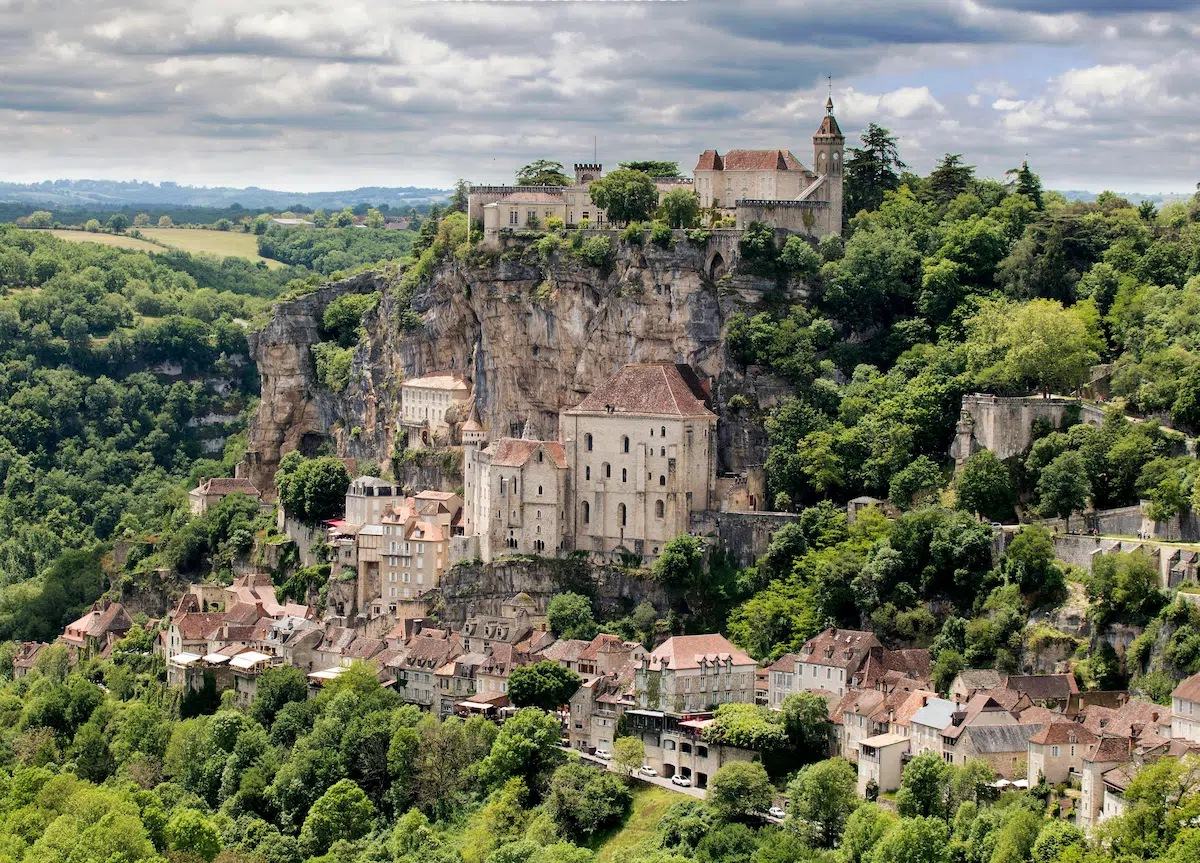


Clinging to a one-hundred-and-twenty-meter limestone cliff above the Alzou canyon, Rocamadour defies gravity for nearly a thousand years. The city is laid out on three levels—the lower town and its Rue de la Mercerie, the esplanade of the sanctuaries with its seven chapels, and the castle perched directly above the rock—forming a unique architectural ensemble in France, classified as a UNESCO World Heritage site and second religious site the most visited in the country, that Guided tour of Rocamadour with GTS, it reveals its full depth. This marvel of balance suspended between sky and stone attracts over a million visitors each year from France and around the world, including pilgrims, families, and aesthetes.
What Rocamadour reveals, however, cannot be grasped at first glance. The story of Saint Amadour, mysterious hermit whose body was discovered intact in 1166, the centuries-old devotion to the Black Madonna of the Chapel of Our Lady, the fourteen Stations of the Cross carved into the rock, the Romanesque frescoes in Saint-Michel Chapel, the relics preserved in Saint-Sauveur Basilica—so many superimposed layers that only a guide speaker unfold with the precision and passion they deserve. Guides Tourisme Services offers you a Guided tour Rocamadour custom-made Guided tour of Rocamadour in French or in any foreign language, tailored to your group, your pace, and your interests.
Rocamadour, city suspended between sky and stone
Rocamadour is unlike any other medieval city in France. Where Provins sprawls across a plateau in Seine-et-Marne and Mont Saint-Michel stands isolated in its Norman bay, Rocamadour literally clings to the vertical face of a white limestone cliff in the Causeway of Gramat, in the Lot department, in the heart of Quercy. The Alzou canyon, a deep river that winds a hundred and twenty meters below, offers from the Hospitalet viewpoint a dizzying panorama of the entire site — the first visual wonder that all guide speaker GTS carefully begin the guided tour of Rocamadour with this exceptional viewpoint.
The city is organized into three distinct levels, each with its own atmosphere and era. At the bottom, the Mercery Street — the city's unique artery in the lower town, lined with medieval limestone houses — once housed the stalls of merchants who profited from pilgrimage. On the intermediate level, the esplanade of the sanctuaries gathers the seven chapels around which Rocamadour's spiritual fame has been built since the 12th century. At the summit, the castle, remodeled in the 14th and 15th centuries, crowns the rock with its ramparts and offers families and history enthusiasts a breathtaking view of the surrounding canyon and causses. Between these three levels, the Grand Staircase of the Pilgrims — Two hundred and sixteen steps that medieval faithful climbed on their knees reciting their prayers — connect the lower city to the sanctuary’s forecourt, constituting one of the most striking experiences that Visiting Rocamadour can offer.
Visit Limestone of the Causse, omnipresent in the architecture, changes color according to the light and season—golden under the July sun, almost white in the November mist, ochre and warm at sunset in September. Rocamadour can be visited in all seasons, each revealing a different sensory palette, and Guides Tourisme Services organizes guided tours throughout the year, for families as well as professional groups.
Saint Amadour and the pilgrimage of Rocamadour
Rocamadour owes its name and fame to a historical mystery that has never been entirely solved. In 1166, the canons of the sanctuary discover in the rock, in front of the door of the Notre-Dame chapel, the perfectly preserved body of an unknown hermit. This incorruptible body is immediately identified as Saint Amadour — whose name, Amateur In Latin, it means «he who loves,» a friend of God and the Virgin Mary. Popular tradition quickly made him the servant of the Holy Family, who came to end his days in this limestone corner of Quercy after accompanying Christ and Mary in Palestine.
The publication of 1172 from the Book of Miracles — collection of one hundred twenty-six miracles attributed to Our Lady of Rocamadour — propels the sanctuary to the rank of the great pilgrimage sites of medieval Christendom. Crowds flock from all over Europe. Henry II Plantagenet, King of England, visited there twice, in 1159 and 1170, to implore the protection of the Black Madonna. Saint Louis performed the pilgrimage in 1244. Thousands of anonymous pilgrims from France, Spain, Portugal, and Italy climbed the two hundred and sixteen steps of the grand staircase on their knees, carrying the Doorway — lead medal struck with the effigy of the Virgin and Saint Amadour — as a badge of their accomplished devotion.
Rocamadour naturally stands out on the Routes of Santiago de Compostela, it represents a major step for pilgrims descending towards Spain. This position on the pilgrimage routes explains the spread of the cult of Notre-Dame de Rocamadour far beyond the borders of Quercy—even to Brittany, where the Black Virgin is venerated as the patron saint of sailors and fishermen, and to Quebec, where her name still designates several chapels today. guide speaker GTS will restore all the depth of this spiritual and historical heritage, for families as well as professional groups seeking a high-quality cultural experience in France.
The sanctuary of Rocamadour and the Black Madonna
Visit Guided tour of Rocamadour naturally leads to the esplanade of the sanctuaries, where seven religious buildings huddle against the limestone cliff in a space demarcated only by the rock. The Basilica of the Savior from the 12th century, the Crypt of Saint-Amadour who preserves the relics of the saint, the chapels of Saint John the Baptist, Saint Anne, Saint Blaise, and Saint Michael with its Romanesque frescoes — each building bears an additional layer of the site's spiritual history. The Saint Michael chapel, clinging to the wall above the esplanade, houses two remarkable 12th-century frescoes representing the Annunciation and Saint Michael slaying the dragon — among the most beautiful Romanesque paintings in Quercy.
A guide speaker GTS will guide you through this exceptional site, conveying the meaning of each chapel, each sculpture, and each inscription – a reading of the site impossible to achieve on your own, so much have historical and artistic layers overlapped here for nine centuries.
At the bottom of the Our Lady's Chapel, in the dim light of the rock, a small 76-centimeter walnut wood statue draws all eyes. The Black Virgin of Rocamadour, sculpted in the 12th century, depicts a Madonna enthroned — Majesty of Mary — holding the Child Jesus on her left knee, her eyes half-closed, her expression hieratic and serene. Its dark hue, the result of a progressive transformation between the 16th and 17th centuries, lends it an almost magnetic presence that nine centuries of prayers have imbued with a rare intensity. Above the altar, the miracle bell — whose spontaneous ringing, according to tradition, once signaled the rescue at sea of sailors in distress — completes this picture of a living and still active spirituality.
The medieval city of Rocamadour and the castle
Downstream from the sanctuary, the Mercery Street constitutes the sole artery of the lower town of Rocamadour. This medieval street, lined with limestone houses from the causses, once housed the shops of merchants, artisans, and pilgrims who benefited from the sanctuary's renown. Even today, its medieval facades, Gothic vaults, and stone markers bear witness to the urban organization of a town entirely devoted to pilgrimage. The Salmon door and the fragments of ramparts that mark the route are reminders that Rocamadour was also a fortified place, contested during the Hundred Years' War and looted by the Huguenots in 1562.
At the top of the cliff, the Rocamadour Castle — remodeled in the 14th and 15th centuries on older foundations — crowns the site with its crenellated ramparts. It offers families and groups the most vertigo-inducing panorama of the site: the Alzou canyon unfolds a hundred and twenty meters below, framed by the Quercy causses as far as the eye can see. It is from this viewpoint that Rocamadour's suspended silhouette reveals its full uniqueness—a city, sanctuary, and castle superimposed on the same vertical wall, Rocamadour day trip unforgettable for visitors from all over France and Europe.
Guided tour of Rocamadour with GTS
Guides Tourisme Services organizes Private guided tours of Rocamadour in French and in all foreign languages, adapted for all audiences — families with children, professional groups, agencies and tour operators. Your guide speaker privé accompanies you from the Hospitalet viewpoint to the sanctuaries, descending via the Way of the Cross, at your own pace and according to your interests. The standard duration of a Guided tour of Rocamadour is approximately two hours, with the possibility of a customized tour according to your wishes.
GTS also proposes the provision of a vehicle with driver To reach Rocamadour from your accommodation — an ideal solution for a Rocamadour day trip from Bordeaux, Toulouse, or any other city in France. Available 7 days a week, 24 hours a day, our agency will provide you with a personalized quote as quickly as possible. Contact us to organize your tailor-made guided tour of Rocamadour.