


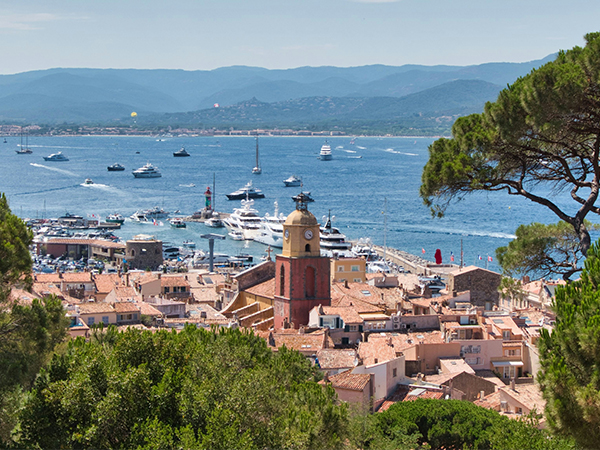
Visiting Saint-Tropez with a guide is discovering the village behind its famous quays. The Vieux-Port, the streets of the Ponche, the bell tower of Notre-Dame-de-l’Assomption and the Citadel all recall its maritime and military history. Your guide-lecturer It also allows you to discover the places that attracted Paul Signac and the great modern painters.
Discover the Vieux Port of Saint-Tropez and its maritime history
It’s hard to visit Saint-Tropez without starting with its famous Vieux-Port. With its colorful facades, terraces, and yachts moored along the quays, it’s today one of the most photographed places on the Côte d’Azur. But before becoming a renowned tourist destination, Saint-Tropez was a particularly active fishing and trading port.
As early as the 15th century, the village developed its maritime activities. Fishermen set sail, merchant ships transported wine, oil, or timber, while shipyards built boats for trade. In the 19th century, the sailors of Trogir sailed to the African coast and on the major international trade routes.
As you stroll along the quays, you may come across some pointus, These traditional fishing boats with colorful hulls, recognizable by their tapered bow, evoke a time when the port mainly relied on fishing and maritime transport.
The names of the quays, the old port facilities and the monuments that line the basin allow us to recall this history, often unknown to visitors.
The Jean-Réveille pier and the statue of the bailiff of Suffren
Since the Portalet Tower, the Jean-Réveille quay protects the Vieux Port from winds and waves. Its origins date back to the 15th century, but the jetty has undergone several expansions over the centuries, notably in the 18th and 19th centuries.
The promenade offers a beautiful view of the village, its pastel-colored houses, and the bell tower of Notre-Dame-de-l’Assomption. At the end of the large pier, the red lighthouse immediately catches the eye. The first lighthouse, built in the 19th century, was destroyed in 1944 during the Second World War. The one you see today was rebuilt exactly the same in 2001.
Another indispensable character of the port: Pierre-André de Suffren, whose statue dominates the Suffren quay.
Born in 1729, this famous naval officer spent part of his childhood in Saint-Tropez. He notably distinguished himself in the 18th century during the French naval campaigns against the British in the Indian Ocean, before being appointed vice-admiral.
Why is this man so important in the local history? His story highlights the close ties between Saint-Tropez and the French Navy, long before the arrival of the first tourists.
The Annonciade Museum and the painters of Saint-Tropez
Saint-Tropez owes part of its fame to the artists who settled there starting from the end of the 19th century.
It all began in 1892, when Paul Signac arrives in Saint-Tropez aboard his yacht, the Olympia. The painter is drawn to the Mediterranean light, the landscapes of the gulf, and the colors of the village. He buys a house there, La Hune, which he transforms into a studio.
Signac then welcomed several artists, including Henri Matisse, Henri-Edmond Cross and Albert Marquet. Saint-Tropez then became a meeting place for the neo-impressionist painters, and later for the artists associated with Fauvism.
Near the port, the Museum of the Annunciation It occupies an old chapel from the 16th century. Founded in 1922, it houses a remarkable collection of paintings created between 1890 and 1950.
Signac, Matisse, Derain, Bonnard… The museum brings together works by several major names of modern painting. An indoor visit can be arranged according to the chosen program and access conditions.
Even from the quays, your guide can show you some of the landscapes depicted by the painters, including the port facades and the views of the bay that inspired their paintings.
Visit the Ponche neighborhood and the old village of Saint-Tropez
Just a few steps from the action of the Vieux-Port, the district of la Ponche takes you back to the Saint-Tropez of fishermen. The streets become narrower, the houses close together and the small squares retain their Provencal architecture.
This is one of the oldest neighborhoods of the village. In the past, fishermen lived in the immediate vicinity of their boats, which they used to pull out onto the small beaches of the Ponche and Fontanette.
Even today, you can still find these old houses facing the sea, narrow passages and some facades with warm colors. The beach of la Ponche, lined with old buildings, is also worth a visit. It recalls the time when maritime activities directly occupied the shoreline.
By joining the Place de l’Ormeau, you arrive near one of the most recognizable monuments of Saint-Tropez: its parish church.
The church of Notre-Dame-de-l’Assomption and its famous bell tower
With its ochre and Sienna earth colors, The bell tower of Notre-Dame-de-l’Assomption It dominates the roofs of the village. You have probably already seen it from the port: it is one of the symbols of Saint-Tropez.
The bell tower dates from 1634, while the current church was built in the XVIIIth century. Its relatively sober façade features decorative elements characteristic of that era.
Inside, the Italian-inspired decor contrasts with the building’s simple exterior. The church houses, among other things, a statue of Saint Tropez, the patron saint of the commune.
Moreover, its history is directly linked to one of the most famous local traditions: The Bravade of Saint-Tropez.
Every year, in May, the inhabitants pay tribute to their patron saint during religious ceremonies and parades in traditional costumes, accompanied by the firing of trumpets.
This festival also perpetuates the memory of the village’s military past, when the inhabitants participated in its defense. Your guide can explain the origin of the Bravade and its place still holds in the life of Troyes.
The Portalet Tower and the old fortifications
Saint-Tropez had to protect itself for a long time from attacks from the sea. To defend the village, the inhabitants built walls and several watchtowers.
Visit Tour of Portalet, Built in the 15th century, it is located on the edge of the water, near the Glaye creek. With its thick stone walls, it controlled the shores of the coastline and participated in the defense of the sea access routes.
Nearby, the Old Tower also watched over the coast from the district of la Ponche. Other defensive constructions still survive in the historic center, including the Jarlier Tower and the Suffren Tower.
Why so many fortifications around a village of this size? In the 15th and 16th centuries, the ports of Provence had to face maritime threats, particularly pirate and corsair incursions.
The towers and the old fortresses served to protect the inhabitants, goods and boats.
As you walk around the outskirts of the Ponche, your guide can show you the various elements of this ancient defensive structure and explain how the fortifications expanded with the development of the village.
Discover the Citadel of Saint-Tropez and the Maritime History Museum
In the heights of the city, it is difficult to miss the Citadel of Saint-Tropez. This imposing 17th-century fortress dominates the roofs of the old city center and offers a remarkable panorama of the gulf.
Its construction began in 1602, under the reign of Henry IV, according to the plans of the military engineer Raymond de Bonnefons. At that time, tensions with Spain made it necessary to strengthen the defenses of the coastal region of Provence.
The hexagonal keep was built between 1602 and 1608. A few years later, a fortified enclosure, ditches and other defensive structures were added to the overall structure.
Observing the walls, you will notice the importance of the military constructions. The bastions, among other things, allowed for monitoring the approaches to the fortress and for covering the neighboring sectors with artillery.
The site also offers one of the most beautiful views of Saint-Tropez. From the outskirts of the fortifications, the roofs of the old village stretch out to the harbor, with the gulf and the hills of the coast in the background.
But the Citadel has another interest: its dungeon is now home to the Maritime History Museum of Saint-Tropez, inaugurated in 2013.
The museum traces several centuries of maritime adventures in Tahiti, from fishing and cabotage to the great commercial voyages. You will find there the history of the shipyards, the captains and the sailors who set off to sail the seas of the globe.
Among the characters presented are the bailiff of Suffren, but also Hippolyte Bouchard, a sailor from Tahiti who became one of the actors in the South American wars of independence.
The discovery of the ramparts and the panorama can be complemented by a visit to the museum, according to the chosen itinerary and the access possibilities to the monument.
The Place of the Lions and the Chapel of Notre-Dame-de-la-Miséricorde
It’s impossible to talk about Saint-Tropez without mentioning Place des Lices. A few minutes from the port, this large, shaded square with plane trees welcomes pétanque players, terraces, and the traditional Provençal market.
On Tuesdays and Saturdays in the morning, the stalls fill the square. Seasonal fruits and vegetables, Provençal specialties, flowers, textiles and handmade crafts attract both locals and visitors.
Outside of market days, the square retains its atmosphere of a meeting place. Petanque matches are played in the shade of the trees, a tradition that contributes to Saint-Tropez’s reputation.
A little further down, on Gambetta Street, there is a less well-known religious building: the chapel of Notre-Dame de la Miséricorde.
Built in the mid-17th century, it belonged to the Black Penitents fraternity, whose members were dedicated, among other things, to caring for the sick.
Observe its serpentine portal, a stone with greenish hues, then the small bell tower topped by a dome covered with glazed tiles. These elements give the chapel a very different appearance from that of the parish church.
The Rue Gambetta used to be located in a neighborhood inhabited by large families of itinerant navigators. This is an interesting detail that helps us understand the importance of the sea in the social organization of the village.
Tour highlights
To discover Saint-Tropez, nothing compares to a walk through its historic center with a guide-lecturer. Behind the facades of the Vieux-Port and the alleys of the Ponche, you discover the village’s maritime past, its ancient fortifications, and the monuments that marked its development.
The main points of interest of your visit:
- The Old Port and its maritime history: the old wharves, the pontoons, the Jean-Réveille quay and the statue of the bailiff of Suffren.
- The neighborhood of la Ponche: the alleys of the old village, the fishermen's houses and the towers that once protected the coastline.
- The Church of Notre-Dame-de-l’Assomption: its famous bell tower, its architecture and the traditions of the Bravade.
- The Citadel: the 17th-century fortifications, the panorama over the gulf and the history of the sailors of Tropez.
- The Saint-Tropez of painters: Paul Signac, the Modern Artists and the Annonciade Museum.
The Place des Lices and the Notre-Dame de la Miséricorde chapel can also find their place in your exploration of the old city center.
Your guide-speaker knows the monuments, local anecdotes and events that shaped the village. You can ask him your questions, become more interested in a historical figure or prioritize certain aspects of the Tropezian heritage.
The itinerary is defined according to your request. The internal visits to museums and monuments can be studied separately, according to their opening and access conditions.
Book your guided tour of Saint-Tropez with a guide-speaker
Do you want to visit Saint-Tropez with a professional guide, as a family, with friends or in a group?
Guides Tourisme Services Organize your guided tour of Saint-Tropez with a guide-speaker, To discover the monuments and historical neighborhoods that interest you.
Do you enjoy history? Take a tour of the Citadel, the ancient defensive towers, and the maritime past of Troyes. Do you prefer art? The places frequented by Paul Signac and the modern painters offer another route, around the Old Port and the Annonciade Museum.
For a first visit to Saint-Tropez, the old town centre is an excellent starting point. The district of la Ponche, the church of Notre-Dame-de-l’Assomption, Place des Lices and the quays allow you to discover the main monuments of the village on foot.
The visits are also aimed at individuals, groups, travel agencies and tourism professionals. Guide-lecturers can provide information in different languages according to your needs.
Do you have a date in mind or a particular itinerary to organize? Contact us Guides Tourisme Services to request a personalized quote. Specify the number of participants, the desired language, and the places you would like to discover. This way, you can define a guided tour tailored to your group and your interests.