


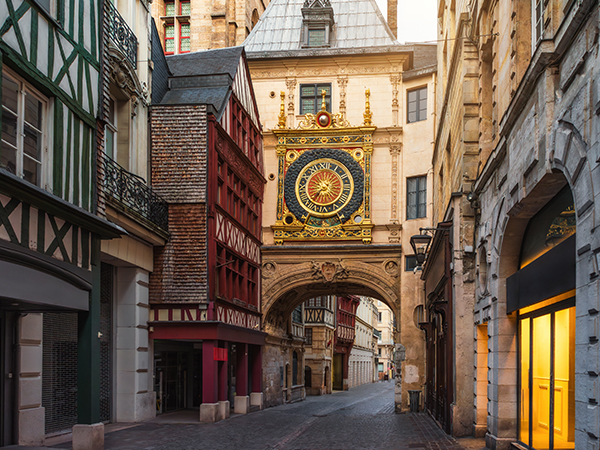
Discover Rouen with a guide-lecturer and embark on a journey through its medieval heritage. From Notre-Dame Cathedral to the Great Clock, your guided tour of Rouen will introduce you to timber-framed houses, Gothic monuments and places associated with Joan of Arc. A wonderful opportunity to visit the Norman capital and its historic districts.
Discover the historic center of Rouen and its wooden houses
Former capital of the Duchy of Normandy, Rouen boasts a particularly well-preserved historic center. Its cobbled streets, Gothic churches, and numerous wooden houses evoke the prosperity of this great medieval commercial city. The city owes much of its wealth to its position on the Seine, which favored trade with Paris, the ports of the English Channel, and England.
To discover old Rouen, take a stroll around Notre-Dame Cathedral. Rue Saint-Romain, lined with old houses, is one of the most interesting streets. The colorful façades and the arches immediately catch the eye. Some of the houses have crenellated floors that rise above the street. This technique allowed, among other things, to gain more living space on the upper floors.
Other streets are worth a detour, including Damiette Street and Martainville Street in the Saint-Maclou district. You will find beautiful wooden-panelled buildings here, sometimes separated by very narrow passages. The houses vary in size and their facades feature interesting details: carved beams, old windows, wooden joinery…
Rouen was also a major textile trading city. In the Middle Ages, sheets and fabrics employed many artisans and merchants. Your guide-speaker can discuss these activities by exploring the old commercial districts, where the ground floors of houses often housed shops or workshops.
Notre-Dame Cathedral of Rouen, a masterpiece of Gothic architecture
It’s hard to visit Rouen without stopping by its famous cathedral Notre-Dame! With its sculpted facade, its imposing towers and its spire reaching 151 meters high, it dominates the historic center.
The construction of the current cathedral began in the 12th century on the site of an older Romanesque building. Several construction campaigns subsequently modified its appearance, until the 16th century. This long history explains the diversity of Gothic styles that can be observed on its façade.
Take a look, in particular, at the two towers that frame the main entrance. On the left, the Saint-Romain tower retains some of its original parts. On the right, the Beurre tower, mainly built at the end of the 15th and beginning of the 16th century, features a characteristic decoration of flamboyant Gothic style. As for the large metal spire, it dates from the 19th century.
Inside, the cathedral houses the tombs of several figures associated with Norman history. Among them is Rollon, the first prince of Normandy. Richard the Lionheart also has a funerary monument there. The King of England, who was also Duke of Normandy, had wished that his heart be placed in the cathedral of Rouen after his death.
Another peculiarity: the cathedral inspired one of Claude Monet’s most famous series of paintings. In the 1890s, the impressionist painter depicted its facade at different times of the day, under changing lights. Your guide can show you the parts of the monument that Monet painted and explain why these variations in light interested him so much.
The Great Clock and the monuments of the historic center
The Great Clock and the Palais de Justice are among the major civic monuments of Rouen. Located in the old city center, they recall the city's political and economic role at the end of the Middle Ages.
The first was associated with municipal power and the passage of time. The second housed the judicial institutions of Normandy. Their richly decorated façades deserve a closer look.
The Rue du Gros-Horloge and its astronomical clock
The Rue du Gros-Horloge connects the cathedral district with the Place du Vieux-Marché. This pedestrian street, lined with shops and old houses, owes its name to the monumental clock installed above the roadway.
It’s hard to miss its large golden dial! Installed on a Renaissance arch, the Big Clock has only one hand to indicate the hours. An astronomical mechanism completes the ensemble, featuring a globe representing the phases of the Moon and a device indicating the days of the week.
But have you noticed the sheep carved on the monument? They remind us of the importance of the wool trade and the weaving industry in the Rouen economy. Underneath the arch is also a Paschal Lamb, a traditional symbol of the city.
The Gros-Horloge is associated with a Gothic belfry built at the end of the 14th century. This housed the communal bells and the mechanism of the clock. At the time, these equipment were used to rhythmize the daily activities of the inhabitants and to mark the major events of municipal life.
The Palais de Justice, former Parliament of Normandy
A few minutes from the Grande Horloge, the Palais de Justice attracts attention with the richness of its flamboyant Gothic decor.
Its construction began in 1499 to house, among others, the Échiquier de Normandie, a high court responsible for judicial functions. Under the reign of François Ier, this institution became the Parlement de Normandie.
The building underwent several expansion campaigns. As early as 1508, a new building was constructed, with a particularly elaborate façade.
Notice the large windows, the balconies adorned with sculptures and the balustrade topped with numerous pinnacles. The details are impressive, especially around the roof, where the perforated stone elements give the whole structure a very light feel.
The palace also suffered significant damage during the 1944 bombings. Some of the stones retain the marks of that period, while restorations have preserved much of the original decor.
The Old Market Square and the historical sites of Joan of Arc
Rouen holds a major place in the history of Joan of Arc. It was here that the young woman was imprisoned, tried, and executed in 1431 during the Hundred Years’ War.
Several places in the historic center are associated with these events. Place du Vieux-Marché remains the most well-known, but religious buildings and the old neighborhoods of Rouen also allow visitors to discover the context in which this period of Norman history took place.
The Old Market Square, the place of Joan of Arc’s ordeal
On May 30, 1431, Joan of Arc was burned alive in the Old Market Square. She was only 19 years old at the time.
Captured in Compiègne the previous year and then handed over to the English, she was transferred to Rouen to be tried. Her trial, presided over by Bishop Pierre Cauchon, resulted in a conviction for heresy.
Today, the Old Market Square has changed considerably. In the 15th century, it was smaller and included halls as well as several churches. A large cross now marks the location traditionally associated with Joan of Arc’s execution stake.
Nearby, you can also see the remains of the old Saint-Sauveur church. It was in this building that Pierre Corneille, the famous Rouen playwright, was baptized, born in 1606. His birthplace is also located on Rue de la Pie, just around the corner.
The Church of Sainte-Jeanne-d’Arc
Right next to the Place du Vieux Marché, the church of Sainte-Jeanne-d’Arc stands out for its contemporary architecture. Inaugurated in 1979, it was designed by the architect Louis Arretche.
Its silhouette evokes a overturned boat hull, a reference to the Norman maritime tradition. The roof, covered with tiles and copper, forms large curves that contrast with the surrounding old houses.
Inside, another feature deserves attention: the Renaissance stained glass windows from the former Saint-Vincent church. Dating from the 16th century, these stained glass windows were dismantled and stored away before the destruction of their original church during the Second World War. They were then placed in the new building.
The church also serves a commemorative function, in honor of Joan of Arc.
Your guide will be able to discuss the circumstances of his trial, as well as his rehabilitation in 1456. Twenty-five years after his execution, a new trial effectively nullifies the conviction handed down in Rouen.
The Saint-Maclou neighborhood and the Saint-Ouen abbey
The Saint-Maclou neighborhood is one of the most interesting areas of old Rouen. With its small streets lined with wooden houses and religious monuments, it retains much of its medieval character.
The Church of Saint-Maclou is one of its main buildings. Begun in the 15th century, it stands out for its flamboyant Gothic architecture. Its façade features five arcaded porches adorned with carved wooden doors dating from the Renaissance.
Just a few steps away is a much more unusual place: the Saint-Maclou altar, an ancient medieval cemetery that was created after the great epidemics of the plague.
Its wood-panelled galleries, built in the 16th century, served, among other things, as a burial chamber. Look at the sculptures that adorn the beams and columns: skulls, bones and tools of grave-diggers directly recall the funerary function of the buildings. This macabre decor is particularly unusual for visitors to Rouen.
Further north, the Saint-Ouen abbey impresses with its dimensions. It is 137 meters long and was part of one of the major Benedictine abbeys in Normandy.
Its construction, begun in the 14th century, continued for more than two hundred years. Despite this long period, the building retains remarkable architectural harmony.
Inside, its high vaults, medieval windows and the large Cavaillé-Coll organ are among the most remarkable features. The current western façade, with its two towers, was completed in the 19th century.
Tour highlights
With Guides Tourisme Services, discover the main monuments of Rouen during a visit accompanied by a professional guide-speaker.
Depending on the route chosen, several historical sites and neighborhoods can be included in your exploration:
- The historic center of Rouen, with its wooden houses, its old commercial streets and its medieval neighborhoods.
- Notre-Dame Cathedral, famous for its Gothic architecture and Claude Monet's paintings.
- The Great Clock and the Palais de Justice are two emblematic monuments of the municipal and judicial history of Rouen.
- The place of the Old Market, associated with the trial and execution of Joan of Arc.
- The Saint-Maclou neighborhood and the Saint-Ouen abbey, to discover other major monuments of Rouen’s religious heritage.
Your guide will introduce you to the events and characters that marked these places. He or she may, in particular, draw your attention to the sculpted façades, explain the different periods in which the buildings were constructed, or discuss the major milestones in the history of the Duchy of Normandy.
The route can focus on emblematic monuments in the old city center or on a particular historical period, architecture, or Jeanne d’Arc.
Book your guided tour of Rouen with a guide-speaker
Would you like to visit Rouen with a guide and discover its most famous monuments? We Guides Tourisme Services organize guided tours of Rouen for individuals, families, groups and tourism professionals.
Whether you wish to discover the historic center, be interested in the history of Joan of Arc, or prefer the city’s great Gothic monuments, your visit can be organized according to your expectations.
The visits are led by professional guide-lecturers who are accustomed to presenting the heritage of Rouen to different audiences. They can also be offered in several languages.
Contact Guides Tourisme Services to organize your guided tour of Rouen and obtain a quote tailored to your request.