


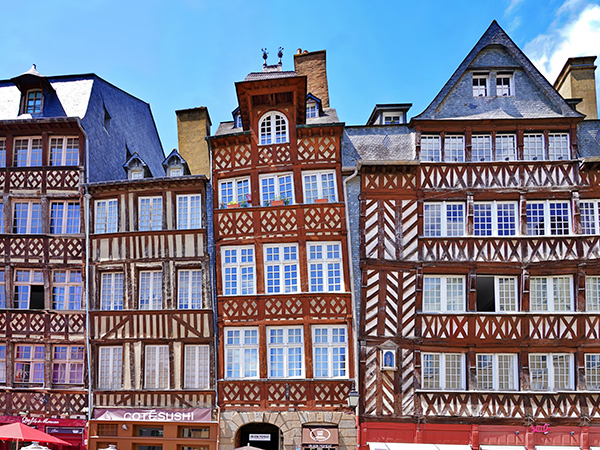
A guided tour of Rennes takes you through the timber-framed houses of the historic center, the Portes Mordelaises, the Cathedral of Saint-Pierre and the Parliament of Brittany. With a guide-lecturer, Discover the monuments of the Breton capital, its medieval heritage, and the architectural transformations that followed the great fire of 1720.
Discover the historical center of Rennes and its wooden-frame houses
The historic center of Rennes has one of the most important collections of timber-framed houses in Brittany. The city has about 370 of them, mainly in the pedestrian streets of its old center. Built between the late Middle Ages and the 18th century, they bear witness to several centuries of urban architecture.
Their colorful façades, exposed beams, and crenellated floors give the streets of Rennes their unique appearance. Some feature sculptures and decorative motifs from the Renaissance, while others prioritize the geometric forms characteristic of the 17th century.
When visiting Rennes with a guide, you discover the techniques employed by artisans, the organization of the old houses, and the transformations that marked these neighborhoods. The Chapitre, Saint-Michel, and historic squares preserve many examples of this architecture.
Place Sainte-Anne and the houses of Champ-Jacquet
Place Sainte-Anne is one of the main attractions of old Rennes. It is lined with old houses and houses the Saint-Aubin Church and the Couvent des Jacobins, an old Dominican convent founded in the 14th century and now transformed into a congress center.
Several facades with wooden panels, notably at number 9, recall traditional Rhenish architecture. The neighboring streets also preserve many ancient structures.
A few minutes’ walk away, the Place du Champ-Jacquet is home to a particularly remarkable ensemble of 17th-century houses. Their sloping façades and wooden structures immediately catch the eye.
These houses were built against an old fortified enclosure. They were intended, among other things, to house the lawmen who came to work in Rennes, which had become an important parliamentary city.
The square also allows visitors to observe the consequences of the 1720 fire. The wooden-frame houses spared by the flames coexist with stone buildings built in the 18th century. In the center, the statue of Jean Leperdit commemorates the role of this former mayor of Rennes during the French Revolution.
The Place des Lices and the Martenot Hall
An area located near the fortifications, Place des Lices was the venue for exercises and tournaments in the Middle Ages. It gradually became an important place for trade and markets.
Since 1622, the Lices market tradition has been part of the life of the neighborhood. Even today, it takes place every Saturday morning.
The square is lined with private hotels built mainly in the 17th century, when parliamentarians and wealthy families chose to settle in this area. Among the notable buildings are the Hôtel de la Noue and the Hôtel Racapée de la Feuillée, two wooden-frame buildings whose facades illustrate the residential architecture of that era.
Facing these buildings are the Martenot halls, built between 1868 and 1871 by the architect Jean-Baptiste Martenot. Their cast-iron columns, their metallic structures and their polychrome bricks bear witness to the evolution of market architecture in the 19th century.
This neighborhood allows us to explore several aspects of Rennes’ history, from medieval activities to the development of commerce and the grand parliamentary buildings.
The Mordelles Gates and the ramparts of Rennes
The Portes Mordelaises are one of the main remains of the medieval fortifications of Rennes. Rebuilt in the 15th century, this ancient fortified access consists of two massive towers, connected by a passage once protected by a system of drawbridges.
The whole retains characteristic elements of medieval military architecture: machicolations, separate passages for pedestrians and vehicles, as well as an advanced defensive structure called a barbican.
The Mordelles Gates held a special place in the history of the Duchy of Brittany. Before their coronation in Saint-Pierre Cathedral, the dukes traditionally entered through this entrance to the city. They were required to swear to respect the freedoms and privileges of Brittany beforehand.
The guided tour also allows us to explore the evolution of the fortifications in Rennes. The city already had fortifications during the Gallo-Roman period, some of which were continued during the medieval expansions.
The remains of the walls and the improvements made around the Mordelles Gates offer several vantage points today over the old defensive system. The gardens of the walls, landscaped as part of the site’s revitalization, provide access to this historical sector.
The guide-speaker can, in particular, explain the organization of the various venues, the role of the fortifications in the defense of Rennes, and the ceremonies associated with the entry of the Dukes of Brittany.
Visit the Cathedral of Saint-Pierre in Rennes
Saint-Pierre Cathedral is one of the main religious monuments in Rennes. Located near the Mordelles Gates, it occupies a site associated with the city's Christian life since the early centuries of the Middle Ages.
The current building resulted from several construction and reconstruction campaigns. Its western facade, framed by two towers, retains classical architecture developed between the 16th and 18th centuries.
The interior features particularly rich decoration, largely created in the 19th century under the impetus of Archbishop Godefroy Brossay-Saint-Marc. Inspired by the great Roman basilicas, its layout stands out from the Gothic cathedrals commonly found in Brittany.
The nave has high columns covered with stucco imitating marble. The murals created by Félix Jobbé-Duval evoke, among other things, the Breton dioceses and the Tro Breiz, an ancient pilgrimage linking the major religious sites of Brittany. The main altar, the large organs and the gilded decorations also deserve special attention.
The cathedral also houses an 16th-century altarpiece from Antwerp dedicated to the life of the Virgin, which is presented in its treasury.
The monument holds a major place in the political history of Brittany. Several dukes and duchesses of Brittany were crowned there after their ceremonial entry into Rennes through the Mordelles Gates.
Depending on the opening conditions and the itinerary chosen, the visit with a guide-speaker may include the interior of the cathedral, in order to present its works and the major architectural milestones.
The Parliament of Brittany and the Rennes of the 18th century
The Parliament of Brittany and the main squares in the center of Rennes testify to the political and administrative importance of the Breton capital.
The Palace of Parliament, built in the 17th century, represents the judicial power under the Old Regime. A century later, the great fire of December 1720 profoundly transformed the urban landscape.
A significant part of the city center was then rebuilt according to new architectural principles: more regular streets, stone buildings, and monumental squares. This reconstruction, led by the architect Jacques Gabriel, explains the contrast between the medieval neighborhoods and the classical ensembles of Rennes.
The Parliament Palace of Brittany
Constructed between 1615 and 1655 according to the plans of Salomon de Brosse, also the architect of the Palais du Luxembourg in Paris, the Parlement de Bretagne remains one of the most representative monuments of Rennes.
The parliamentary institution had been created in the 16th century, after the union of the Duchy of Brittany with the Kingdom of France. It constituted a sovereign court of justice and played a political role in the relations between the royal power and the province.
The palace features an imposing stone facade and an architectural design that expresses the prestige of the institution. In the 18th century, the creation of Parliament Square further enhanced the building, around which regular-shaped buildings rise.
Inside, the Grand Chamber is particularly renowned for its coffered ceilings, carved and gilded woodwork, and allegorical paintings. The decorations designed by Charles Errard and the works of Noël Coypel are among the major artistic achievements of the 17th century preserved in the palace.
In February 1994, a fire severely damaged the building. Restoration work has made it possible to preserve and restore a large part of its historical decor.
The palace still houses the Rennes Court of Appeal. During a guided tour of Rennes, its façade and the surrounding square allow one to discuss the functioning of justice under the Old Regime, the transformations of the institution, and the history of the fire.
Access to the interior rooms of the Parliament is subject to regulated visits. Any possible internal visit must be specifically arranged and remains subject to the access conditions of the monument.
The Town Hall Square and the Opera of Rennes
The Town Hall Square illustrates the large reconstruction program undertaken after the 1720 fire.
The town hall was designed by Jacques Gabriel, the architect of King Louis XV, and built in the 18th century. Its architecture features an original layout: two curved pavilions frame a central tower intended to house the municipal clock.
The building initially served several administrative and judicial functions. One of the pavilions housed municipal services, while the other housed the présidial, a court of the Old Regime.
The clock tower symbolically replaced the old belfry of Rennes, which was destroyed during the fire.
Facing the town hall, the Rennes Opera complements this architectural ensemble. Built according to the plans of Charles Millardet, it was inaugurated in 1836. Its rounded facade responds to the curvature of the town hall, despite a century separating the two constructions.
The building, originally designed as a theater, has neoclassical architecture. Its rotunda and columns are the main elements visible from the square.
A visit to this area allows us to explore the reconstruction of Rennes under Louis XV, the development of municipal institutions, and the evolution of cultural life in the 19th century.
Tour highlights
The guided tour of Rennes offered by Guides Tourisme Services is led by a professional guide-speaker. It allows you to discover the main monuments of the historic center and the neighborhoods that have marked the evolution of the Breton capital.
The route highlights, among other things, the wooden-frame houses, the old fortifications, Saint-Pierre Cathedral and the large public buildings built between the 17th and 19th centuries.
The guide’s commentary links the visible architectural elements to the events that transformed Rennes: the history of the Duchy of Brittany, the development of the Parliament, the 1720 fire and the reconstruction of the city.
The visit can be organized for individuals, families, groups or professionals. The content of the comments can be adapted to the interests of the participants, whether they wish to focus on the history of Brittany, architecture or monuments.
Guides Tourisme Services It also offers guided tours in foreign languages, conducted by professional conference guides.
Book your guided tour of Rennes with a guide-speaker
Do you want to visit Rennes with a guide and discover its main historical monuments?
Guides Tourisme Services organizes guided tours of Rennes for individuals, families, formed groups, and tourism professionals.
A guide-lecturer introduces you to the old neighborhoods, remarkable buildings, and events that have marked the history of the Breton capital. The itinerary can be tailored to the places you wish to prioritize, the characteristics of your group, and the accessibility to the monuments.
To organize your guided tour of Rennes, contact us Guides Tourisme Services to specify your project, your visit wishes, and to obtain a customized proposal.