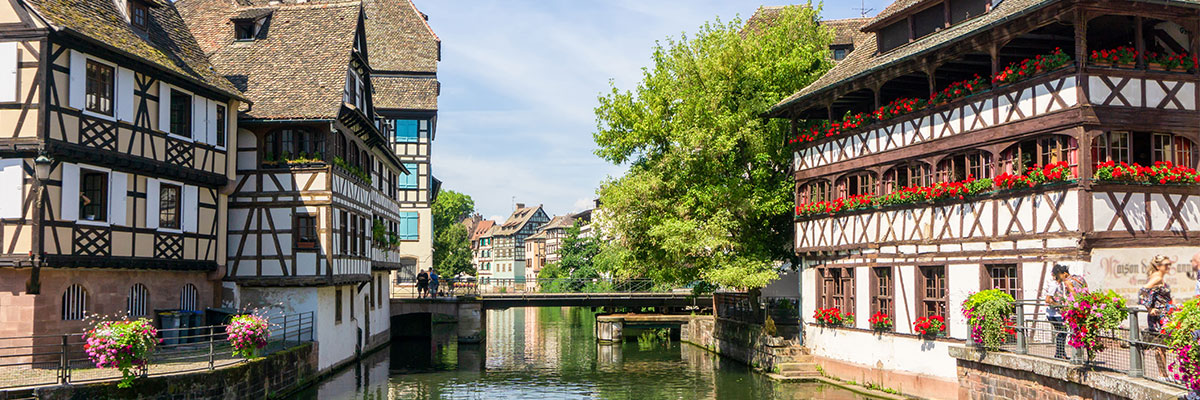


The guided tour of Petite France takes you to one of Strasbourg's most famous neighborhoods, amidst half-timbered houses, canals, and former tanners' quays. With a licensed guide, you will also discover Saint Thomas Church, the Covered Bridges, the Vauban Dam, and the activities that shaped this area of the city.
Why is La Petite France a must-see when you visit Strasbourg?
It is hard to visit Strasbourg without stopping by Petite France. The neighborhood concentrates a part very recognizable of the Alsatian heritage, but its main interest lies in its history. Here, the Ill divides into several branches, the streets run along the quays and bridges connect small islands once occupied by artisans.
This presence of water largely explains the development of the sector. Since the Middle Ages, activities that depended directly on it settled there, notably mills and tanneries. The buildings you see today still bear the trace of this ancient organization.
A guided tour of Strasbourg then takes on another dimension in Petite France. The timber-framed facades immediately attract attention, of course, but behind them lie several centuries of craft, urban, and military history.
What is the story of Petite France about?
The neighborhood's name comes from a rather unexpected episode in Strasbourg's history. At the end of the 15th century, a facility for people suffering from syphilis was established in this area. Since the disease was then nicknamed the «French pox,» the name Petite France gradually became attached to the location.
The neighborhood is also characterized by its trades who had gathered near the canals. The tanners needed water to treat hides and therefore occupied an important place in this part of Strasbourg. The nuisances related to their activity also explain their settlement away from the wealthier areas near the cathedral.
Throughout the tour, your guide places these elements within the evolution of the city. We better understand why Petite France has such a unique organization and how a former working-class and artisanal district became one of the most visited places in Strasbourg.
And undoubtedly one of the most beautiful neighborhoods in the city!
Half-timbered houses, quays and canals: how was the neighborhood shaped?
Timber-framed houses now give her character in Petite France. Some old tanners' houses can be recognized by their sloping roofs and wide-open attics. These spaces were used, among other things, for drying the skins after treatment.
Tanners' Quay and the neighboring streets maintain this close relationship between the buildings and the canals. In just a few steps, you go from a street lined with old facades to a bridge, then to a square opening onto the Ill. This urban topography constantly changes the perception of the neighborhood.
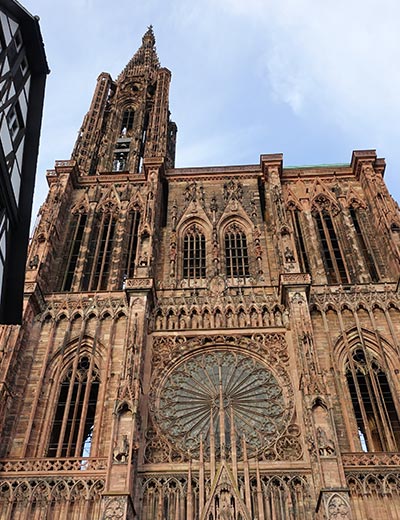
The tour can also join the Saint-Thomas Square and its Protestant church. Saint-Thomas Church is one of the great Gothic buildings of Strasbourg. It houses the mausoleum of Marshal Saxe as well as a Silbermann organ completed in the 18th century, on which Mozart played during his stay in Strasbourg in 1778.
This detour adds another facet to the visit of Petite France: religious heritage meets the history of artisans and fortifications here.
Besides, a quick story:
Half-timbering has a meaning, the cross represents multiplication, for example; a rhombus with a cross represents fertility and the wish to have many children.
What do you discover during the guided tour of Petite France?
The route connects several iconic sites without losing the historical thread of the neighborhood. Your guide puts into perspective the traditional trades, the organization of the docks, the architecture of the houses, and the defensive systems installed around the Ill.
One detail often surprises visitors: Pheasant Bridge. This small pedestrian bridge, also called swing bridge, pivots for the passage of certain boats. With a little luck, you will be able to observe its operation during the tour, with a brief interruption to let the vessel pass.
Bain-aux-Plantes Street, Benjamin-Zix Square and the tanners' house
Benjamin-Zix Square opens onto one of the most characteristic areas of Petite France. Rue du Bain-aux-Plantes is lined with several half-timbered houses whose architecture directly recalls the activity of the former tanners.
The House of Tanners is part of this complex. Its presence gives the guide the opportunity to explain more concretely how these artisans worked, why they needed the Ill River, and what certain spaces under the roofs were used for.
You then look at the facades differently: their shape and location respond to specific uses, linked to daily life and the trades of the neighborhood.
The Covered Bridges and the Vauban Dam
At the end of Petite France, Covered Bridges reminiscent of Strasbourg's defensive past. Their name can be misleading today, as the wooden galleries that protected them disappeared in the 18th century. Three medieval towers are still visible.
Nearby stands the Vauban Dam, also known as the Great Barrage. Built as part of the reinforcement of Strasbourg's defenses in the late 17th century, it made it possible to control the waters of the Ill and complicate the approach to the city in the event of an attack.
The contrast is striking with the tanners' houses located a few streets away. Over a short distance, the tour goes from a district shaped by water trades to structures designed to protect Strasbourg.
Tour highlights
The guided tour of Petite France brings together the main landmarks of the district while giving meaning to the buildings, quays, and canals you cross.
- the half-timbered houses and the old tanners' houses; ;
- the Tanners' wharf, Bain-aux-Plantes street and Benjamin-Zix square; ;
- Saint-Thomas square and Saint-Thomas church; ;
- the Pheasant Bridge, with its pivoting mechanism visible when certain boats pass; ;
- the Covered Bridges and their medieval towers; ;
- the Vauban Dam and its role in Strasbourg's former defensive system.
The neighborhood is particularly well-suited for exploration on foot. The various points of interest are close to one another, leaving more time for the guide's explanations and discussions along the way.
What the tour guide brings to the discovery of Petite France
It is pleasant to wander freely through La Petite France, but much of its history is hidden behind details that are easy to miss. Why did the tanners settle here? What were the openings in certain attics used for? Why do people still talk about Covered Bridges when they are no longer covered?
The tour guide provides the points of reference that connect these elements together. Their explanations place the neighborhood within the broader history of Strasbourg, whether concerning ancient trades, Alsatian architecture, religious heritage, or fortifications.
That is also the benefit of a guided tour of Strasbourg led by a professional: you can ask questions, return to a detail seen a few meters earlier, or delve deeper into a subject according to the group's expectations.
Guides Tourisme Services organizes this tour with professional guide-lecturers for individuals, families, groups, and businesses. The tour can also be provided in various foreign languages to welcome both French and international visitors.