
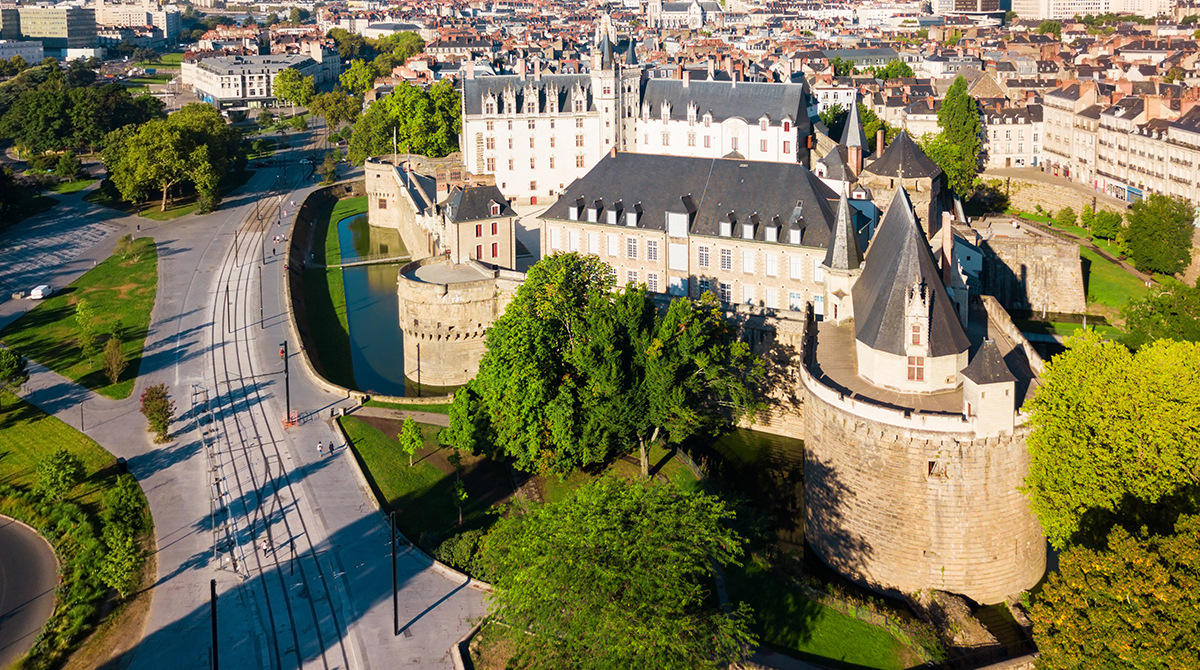
A guided tour of Nantes takes you through the major landmarks of the historic center: the Château des Ducs de Bretagne, Bouffay, the Saint-Pierre-et-Saint-Paul Cathedral, the Isle of Feydeau, the Passage Pommeraye, and the Graslin neighborhood. With your guide-lecturer, you observe the monuments in person and link their architecture to the major transformations of Nantes, from the Middle Ages to the 19th century.
The Château of the Dukes of Brittany and the Bouffay neighborhood
Start with two views of medieval Nantes, separated by only a few streets. On one side, the Château des Ducs de Bretagne imposes its granite and sandstone walls. On the other, Bouffay preserves narrow streets, a few wooden houses, and the layout of the old city enclosed within its ramparts.
Your guide points out here the limits of the medieval city, the ancient fortifications, and the square occupied by the ducal power. This proximity makes the visit particularly concrete: you go directly from the residence of the dukes to the streets where part of the population of Nantes lived.
The Castle of the Dukes of Brittany
François II, the last duke of independent Brittany, had the main part of the current castle built in the late 15th century. His daughter, Anne of Brittany, continued the work before becoming queen of France through her marriages with Charles VIII and Louis XII.
From the outside, the seven towers and the courtyards immediately show the building’s defensive function. The walkway runs for about 500 meters. Enter the courtyard and the decor changes: the Grand Logis, the tuffeau façades, the carved balconies, and the loggias of the Golden Crown Tower are more akin to a princely residence than to a fortress.
Your guide distinguishes these two functions and shows you the architectural elements that characterize them. He also discusses the successive uses of the castle, which became a royal residence, barracks, arsenal, and then a prison after the union of Brittany with France.
The medieval streets and the wooden houses of Bouffay
A few minutes from the castle, enter the Bouffay district. The area mostly retains its old layout: narrow streets, deep plots of land, and a few buildings inherited from the medieval city.
The Rue de la Juiverie offers a good example. At number 7, a medieval house with wooden beams remains, with floors in the form of a crenellation, a technique that increased the available surface in the upper levels.
Many buildings of this type disappeared during the urban transformations of the following centuries. Your guide therefore relies on the still visible elements to explain the density of the old city and the organization of its streets.
The Cathedral of Saint-Pierre-et-Saint-Paul and the Saint-Pierre gate
The Cathedral of Saint Peter and Saint Paul underwent nearly five centuries of construction. Its construction began in 1434 and was completed in 1891. The western facade, completed much earlier, at the end of the 15th century, features five sculpted portals framed by two towers.
After the fire in July 2020, the building reopened to the public in September 2025. Some interventions are still ongoing, while the tomb of François II and Marguerite de Foix is undergoing restoration with a relocation announced for the end of 2026.
In the immediate vicinity, the Saint-Pierre gate changes the scale of the visit. Here you can see the location of Nantes’s former eastern defenses. The area preserves remnants related to the ancient enclosure and then to the medieval fortifications. In the late 15th century, the people of Nantes strengthened the gate to adapt it to the development of artillery, notably with thick towers and cannon turrets.
Your guide will identify these different periods on site and explain how the fortifications evolved with military techniques. The Saint-Pierre gate remains the only former gate in the Nantes enceinte that has been preserved.
The Isle of Feydeau and the Nantes of the 18th century
With the island of Feydeau, you leave medieval Nantes for the great urban and commercial development of the 18th century. The people of Nantes develop this new neighborhood on land won over the Loire. Construction increases especially between the years 1750 and 1780.
Look at the buildings: wrought-iron balconies, carved masks, courtyards and orderly facades testify to the level of wealth of their patrons. The tiled floor also left a very visible mark. Several buildings have tilted with the movements of their foundations, giving some facades a slightly sloping appearance today.
It is nevertheless difficult to understand Feydeau without mentally reliving the Loire that once surrounded it. The fillings of the 20th century have connected the former island to the rest of the city center. Your guide will show you its old boundaries and link the neighborhood’s organization to the port activities.
The economic history of Nantes in the 18th century also includes the Atlantic slave trade. Nantes was then the first French port of this kind. Colonial trade, the activities of shipowners and merchants, banking, and the trafficking of people reduced to slavery all contributed to the city’s wealth. In Feydeau, the architecture provides a concrete foundation for exploring this period.
The Pommeraye Passage and the Graslin neighborhood
You are now moving towards the urban transformations of the 18th and 19th centuries. The streets are widening, new amenities are appearing, and the center of Nantes is extending towards the west. The Graslin neighborhood and the Passage Pommeraye directly reflect this evolution.
The Pommeraye Passage
Opened in 1843, the Pommeraye Passage connects the lower part of the city to the Crébillon Street area. Its architecture addresses a very concrete difficulty: the steep difference in elevation between the two sectors.
The architects Jean-Baptiste Buron and Hippolyte Durand-Gasselin therefore divided the gallery into three levels connected by a grand staircase. Look up towards the skylight, then observe the cast iron, steel, sculptures and allegorical figures arranged around the galleries. The trade is an integral part of the architecture here.
The passage also belongs to the history of cinema in Nantes. Jacques Demy, born in Nantes, filmed several scenes there, notably for Lola and The Parapluies de Cherbourg.
Graslin Square and the Graslin Theatre
A few steps away, Place Graslin opens up a much more regular space than the streets of Bouffay. Jean-Joseph-Louis Graslin initiated the development of the neighborhood in the 1780s, and architect Mathurin Crucy designed the theater, among other things.
Inaugurated in 1788, the Graslin Theatre adopts a neoclassical vocabulary. Its pediment dominates a square partly designed in a hemicycle, towards which several streets converge. A fire destroyed the theatre in 1796; it reopened in 1813 after reconstruction.
Your guide compares here two very different urban organizations: the narrow streets of the medieval center and the more regular compositions developed from the 18th century.
Tour highlights
This guided tour of Nantes brings together several key stages in the city’s history within a restricted area. You will see the medieval fortifications and ducal power, the commercial development of the 18th century, and then the urban improvements of the Graslin district and the Pommeraye Passage.
The guide-lecturer works directly with the monuments in front of you. He shows you the defensive structures of the castle, identifies the characteristics of a house with wooden beams, retraces the old boundaries of Feydeau and explains the architectural organization of the Passage Pommeraye.
Guides Tourisme Services organizes these tours for individuals, groups, and tourism professionals. Visits in different foreign languages are also offered.
Book your guided tour of Nantes with a guide-speaker
Guides Tourisme Services organizes your guided tour of Nantes with a professional guide-speaker. You will visit the main heritage sites in the historic center, from the Château des Ducs de Bretagne to the Graslin neighborhood, with the Bouffay, the cathedral, Feydeau, and the Passage Pommeraye.
Please indicate the desired date, the number of participants and the language of the visit when contacting us. The agency will then arrange the service with a guide-speaker corresponding to your request.