
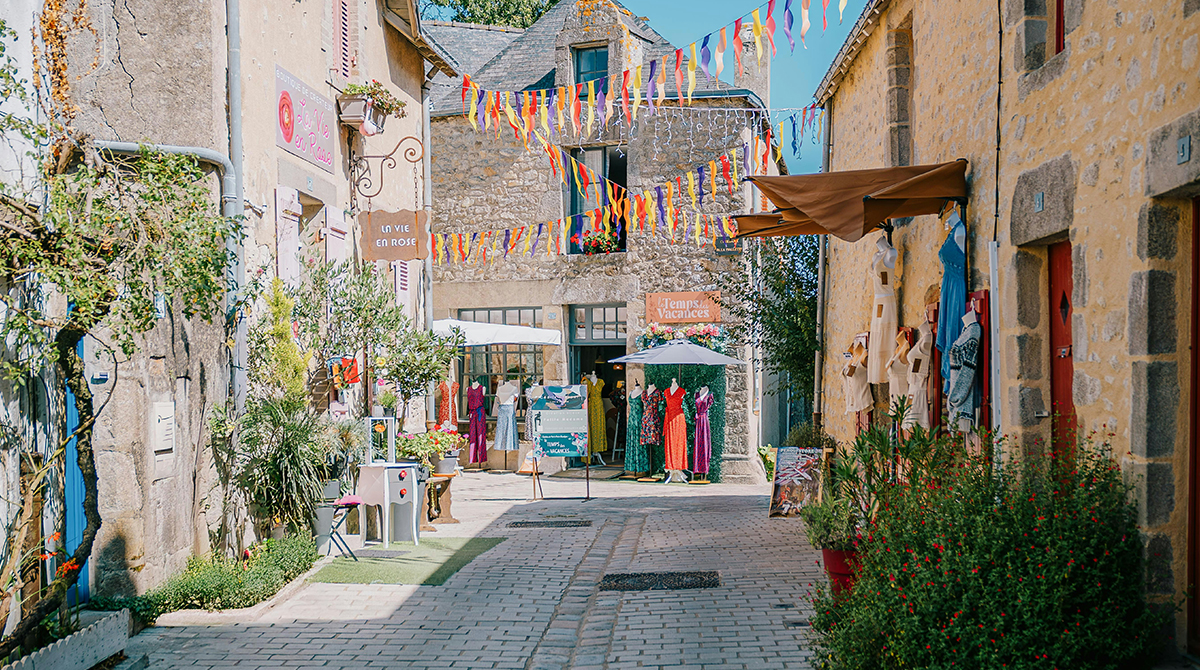
Discover the closed city during a guided tour of Guérande led by a guide-speaker. The tour passes through the ramparts, the Porte Saint-Michel and the collegiate church of Saint-Aubin, with precise references to the history of the city. An immersive tour of Guérande, to better understand its place in medieval Brittany.
Discover Guérande, a fortified city in Brittany
Guérande retains a medieval enceinte of about 1,300 meters, dotted with six towers and four gates: the Saint-Michel Gate, the Vannetaise Gate, the Bizienne Gate and the Saillé Gate. The fortifications visible today were mainly built in the 15th century on older structures. The fortifications have been classified as historical monuments since 1877.
Within the walls, the closed city gathers several witnesses to its history. The Saint-Aubin collegiate church holds a major place in this ensemble, alongside the Notre-Dame-la-Blanche chapel and former civilian buildings. The constructions date from different periods, which also allows us to overcome the image of a city that has remained unchanged since the Middle Ages.
Visiting the city of Guérande with a guide-lecturer helps to distinguish these different periods. The organization of the streets, the function of the gates, or the transformations of the fortifications then take their place in the history of the city.
Guérande in the Middle Ages, in Breton history
The Lower Middle Ages profoundly marked Guérande. At the end of the 15th century, the city had nearly 4,000 inhabitants and ranked second in the Nantes county after Nantes. It was also during this period that the fortified enclosure acquired much of its current appearance.
The city was directly affected by the War of the Succession of Brittany. In 1342, Guérande was pillaged during the conflict between the supporters of Jean de Montfort and those of Charles de Blois. The first Treaty of Guérande, concluded in 1365 after the victory of the Montfortist faction, recognized Jean IV as Duke of Brittany.
A second treaty was ratified in Guérande in 1381, in the Notre-Dame-la-Blanche chapel. It restored relations between John IV and the King of France after a new period of tensions.
These events provide a precise context for the monuments encountered during the visit. The ramparts, the fortified gates, and the religious buildings belong to a city that at that time held a notable political and economic position in the Guérandais peninsula.
Visit the fortifications of Guérande
The ramparts are one of the highlights of a guided tour of Guérande. Their length, which extends over approximately 1,300 meters, still forms a continuous enclosure around the closed city. Six towers and four gates characterize this fortified complex, which is considered one of the best-preserved medieval urban enclosures in France.
Take a closer look at the walls: fortified gates, towers, and courtyards serve specific defensive functions. The arrangements have also evolved with military techniques, especially with the development of artillery in the late Middle Ages.
The guide-speaker can then explain why certain towers occupy particular positions, how access to the city was controlled, or how the fortifications were adapted. Elements that were once discreet become much easier to place in their original context.
Part of the walls is accessible from the Saint-Michel Gate. The exterior of the enclosure also offers a good view of the continuity of the walls and of how they still clearly delimit the closed city.
The Saint-Michel Gate, an emblematic monument of Guérande
The Porte Saint-Michel dominates one of the main entrances to the city. Built around 1450, it consists of two towers surrounding a manor-château. Its dimensions indicate that it served functions beyond the mere defense of the entrance.
The building was formerly home to the town captain’s apartments, then those of the governor of Guérande. Its use subsequently changed: a prison during the revolutionary period, the Saint-Michel Gate became the town hall from 1800 to 1954. Today it houses the Guérande Castle-Museum.
Its architecture makes it possible to approach the organization of a fortified gate in a very concrete way. The passage, the towers and the spaces intended for habitation combine military and residential functions in a single building. The guide can also place this construction in the political context of the Duchy of Brittany at the end of the Middle Ages.
The Saint-Aubin Collegiate Church in the closed city
The Saint-Aubin Collegiate Church occupies a central position in the city. The building retains elements from a more ancient Romanesque church, which was damaged by the fire linked to the Sack of Guérande in 1342. The nave and several pillars adorned with historiated capitals belong to this first phase of construction.
Much of the church was rebuilt in the 15th and 16th centuries in the flamboyant Gothic style. The stone vaults bear witness to this era, while the stained glass windows visible today date mainly from the 19th century. The collegiate church has been classified as a historical monument since 1840.
This succession of periods provides a particularly concrete basis for a visit. The Roman elements can be distinguished from the Gothic parts, while the fire of 1342 and the subsequent reconstructions place the building within the evolution of Guérande.
The location of Saint-Aubin also recalls the antiquity of urban occupation. The first nucleus of the town developed around the church, at the intersection of several traffic axes. This location has permanently structured the village and then the closed city.
Tour highlights
The visit combines the main monuments of Guérande with their historical context. It provides precise information about the medieval fortifications, the Porte Saint-Michel, the Saint-Aubin collegiate church, and the events that marked the city during the War of the Succession of Brittany.
The course includes, among other things:
- the discovery of the medieval enclosure and its defensive devices; ;
- the presentation of the Porte Saint-Michel and its various functions; ;
- the visit of the city and the Saint-Aubin collegiate church; ;
- explanations on the treaties of Guérande and the history of the Duchy of Brittany; ;
- the accompaniment of a professional guide-speaker, with commentary adapted to the audience; ;
- the possibility of organizing the visit in several languages.
The exchanges with the guide also allow for some explanations to be adapted to the group’s interests, whether they be architecture, fortifications, or medieval history.
Book your guided tour of Guérande with a guide-speaker
Guides Tourisme Services organizes guided tours of Guérande for individuals, groups, and tourism professionals. They are provided by professional guide-lecturers who are able to explain the monuments in their historical context and adapt their commentary to the visitors.
The tour focuses on the walled city, its ramparts, the Saint-Michel Gate, and the Saint-Aubin Collegiate Church. Visits can also be organized in several languages to accommodate French or foreign groups.