
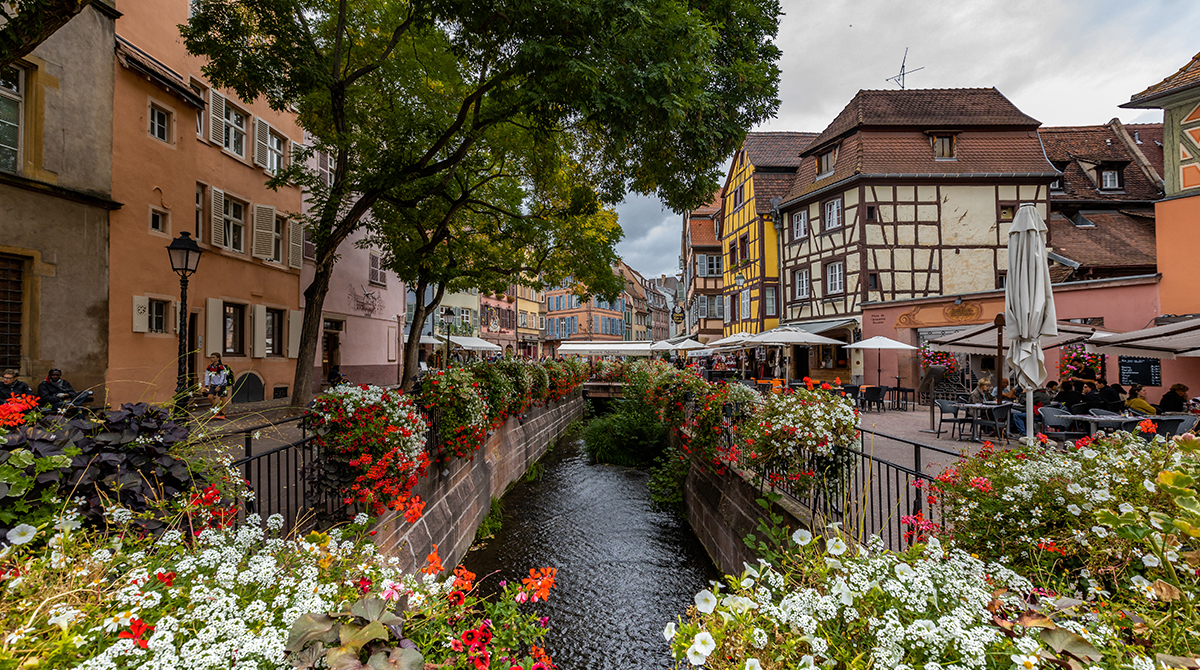
A guided tour of Colmar takes you through the historic center, between the Little Venice, the Koïfhus, the great Renaissance houses, and the Saint-Martin collegiate church. With your guide-lecturer, you will discover the original functions of the buildings, the transformations of the city, and the architectural details that distinguish each period.
Discover the historic center of Colmar, from the Middle Ages to the Renaissance
The old city center brings together several centuries of architecture in a narrower area. Colmar joined the Décapole in 1354, this federation of imperial Alsatian cities that permanently marked its history. Its commercial activity also fueled the rise of an urban bourgeoisie whose mansions still occupy the streets of the old city.
As you move through the historic center, you pass from Gothic buildings to Renaissance constructions. Oriels, gables, wooden galleries, and murals: your guide identifies these elements on the facades and distinguishes the different phases of construction. The Pfister House is particularly illustrative of this transition, with architecture still marked by the Middle Ages and settings associated with the Renaissance.
Little Venice and the Tanneurs neighborhood
Behind the Koïfhus, the Lauch leads the way towards the Poissonnerie quay, the Turenne and Saint-Pierre bridges. You enter the Petite Venise, an area of the former Krutenau where winemakers, fruit and vegetable growers and boatmen used to work.
Nearby, the Tanneurs neighborhood evokes another activity. Its tall wooden houses, most dating from the 17th and 18th centuries, combined housing with artisanal work. The tanners dried the hides in the upper parts, often with openings. Between 1968 and 1974, a vast restoration transformed this complex profoundly.
The Fish Market Pier
Since the Middle Ages, fishermen have sold the fish caught in the nearby streams here. Boatmen also lived in this area, which was directly connected to the Lauch.
A fire destroyed about forty houses in 1706. Between 1978 and 1981, a restoration campaign restored, among other things, the roofs of several buildings. Facing the quayside facades, your guide links the organization of the houses to the trades of fishing and river transport.
The covered market in Colmar
A few steps are enough to change the season. Inaugurated in 1865, the covered market combines brick with a metal frame supported by cast-iron pillars. The architect Louis-Michel Boltz designed a building characteristic of the new construction methods of the 19th century.
La Lauch runs directly along the hall. The farmers used to dock in boats to unload their produce at the foot of the building. Restored in 2010, the market still hosts merchants and retains its function as a marketplace.
The Koïfhus and the grand mansions of the old city
Completed in 1480, the Koïfhus is the oldest public building in Colmar. Its position at the intersection of Grand’Rue and Rue des Marchands corresponded to two major axes of the medieval city. Imported or exported goods passed through its ground floor, where they were stored and taxed. The deputies of the Décapole and the Magistrate of Colmar met on the upper floor, for example.
The building has evolved over the centuries. Two constructions were added in the 16th century, while a restoration carried out at the end of the 19th century brought, among other things, the current turret and glazed tiles. Your guide will be able to identify these transformations directly on the building.
Around the Koïfhus, the merchant houses show another aspect of Colmar.
The Pfister House
Built in 1537 for Ludwig Scherer, a chaplain enriched by the trade of silver in the Val de Lièpvre, the Pfister House marks the arrival of Renaissance architecture in Colmar while retaining several medieval features.
Look at the angle: a two-story oriel overlooks the street, accompanied by a wooden gallery and an octagonal turret. The murals blend biblical and secular subjects. Your guide identifies these designs and links them to the tastes of a mercantile bourgeoisie open to the new forms of the Renaissance.
The current name comes from the Pfister family, who occupied and restored the house in the 19th century.
The House of Heads
Anton Burger, a wealthy merchant from Colmar, had the Maison des Têtes built in 1609. Its facade is of German Renaissance style and features more than a hundred sculpted heads and masks, arranged around the windows and the central oriel.
Lift your eyes towards the spire with the volutes: a statue of a mason made by Auguste Bartholdi in 1902 overlooks it. It recalls the installation of the Wine Exchange in the building. Several centuries of architecture and transformations are concentrated on this single façade.
The Saint-Martin Collegiate Church and the religious heritage of Colmar
The large religious buildings form another part of the visit. The Saint-Martin collegiate church (often called Saint-Martin Cathedral) and the Dominican church in particular bear witness to the development of Gothic architecture in the 13th and 14th centuries and the establishment of the mendicant orders in Colmar.
Their architecture differs markedly. Saint-Martin imposes its dimensions on the square in front of the Cathedral, while the Church of the Dominicans adopts an organization linked to the principles of its order.
The Saint-Martin Collegiate Church
The construction of the current building spans from 1235 to 1365. Restoration work has also revealed the foundations of a church dating back to the year 1000, as well as traces of enlargements carried out in the 11th and 12th centuries.
The current silhouette also bears the mark of the 1572 fire, which destroyed the frame and the crowning of the south tower. Three years later, a bulb lantern replaced the missing part. Your guide shows these different phases and distinguishes the Gothic elements from the later transformations.
The Church of the Dominicans
The Dominicans began building their church in 1283, and work continued mainly during the first half of the 14th century. A fire damaged the roof and cloister in 1458. The building then underwent several changes of use and restoration campaigns.
Since 1973, the church has kept the Virgin Mary in the Rose Bush by Martin Schongauer, painted in 1473 for the Saint-Martin collegiate church. This work directly links the visit to one of the major artists of the late Middle Ages associated with Colmar.
Tour highlights
You will walk through the main districts of old Colmar, connecting public buildings, merchant houses, former artisan quarters and religious buildings. Petite Venise, Quai de la Poissonnerie, the Tanneurs district, Koïfhus, Maison Pfister, Maison des Têtes and Saint-Martin collegiate church are the main landmarks of the route.
Your guide-lecturer speaks directly in front of the monuments. He distinguishes the periods of construction, explains the former function of a building, draws your attention to a facade detail, or connects a neighborhood with the activity that used to take place there.
Book your guided tour of Colmar with a guide-speaker
Guides Tourisme Services Organizes guided tours of Colmar with professional guide-lecturers, for individuals, families, groups, and professionals.
Would you like to visit Colmar with a guide? Please indicate the desired date, the number of participants, and the characteristics of your group. Guides Tourisme Services organizes the visit around the historic center and the main sites included in the itinerary.