
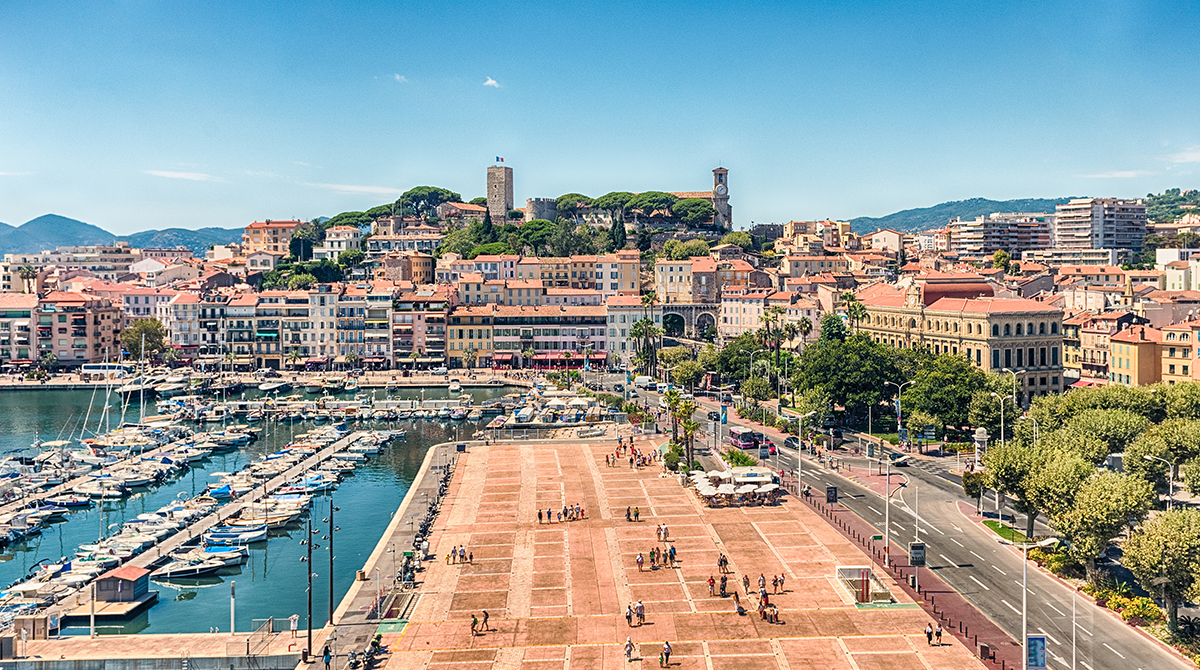
A guided tour of Cannes that connects the Suquet, the Forville market, the Vieux Port, the Croisette, and the Palais des Festivals. With your guide-lecturer, you will go from the old fishing village to the 19th-century resort town, then to Cannes as a film city. A very concrete journey to understand the city through its neighborhoods and monuments.
Cannes, from the fishing village to the city of the Festival
At the beginning of the 19th century, Cannes remained a small Provençal town oriented towards the sea and fishing. Its development accelerated from 1834 with the arrival of Lord Brougham. The former British chancellor had the Villa Éléonore-Louise built at Croix-des-Gardes and helped attract an aristocratic clientele from abroad.
Villas and hotels appear, the port is developed, and the railway reaches Cannes in 1863. The city changes in scale rapidly. Your guide links these transformations to the places you pass through: the old Suquet district retains the atmosphere of the old Cannes, while the seafront bears witness to the rise of tourism and the resort industry.
Cinema adds a new stage. Planned for the first time in September 1939, the International Festival did not take place due to the outbreak of the Second World War. The first effective edition of the Cannes Festival took place in 1946. Since then, the event has profoundly shaped the image of the city.
Visit Le Suquet, a historic district in Cannes
You climb towards the Suquet from the lower areas of Cannes. The streets narrow, the stairs take over and the old houses replace the large facades of the seafront. The neighborhood is organized around the hill that overlooks the Vieux Port and the Forville market.
Le Suquet is home to several witnesses to medieval Cannes. Your guide explains, among other things, the role of the monks of Lérins in the history of the site and highlights the religious, residential, and defensive buildings grouped around Place de la Castre.
The Church of Our Lady of Hope
Notre-Dame-d’Espérance Church dominates the neighborhood from Place de la Castre. Its construction began in the 16th century, following the decision in 1521 to build a place of worship more suited to the Canne population.
His position reminds us that local life was centered around this hill. On site, your guide distinguishes the parish church from the former chapel linked to the neighboring castle and explains the function of these different buildings.
The Place de la Castre, the Tour Carrée and the former castle
A few meters further on, the Place de la Castre brings together the main elements of the former fortified complex. The castle of the monks of Lérins houses today the Museum of World Exploration. It preserves, among other things, a building, a chapel, an inner courtyard and the Carrée Tower (also called the Tour du Suquet).
This tower served as a lookout post. Its construction spanned several periods of the Middle Ages until the end of the 14th century. From the promontory, you immediately see the site’s strategic importance: the bay of Cannes, the coastline and the islands of Lérins stretch out in front of the Suquet.
Your guide here links the architecture of the castle to the organization of the ancient city, long before the arrival of hotels and holiday villas.
From the Forville Market to the Vieux Port of Cannes
As you descend from Suquet, you reach the Forville market. A first wooden covered market opened on this site in 1884. The current building resulted from a reconstruction undertaken after a competition held in 1929 and completed in 1934 by the Canarian architect Henri Bret.
Its reinforced concrete structure contrasts with the older constructions of the Suquet district. The market remains closely linked to fresh produce, local farmers, and local fishing. It is currently undergoing renovation by the City of Cannes.
The visit takes in the Vieux Port, located directly at the foot of the historic district. The quai Saint-Pierre was built between 1838 and 1841, at a time when Cannes began to develop its coastline further.
From the quays, your guide links the ancient maritime activity with the transformations related to boating and tourism. The contrast with the Croisette, located a short distance away, becomes immediately apparent.
La Croisette and the Palais des Festivals
La Croisette was born from an old sandy path that ran along the coast. The municipality began to develop a promenade starting in 1863. It was named Boulevard de l’Impératrice in 1866, and then Croisette in 1871, in reference to a small cross that was once installed near the tip of the cape.
You are leaving the medieval Cannes for an area shaped by the tourist development of the 19th and 20th centuries. Hotels, landscaped beaches, and recreational venues are gradually transforming the waterfront.
The Boulevard de la Croisette and its grand hotels
The major hotels are directly reporting this development. The Carlton opened in 1911. Construction of the Majestic began in 1923 and the hotel opened in 1926. Its Art Deco architecture already belongs to a different generation of establishments than the first resort villas of the previous century.
Your guide draws attention to these differences in period and architecture. In the 1920s, the large hotels, beaches, and leisure facilities took up an increasing place along the boulevard. Cannes then asserted itself as an international tourist resort.
The Palais des Festivals, its steps and the Chemin des étoiles
The current Palais des Festivals came into being well after the festival was established. The first edition in 1946 took place at the municipal casino. A first palace opened on the Croisette in 1949. As the event grew in popularity, Cannes built the current building, which was inaugurated in December 1982 and used for the festival from 1983 onwards.
Its steps lead, among other places, to the grand Louis Lumière auditorium. During the Festival, the red carpet installed on that staircase draws much of the media attention.
Around the Palais, the Chemin des étoiles brings together about 150 footprints of figures from cinema. Your guide highlights here the different stages of the Festival’s history and the buildings that have successively hosted it. The chronology is richer than the mere image of the red steps.
Tour highlights
The visit brings together the main areas of central Cannes in a continuous route: the Suquet and Place de la Castre, the Forville market, the Vieux Port, the Croisette and the Palais des Festivals.
Your guide-speaker links the monuments directly to the major phases of the city's development. He distinguishes the medieval Cannes from Suquet, the resort that developed in the 19th century, and the developments related to cinema and international tourism.
The contrasts are also evident in the architecture: the old castle complex, the Forville market from the 1930s, and the palaces and Palais des Festivals belong to very different periods.
Guides Tourisme Services organizes these tours with professional guide-lecturers for individuals, groups, and tourism professionals. The tours are offered in many languages.
Book your guided tour of Cannes with a guide-speaker
To visit Cannes with a guide, Guides Tourisme Services organizes tours around the main sites of the historic center and the waterfront, from Suquet to the Palais des Festivals.
The visit is aimed at both individuals and groups, as well as tourism professionals. A professional guide-speaker provides commentary in the requested language, subject to availability.
Indicate the desired date, the number of participants, the language of the visit, and your specific expectations. These elements are used to organize a tour tailored to your group and focused on the main sites in Cannes.