
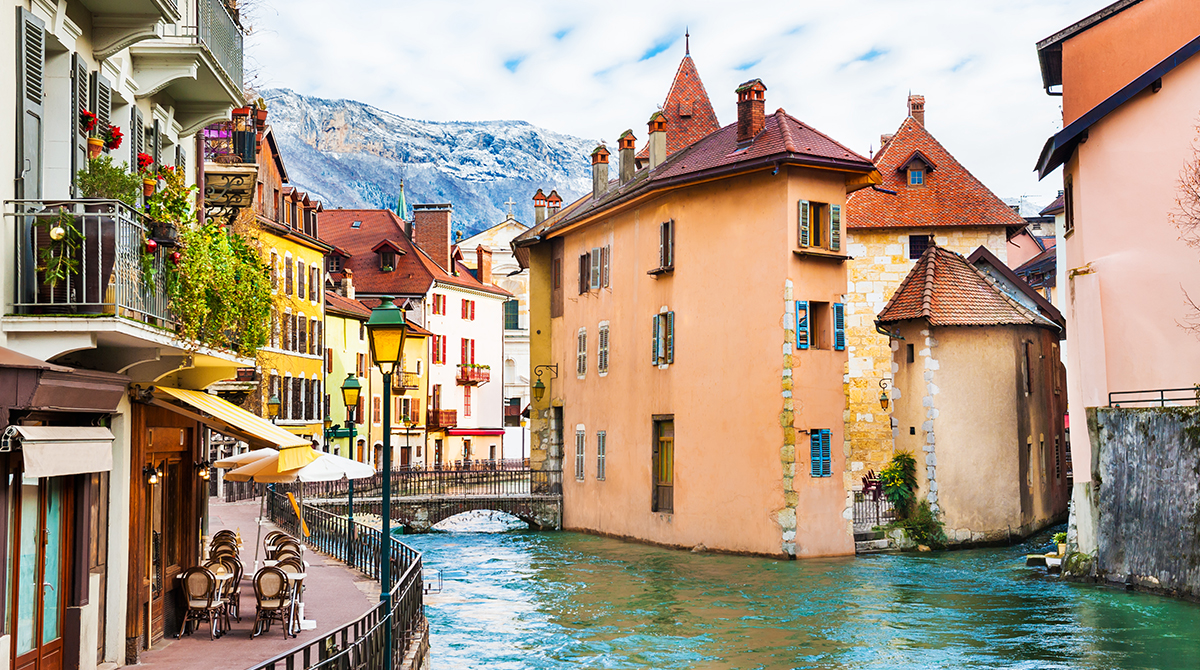
A guided tour of Annecy takes you to Old Annecy, along the Thiou canals, in front of the Palais de l’Île, the castle and the main religious buildings of the old city center. With a guide-lecturer, the tour also visits the Pont des Amours and the Jardins de l’Europe, on the banks of Lake Annecy.
Discover Old Annecy and the Thiou canals
The Le Thiou forms much of the old center. This stream leaves Lake Annecy before joining the Fier, passing through neighborhoods where water has long served for artisanal and then industrial activities. In the 19th century, a system of valves designed under the direction of Sadi Carnot improved the regulation of the lake level and the flow of the river.
To visit Annecy and understand the organization of its old town, these canals provide a good starting point. The quays, bridges, and narrow passages preserve the trace of an ancient urban fabric that has been deeply remodeled over the centuries.
The Palace of the Island
Situated on a natural rocky island in the middle of the Thiou, the Palais de l’Île is one of Annecy’s most famous monuments. Its oldest parts date back to the 12th century. Originally a fortress, the building was used as a prison as early as the 14th century.
Its functions have evolved considerably. A mint was established there in the 14th century after Count Amédée III of Geneva obtained the right to mint coins. The building also served as a court, administrative center, and archive. Its former cells and interior layout directly recall this judicial history.
Listed as a historical monument in 1900, the Palais de l’Île now houses an interpretation center on architecture and heritage. From the quays, the guide-speaker can also explain the significance of its location in medieval Annecy and its direct connection to the Thiou River.
Rue Sainte-Claire, its arcades and the Morens bridge
Rue Sainte-Claire runs through one of the oldest districts of the city. Its arcades, old houses and Sainte-Claire gate evoke Annecy’s organization at a time when the fortifications still further surrounded the urban center. On Place Sainte-Claire, the Gallo house stands out for its façade from the 18th century, combining classical and Baroque elements.
A few meters away, the Morens bridge marks an ancient strategic passage. Built in the early 14th century, it is considered Annecy’s first stone bridge. The road connecting the Alps to Geneva crossed the Thiou here. Homes and a chapel dedicated to Saint George once occupied the structure, before the works carried out in the 19th century.
The Château d’Annecy, the former residence of the counts of Geneva
Situated on the heights of the old city center, the Château d’Annecy is closely linked to the counts of Geneva. They settled there starting in the 13th century and made it their main residence until the dynasty’s extinction at the end of the 14th century.
The current building results from several phases of construction. The Queen’s Tower, the Old Logis and some of the towers belong to the medieval parts. The transformations of the 15th and 16th centuries then introduce elements characteristic of the Renaissance. The castle thus shows the progressive evolution from a defensive architecture to a more comfortable princely residence.
After the Counts of Geneva, the site came under the authority of the House of Savoy. It later served as a military barracks, before being acquired by the City of Annecy in 1953. It now houses the Annecy Museum-Castle.
On site, the guide-lecturer can distinguish the main periods of construction, clarify the function of the buildings and place the castle in the political relations between Geneva, the Genevois and the Savoie.
The churches of Old Annecy and the religious heritage of the city
The strong presence of religious buildings in Old Annecy is partly explained by the upheavals of the 16th century. After the adoption of the Protestant Reformation in Geneva, several Catholic institutions in Geneva moved to Annecy. The city then became a major center of the Diocese of Geneva, associated in particular with François de Sales and Jeanne de Chantal.
The Church of Saint Maurice, the Church of Saint François de Sales and the Cathedral of Saint Pierre allow us to approach this history from very different buildings.
The Church of Saint Maurice and the Church of Saint François de Sales
The Church of Saint Maurice is the former church of the Dominican convent. Its construction began in 1422 at the initiative of Cardinal Jean de Brogny and was completed in the early 16th century. The main nave meets the needs of Dominican preaching and the hosting of a large congregation. Several chapels were financed by families or guilds, some of which arms still appear on the vaulting.
Close by, the Church of Saint François de Sales is linked to the Visitation Order, founded in Annecy in 1610 by François de Sales and Jeanne de Chantal. It occupied the site of the order’s first monastery and hosted the graves of its founders before their transfer. Its interior decor retains elements related to the successive transformations of the building.
The proximity of the two churches helps to understand the role played by religious communities in the development of the neighborhood and in the Catholic history of Geneva.
Saint-Pierre Cathedral and Jean-Jacques Rousseau Street
Saint-Pierre Cathedral was built between 1535 and 1538 for the Franciscans. It quickly welcomed the bishops of Geneva after their departure from the city following the Reformation, and then officially became the cathedral of the diocese of Annecy in 1822.
Its architecture combines a Gothic-style structure with a façade influenced by the Italian Renaissance. Pilasters, a triangular pediment, and Gothic rose windows allow this combination of styles to be observed directly from the street.
The sector is also linked to Jean-Jacques Rousseau. Facing the cathedral, the Maîtrise house recalls the period during which he learned music in Annecy. The Balustre d’Or preserves the memory of his encounter with Madame de Warens in 1728. The former episcopal palace, now occupied by a conservatory, completes this ensemble that is very closely linked to the city’s religious and cultural history.
The Bridge of Love and the Gardens of Europe on the banks of Lake Annecy
The trail then joins the shores of the lake. The Pont des Amours crosses the Vassé canal between the Pâquier and the Jardins de l’Europe. The current bridge dates from 1907. It succeeds a first wooden bridge built in the mid-19th century and then a cast iron structure.
The Jardins de l’Europe also had several uses. The land once belonged to the Order of the Visitation. After the Revolution, the City of Annecy purchased it in the 19th century and landscaped it into a public garden. The plantings carried out in the 1860s still contribute to the current organization of the park.
This part of the tour allows visitors to explore the extension of Annecy beyond its old core. The guide can link the improvements to the quays, the Vassé Canal, and public spaces to the urban transformations of the 19th century.
Tour highlights
The Annecy guided tour brings together the main landmarks of the historic center: the channels of the Thiou, the Palais de l’Île, Rue Sainte-Claire, the Morens Bridge, the Château d’Annecy and several religious buildings. The tour continues to the Pont des Amours and the Jardins de l’Europe, on the edge of the lake.
The guide-speaker places each site in its context: successive functions of the Palais de l’Île, major phases of construction of the castle, consequences of the Reformation on local religious life or urban transformations of the 19th century.
Tourisme Services organizes these visits for individuals, families, groups, and tourism professionals. They can be offered in many languages with professional guide-lecturers.
Book your guided tour of Annecy with a guide-speaker
To visit Annecy with a guide, Guides Tourisme Services offers tours led by professional guide-lecturers. The visit can cover the main monuments of Old Annecy, the history of the Counts of Geneva, the religious heritage, as well as the neighborhoods built between the canals and the lake.
To prepare the visit, the request can specify the desired date, the number of participants, and the language. This information allows for the organization of a service tailored to the group and the planned itinerary.