
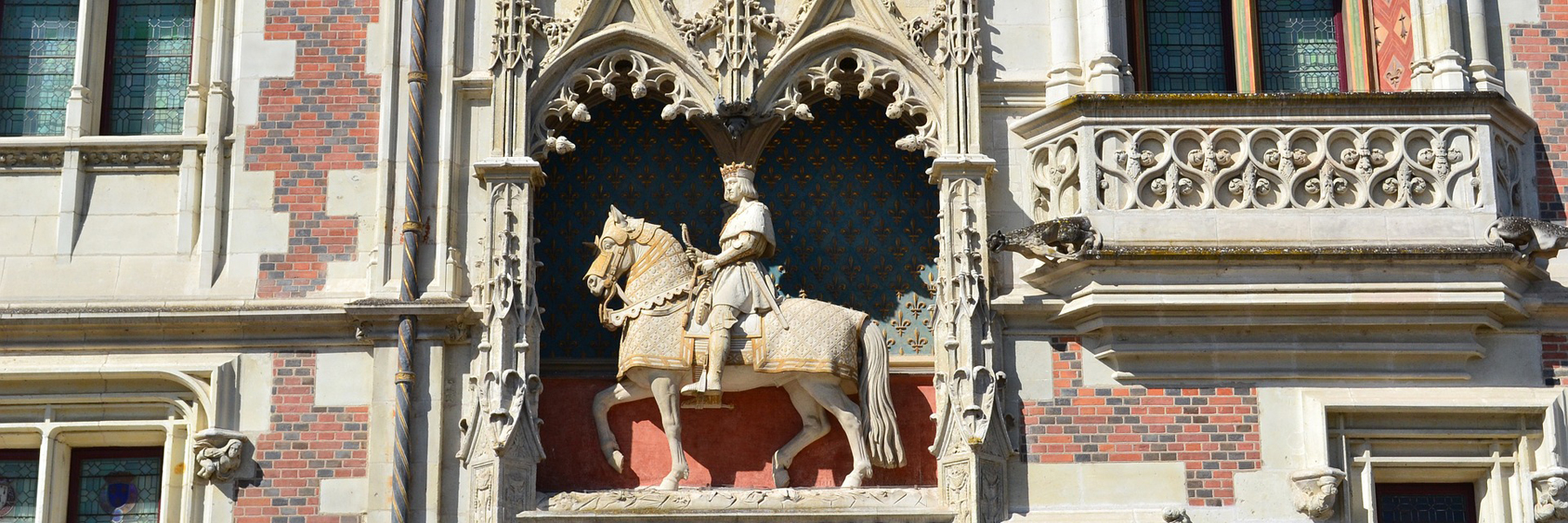


Visit Château de Blois, located in the heart of the Loire Valley, is a must for understanding the history of the kings of France. It brings together centuries of architecture and royal life. Several styles coexist, from the Middle Ages to the Renaissance. It's like a condensed overview of hundreds of years of French history.
Visit the Château de Blois
Visit Château de Blois is a building distinguished by its architectural diversity and rich history. Located in the historic center of Blois, it dominates the city from the hill overlooking the Loire River. The building spans several eras.
The castle's most distinctive feature: 4 architectural styles!
Medieval fortress of the 13thth century, Gothic wing, Renaissance wing and finally Classical wing.
As soon as you arrive, your first impression is marked by this variety of styles. It's not a homogeneous castle, as can be seen in Chambord or Chenonceau, but rather a superposition of architectures ranging from flamboyant Gothic to classical. Visitors can discover how architecture has evolved over the centuries.
The tour usually begins in the inner courtyard, where the different eras are clearly visible. The facade of the François I wing, with its monumental external staircase, is particularly impressive.
The Louis XII wing, with its red brickwork and galleries, shows the influence of Italian art.
As for the Gaston d'Orléans wing, it's a perfect example of the classical style of the 17th century, which heralded the style of Versailles.
Visit Château de Blois is also home to a fine arts museum, housed in the royal apartments. Collections range from painting to sculpture, with works dating from the Middle Ages to the 19th century. Highlights include a portrait of Antonietta Gonsalvus, painted by Lavinia Fontana around 1595, and «L'assassinat du Duc de Guise» by Paul Delaroche.
From the Middle Ages to the Renaissance
Visit Château de Blois was not always a place of royal splendor. Its earliest traces date back to the 9th century, when the Counts of Blois established a fortress there. However, it was in the Middle Ages that the first buildings, still visible today, appeared, notably under Thibaut VI de Blois.
The medieval wing of the château, although modified over the centuries, is reminiscent of the fortified constructions of the time, with its thick walls and defensive towers. Vestiges of this era are visible in the foundations and parts of the walls.
With the Renaissance, the château took on a completely different face. Under the reigns of Louis XII and François I, Blois became a royal residence in its own right. Italian influences made themselves felt, notably with the construction of the François I wing. The king, who was passionate about art and culture, brought in Italian artists to redesign the château, drawing inspiration from Italian Renaissance palaces.
Visitors can move from one era to another in just a few steps, admiring the traces of the Middle Ages and the elegance of the Renaissance.
The Château de Blois under Louis XII
Louis XII is a central figure in the castle's history. When he ascended the throne in 1498, he decided to make Blois his principal residence. He abandoned the Amboise castle, another magnificent Loire château a must-see.
He then built the wing that bears his name, a group of brick and stone buildings in the flamboyant Gothic style.
Louis XII was also responsible for numerous embellishments to the château. He enlarged the gardens and modernized the royal apartments. The king surrounded himself with artists and craftsmen to make Blois a brilliant and refined court.
Today, the Louis XII wing houses the château's fine arts museum, exhibiting works from the Middle Ages to the 19th century. Visitors can discover the artistic treasures of this period, while touring the rooms where the kings of France lived.
The reign of Louis XII marked a period of prosperity for Blois. The château became a place of power, where the major affairs of the kingdom were decided. The king welcomed foreign ambassadors, organized sumptuous festivities and lived there with his wife, Anne of Brittany, whose presence in Blois reinforced the castle's political importance.
Having no son to succeed him, Louis XII marry his daughter Claude de France to François d'Angoulême, future Francis 1st. After becoming queen, Claude de France left the Amboise castle and furnish the Blois castle to set up the Court. Her husband Francis 1st launched the construction of a new Renaissance-style wing, and began one of the most important book collections of the period. However, on the death of the Queen in 1524, Francis I abandoned the Blois castle for the benefit of château de Fontainebleau. The work was never completed, and the imposing collection of books begun a few years earlier was moved to Fontainebleau to form the Bibliothèque nationale.
However, the Blois castle remains at the heart of French history. Queen Claude de France gave birth to and raised her 7 children here, and they remained very attached to the castle. Henri II, then François II and Charles IX would thus keep Blois as a main residence. The château has witnessed some of history's most important events.
The Château de Blois under François I
Visit King Francis I succeeded Louis XII in 1515 and made Blois one of the centers of the French Renaissance. He undertook major works on the château, calling on Italian architects and artists to modernize the royal residence.
The François I wing is the central element of these transformations. This group of buildings is characterized by the monumental staircase The front spiral staircase is one of the masterpieces of Renaissance architecture in France. The staircase, visible from the courtyard, is a true technical and aesthetic feat. Visitors can climb it to reach the royal apartments, where the rich decorations commissioned by François I can be seen.
The king also had new gardens laid out in Blois, inspired by Italian gardens. He brought in exotic plants and created promenade areas reminiscent of those found in the grand mansions of the Renaissance.
The castle's secrets
Your guide will take you to the most beautiful corners of the castle and tell you all its best-kept secrets. Between myths, legends and truths, you'll know it all!
Who lived at Château de Blois?
Visit Château de Blois has been home to several generations of French kings and queens. Among them are such famous figures as François I, Catherine de Médicis, Henri III and Gaston d'Orléans.
Catherine de Médicis, in particular, spent many years at the château. She even set up a secret cabinet, According to some romantic accounts, this was where she kept her potions and poisons. The cabinet continues to intrigue visitors, curious to discover the mysteries of the royal court.
In reality, it was mainly a question of exhibiting precious works and books.
Henri II and Henri IV also stayed in Blois.
All in all, there are 7 kings and 10 queens who lived here !
What works of art are on display?
Visit Château de Blois houses an impressive collection of works of art. The Musée des Beaux-Arts features paintings, sculptures and objets d'art from different periods. Among the highlights, in addition to those already mentioned, are the painting of «The Abduction of Europa», circa 1570, and a sculpture by François 1er hunting.
All in all, over 1,000 objects and works of art can be discovered at the château.
Book a guided tour of Château de Blois
To fully discover the riches of the Château de Blois, We strongly recommend booking a guided tour. Our guides, specialized in the history of the castle and the region, offer a unique and enriching perspective.
With Guides Tourisme Services, you're guaranteed to get the most out of your stay. exceptional guided tour, with a professional tour guide. Our agency specializes in organizing guided tours in Paris and all over France.
Families, friends, groups, companies: contact us for information and bookings.
This guided tour of the Château de Blois will be an opportunity to step back in time and let us tell you a few stories. major events in French history where they took place.
Blessing of Joan of Arc in the château chapel before the Reconquest of Orleans, illegal posting of anti-mass leaflets on the very door of the king's chamber by supporters of the Reformed Church, triggering the repression of Protestantism, Henri IV's engagement with Marguerite de France or assassination of the Duc de Guise in his room on the second floor...
Piece by piece, relive the history of France with this visit to Blois castle with a private guide.