
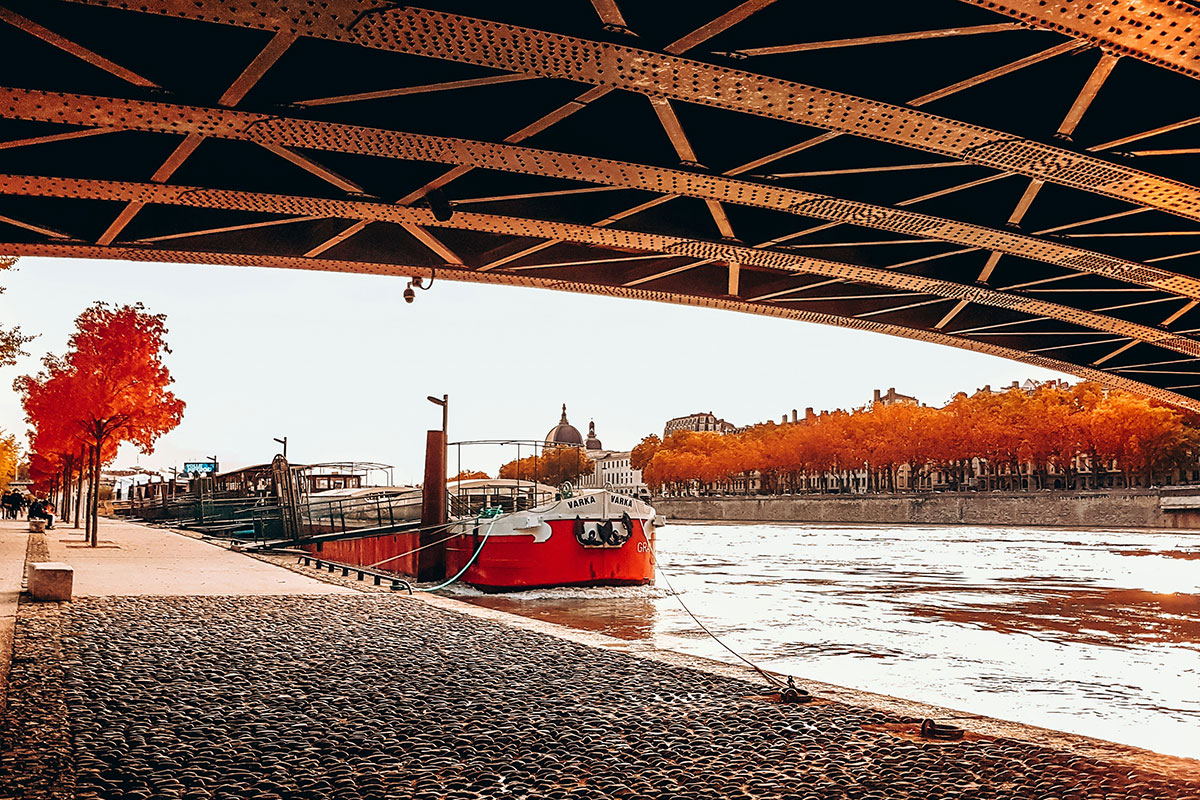
Autumn changes the rhythm of a stay in Lyon. Foliage takes over the parks and hills, museums become precious refuges on rainy days, and the cultural calendar remains packed. To visit Lyon during this season, you can easily alternate between heritage, urban walks, gastronomy, and getaways in the Rhône region.
Visiting Lyon in autumn: why the season makes you want to rediscover the city
The city of Lyon adapts well to beautiful autumn days.
Parks and hills are gradually taking on their seasonal colors. At the Tête d'Or, on the slopes of Fourvière, or around the Jardin du Rosaire, the yellow and orange foliage is radically changing the scenery. Even the panoramas of the Saône and the rooftops of the Presqu'île take on a different look in the October or November light.
Attendance remains variable, particularly during weekends and major cultural events. But the atmosphere is generally different from that of the heavy summer periods. People take more time to walk through the historic neighborhoods, stop in a courtyard, or extend a museum visit.
And with uncertain weather? Just keep a few indoor alternatives up your sleeve: Lyon offers plenty of options to reorganize a half-day without sacrificing it.
Why start with Old Lyon and Fourvière in the fall?
Visit Old Lyon remains an excellent starting point. Sandwiched between the Saône and the Fourvière hill, this Renaissance district of about 24 hectares brings together cobbled alleyways, interior courtyards, galleries, and traboules. It belongs to the historic site of Lyon UNESCO World Heritage Site.
Start around Saint-Jean Cathedral, then take the time to get a little lost in the surrounding streets. Some courtyards open up behind rather discreet facades, while several passageways recall how the district was built and organized over the centuries.
To get to Fourvière, two options: walk up or take the funicular. On foot, the Jardin du Rosaire offers a route particularly suited to autumn, with its terraces, trees, and several glimpses of the city. After the rain, it is still better to avoid smooth-soled shoes: cobblestones and stairs can quickly become slippery.
From the Fourvière esplanade, Lyon unfolds in its entirety. One can make out the Presqu'île between the Rhône and the Saône, then the neighborhoods that extend eastward. The ancient remains of Lugdunum, with the Gallo-Roman theaters, are also very close by.
Where to see the most beautiful autumn colors in Lyon?
To enjoy the foliage, there is no need to leave the city. Several green spaces and walks fit very easily into a day of sightseeing, whether you are looking for a long walk or simply a break between two neighborhoods.
Parc de la Tête d’Or: Enjoy the foliage in the middle of the city
With its 105 hectares, Tête d’Or park remains the major Lyon reference for an autumn walk. Lake, large trees, botanical garden and greenhouses allow you to spend an hour or half a day there, depending on your schedule.
October and November particularly highlight the tree-lined avenues and the areas around the lake. If you like walking without a specific destination, simply let yourself be guided by the paths. The botanical garden offers a different approach, more focused on plant collections.
Starting October 15, winter hours currently apply, with opening hours from 6:30 a.m. to 8:30 p.m.
Parc des Hauteurs and riverbanks: gain height or follow the water
The Parc des Hauteurs rather forms a collection of gardens, walks, and viewpoints spread across the Fourvière hill. The Jardin du Rosaire, the esplanade, the Promenade de la Sarra, and the Passerelle des Quatre Vents allow for a fairly free-form stroll.
The Four Winds Footbridge opens up beautiful vistas towards the Saône and Croix-Rousse. The Jardin du Rosaire, for its part, leads you gradually back towards Saint-Jean.
Do you prefer a flatter walk? Head down to the Saône quays or the banks of the Rhône. These routes are better suited for a linear stroll and allow you to reach several neighborhoods without adding extra climbs.
Croix-Rousse and traboules: exploring Lyon's history on foot
La Croix-Rousse is best discovered on foot. The district still bears the traces of the history of the silk industry and the canuts, those weaver workers who profoundly marked the local architecture and Lyon's social life in the 19th century.
The former studio buildings, staircases, and traboules are must-sees. These passageways cut through certain buildings to connect two streets, sometimes via a courtyard or an interior staircase. More than 160 traboules are listed on the slopes of the Croix-Rousse, but not all of them are freely accessible.
Some still cross inhabited properties. Enter calmly, respect the hours, and avoid turning the courtyards into gathering places. The Cour des Voraces is among the best-known passageways, with its large monumental staircase.
A good option is to start from the plateau and gradually head down towards Terreaux. The route is easier on the legs and makes it easier to understand the neighborhood's layout along the slope. The climb up the Grande-Côte and the former districts associated with the silk trade round out this visit nicely.
A guided tour of Old Lyon and traboules with an official tour guide will allow you not to get stuck and to better understand everything: ceiling heights, workshop organization, interior passages, the social history of the Canuts... Several elements easily go unnoticed without an explanation.
What to visit in Lyon when it rains?
Rain doesn't necessarily complicate a day in Lyon. The choice of museums is wide enough to keep a coherent itinerary, rather than just picking an indoor spot at random.
Musée des Confluences and Gadagne museums
The Musée des Confluences is well-suited for a half-day visit, especially if you like natural sciences, human societies, and major questions related to origins or living things. Its collections blend objects, specimens, and approaches from several disciplines.
Gadagne offers an experience much more connected to Lyon. Located in Old Lyon, the site brings together the History Museum of Lyon and the Museum of Puppet Arts.
You will find there the evolution of the city, its relations with the Rhône and the Saône, its industrial past, as well as its political and social history.
Museum of Fine Arts and Lumière Institute
Located at Place des Terreaux, the Museum of Fine Arts fits easily into an itinerary dedicated to the Presqu'île or the slopes of the Croix-Rousse.
Want to completely change things up? Direction Monplaisir and the Lumière Institute. The Lumière Museum traces the history of the Lumière family, the Cinematograph, and image-related inventions. It is located in the Villa Lumière, on a site directly associated with the beginnings of cinema.
In October, this visit naturally echoes the Lumière Festival, one of the major cultural events of the autumn in Lyon.
Bouchons lyonnais and Halles de Lyon: autumn opens the appetite
Cool days lend themselves quite well to Lyonnese cuisine. Quenelles, cold cuts, cervelle de canut, tablier de sapeur, or praline tart are among the specialties you will regularly encounter on menus.
To choose a bouchon, the «Bouchons Lyonnais» label is a useful guide. Created with the Lyon Chamber of Commerce and Industry and the Tourism Office, it recognizes establishments committed to the tradition of the bouchon.
Do you prefer to graze rather than spend two hours at the table? Les Halles de Lyon Paul Bocuse, in the Part-Dieu district, bring together some sixty vendors. You can buy local products there, have lunch, or sample several specialties depending on the stands and their hours.
For a short stay, this address has a real advantage: it allows you to discover several facets of Lyon's gastronomy in one place, without having to make multiple reservations.
Which events set the pace for autumn in Lyon?
In Lyon, autumn has a particularly busy cultural calendar.
For example, you can enjoy the Biennale of Contemporary Art, or the Lumière Festival, with screenings, restored films, meet-and-greets, and special sessions spread across numerous venues.
Early December, the Festival of Lights marks another highlight. For four evenings, light installations and projections transform several public spaces. The crowds then significantly change the visiting conditions: accommodations, transport, and walking require more anticipation.
Visiting the Rhône in autumn: where to extend your stay from Lyon?
A few kilometers are enough to completely change the scenery. If you wish visit the Rhône in autumn, Beaujolais to the north and the Coteaux du Lyonnais to the west and southwest offer two natural extensions from Lyon.
Easily plan for a full day. This will give you time to walk through a village, tour the wine-growing landscapes, and, depending on availability, visit a wine estate.
During the grape harvest season or for a tasting, check the visitor conditions before you leave.
Beaujolais and Golden Stones: between vineyards and villages
In the south of the Beaujolais, the Pierres Dorées area blends vineyards, hills, and villages built from a warm-toned limestone. Oingt, Theizé, Bagnols, or Jarnioux can easily be included in a day trip.
In autumn, the vineyards gradually change color and enhance the yellow and ochre hues of the landscape. Several routes pass between the hillsides and villages, offering viewpoints very different from those of the Lyon metropolis.
Avoid trying to pack in too many stops. The winding roads of Beaujolais rather invite you to take your time: a village, a walk through the vineyards, and perhaps a tasting already make for a full itinerary.
Discover the Coteaux du Lyonnais
Closer to Lyon, the Coteaux du Lyonnais allow for a quick trip to a wine-growing environment. The vineyards extend around the metropolis, particularly toward the Monts du Lyonnais.
After the grape harvest, the plots take on their autumn colors while some estates continue to welcome visitors to present the vineyard, the cellar, and their wines. The conditions vary from one winery to another.
In Taluyers, for example, several plots fall under the Coteaux du Lyonnais appellation, and certain estates organize visits or tastings. This proximity makes it possible to keep Lyon as a base while setting aside a few hours for a more rural getaway.
When to choose a guided tour of Lyon in autumn?
Certains quartiers lyonnais se comprennent beaucoup mieux avec un guide-conférencier. Le Old Lyon and its traboules, the Croix-Rousse linked to the silk weavers or Fourvière with its ancient ruins offer many architectural and historical details that can go unnoticed during a simple walk.
Autumn adds a very concrete constraint: the weather. A tour planned mainly outdoors may need to be adjusted because of rain, slippery cobblestones, or a group that is not very comfortable with stairs and steep slopes. A guide knows the possible alternatives and can adapt the itinerary without breaking the flow of the tour.
This approach is just as suitable for families and groups who want to structure their tour around a specific theme, such as the Renaissance, silk, Antiquity, gastronomy, or the social history of Lyon.
Guides Tourisme Services organizes tours in Lyon with professional licensed guides in different languages. Contact us for any custom tour organization.