
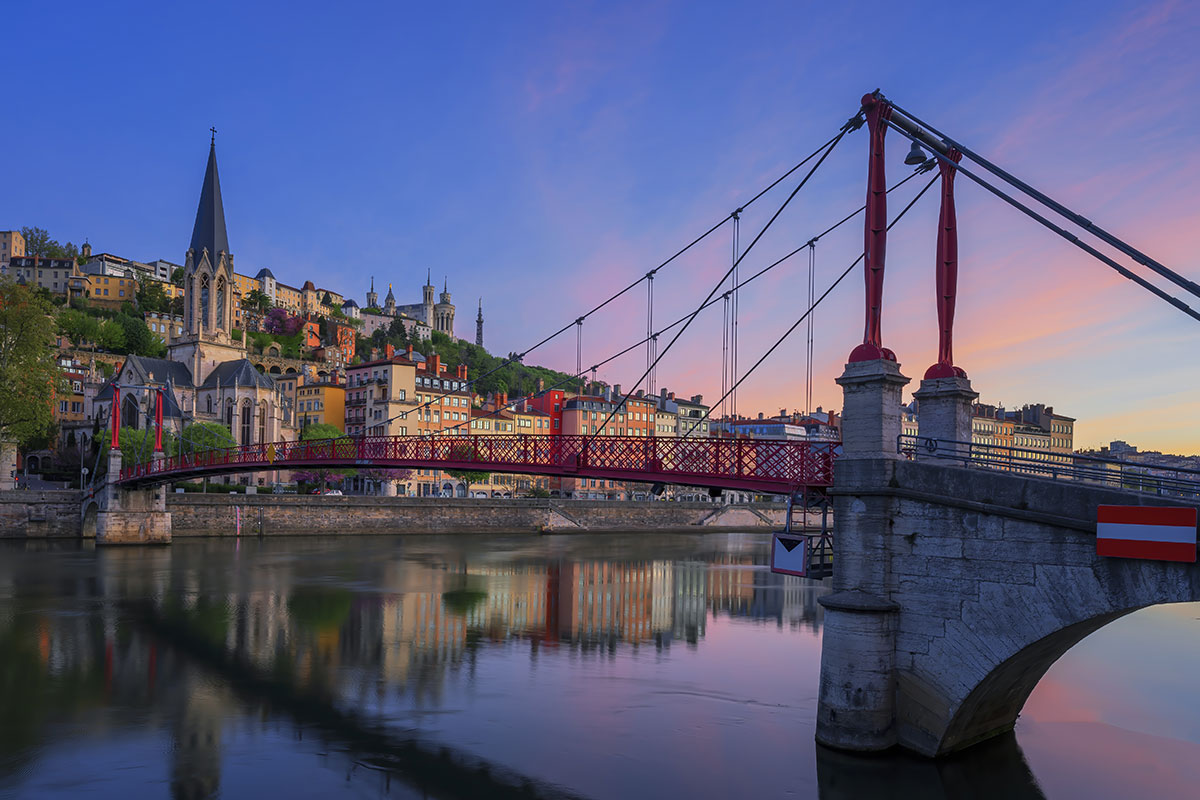
Visiting Lyon on foot is undoubtedly one of the easiest ways to understand the city during a first stay. The Presqu'île, the Saône riverbanks, Old Lyon, and Fourvière follow one another quite naturally. The route remains accessible over half a day or a full day, provided you plan ahead for the climb up the hill.
Can Lyon easily be visited on foot?
Yes, especially in the center. Between Bellecour square, Terreaux and the quays, Lyon is easy to get around on foot. Distances remain reasonable and several major sites are located along the same axis.
This is also what makes the pleasant walk. You leave the large squares of the Presqu’île, reach the Saône, cross Old Lyon, and then gradually make your way up to Fourvière. The atmospheres change quickly without requiring long journeys between points of interest.
Rue de la République is also a practical landmark for a first visit. Largely pedestrianized, it connects Place Bellecour to Place des Terreaux over about a kilometer. You can therefore walk along without taking out your phone at every intersection.
The relief becomes more pronounced starting from the Old Lyon. The climb up to Fourvière requires more effort, especially after several hours of walking. The funicular offers a convenient alternative.
A simple route from Bellecour square to Fourvière
For visit Lyon Without making unnecessary detours, start from Bellecour square, then head up the Presqu’île to Terreaux. Reach the Saône, cross over to Vieux Lyon, and save Fourvière for the final part of the route.
This route follows the geography of the center and avoids backtracking. You start on flat terrain, then save the elevation gain for the end of the walk.
From Bellecour to Terreaux, explore the major squares of the Presqu'île
Place Bellecour works very well as a starting point. It is centrally located and served by subway lines A and D and large enough to quickly get your bearings between the Rhône and Saône.
Head north through the Presqu’île. Rue de la République remains the most direct option, but a few detours are worth the trip: Place des Jacobins, the Célestins Theatre, and Saint-Nizier Church are all located in the immediate vicinity of this axis.
You then arrive at Place des Terreaux, in front of the Hôtel de Ville and the Museum of Fine Arts. La Croix-Rousse It starts further north, but it’s best to save it for another walk if your goal is to explore downtown Lyon in a single day. Its hills, its history tied to the canuts, and its traboules are worth taking the time to explore.
Head to Old Lyon via the Saône riverbanks
From Les Terreaux, head toward the Saône River and then walk back down toward Vieux Lyon. This stretch along the riverbanks gives the walk a completely different atmosphere. The slopes of Fourvière come into view ahead of you, while the facades of the historic district draw closer.
There are several bridges and footbridges that allow you to cross the river. The idea is simply to reach the Saint-Jean area without unnecessarily extending the walk.
Once on the right bank, the Quai Romain Rolland runs alongside Old Lyon. Saint-Jean Cathedral and the district's main streets are just a few minutes away.
This route choice primarily avoids frequent back-and-forth trips for visitors who explore the The Peninsula, then Old Lyon. Here, the two neighborhoods flow naturally into one another.
Explore Saint-Jean among alleys, traboules, and Renaissance courtyards
Starting from Saint-Jean Cathedral, slow down. The neighborhood deserves more than just a quick trip to Fourvière.
Rue Saint-Jean is where much of the action takes place, but the neighboring streets and inner courtyards are just as interesting. Some traboules allow you to pass from one street to another through several buildings. These passageways are a direct result of the very narrow layout of the old lots.
One of the well-known traboules connects 54 rue Saint-Jean to 27 rue du Bœuf. It crosses several courtyards and buildings, featuring a succession of interior spaces typical of the neighborhood.
Keep one thing in mind, though: these paths often pass through residential buildings. Some courtyards may be closed depending on the time of year or access restrictions.
Be discreet and follow the instructions displayed and avoid forcing a door on the pretext that a traboule appears in a tourist guide.
Go up to Fourvière and then come back down towards the center
From Saint-Jean, you can continue on foot towards the basilica Our Lady of Fourvière. A walk through the Rosary Gardens is one of the classic routes starting at the bottom of the hill.
The Fourvière website indicates about a 25-minute climb via this route. The elevation gain is close to a hundred meters, which is noticeable after several hours in the streets of Lyon.
Once on the esplanade, take the time to look at the panorama. The Saône, the Presqu'île, and the neighborhoods located beyond the Rhône are clearly visible from the hill.
To go back down, two options: take the Rosary gardens again or take the F2 funicular to the Vieux Lyon station, connected to metro line D.
How long should I plan to spend walking through downtown Lyon?
The walk itself actually takes very little time. It's the stops along the way that determine the length of the tour.
To visit Bellecour, Les Terreaux, Saint-Jean, and Fourvière without spending too much time on indoor tours, a few hours may be enough. A half-day is still more convenient, however to look at the facades, enter certain courtyards and take a real break.
With a full day, you can take things at a more leisurely pace and add a museum visit, lunch, or a longer stop on the hill. The ancient theaters can also extend your exploration of Fourvière.
You only have two or three hours It is better to focus the route around Bellecour, Old Lyon, and Fourvière. Trying to cover everything risks turning the walk into a succession of hurried travels.
In Old Lyon, where should you really slow down your pace?
Saint-Jean concentrates many details that are easily missed when walking too fast.
Around rue Saint-Jean and rue du Bœuf, take a look at the building entrances, galleries, staircases, and accessible courtyards. It is often these little passages that give the visit the most depth. The traboules show in particular how certain buildings are connected to each other behind the facades visible from the street.
The cathedral remains an obvious landmark, but a walk in Old Lyon is enhanced by straying slightly from the main path. During peak times, the best-known streets can be crowded. The neighboring passageways then offer a quieter atmosphere.
For access the traboules Under better conditions, the morning can be a good choice. The tourist office also recommends this period to avoid some of the crowds.
Fourvière on foot or by funicular: which option to choose?
The answer depends mostly on how you are feeling today and the time available.
Walking up via the Rosary Gardens is well suited for visitors who want to extend their walk from Saint-Jean. Allow about 25 minutes according to the Fourvière website. The slope remains steep and can take a toll after a morning spent walking.
The F2 funicular is the most comfortable option. It departs from the Vieux Lyon station and arrives near the basilicas. With young children, a group not used to walking, or in high heat, the choice is easily justified.
You can also combine the two: take the funicular up and then walk down through the gardens. You get to enjoy the walking route without concentrating the effort on the steepest part.
For people with reduced mobility, the organization deserves more attention. The funicular and the basilica have adapted facilities, while the Rosary Gardens are not indicated as accessible to people with reduced mobility.
Where to take a break without unnecessarily lengthening the route?
The most convenient way is still to stop directly along the way.
Around Bellecour, Jacobins, or Terreaux, you will easily find somewhere to take a break before heading to Vieux Lyon. This option works well for a walk that starts early in the day.
Saint-Jean is often more logical for lunch. You have already walked through the Presqu'île and find yourself just before the climb up to Fourvière. The streets in the district feature many cafés and restaurants, with sometimes heavy foot traffic during meal times.
You can also wait for the arrival on the hill, especially with a funicular ride. In any case, avoid detours that are too long for a specific address. On this type of compact itinerary, an extra twenty minutes of walking in each direction quickly ends up breaking the rhythm of the day.
Guided tour of Lyon: what a tour guide brings to the experience
You can easily follow this itinerary on your own with a map. A tour guide mainly provides context and helps you spot things that are easy to miss.
On the Presqu’île, the explanations help place the major squares, public buildings, and urban transformations within the city's history. In Old Lyon, the contribution becomes more concrete: how traboules work, courtyard architecture, access to certain passageways, and the neighborhood's evolution over the centuries.
A guided tour of Lyon also makes it possible to adapt the walk to the group. A family with children moves at a different pace than a group of adults passionate about architecture or foreign visitors discovering the city for the first time.
Guides Tourisme Services operates on this type of route with licensed guides specialized in history and heritage, including for tours in foreign languages. The main value lies in how the sites are connected and in providing landmarks during the walk.
This is particularly noticeable in the traboules: without explanation, they can resemble simple passages between two streets. When in fact, not at all!
With a guided tour of Lyon's traboules, you will discover much more. Their architecture, organization, and role in the city become much more concrete with the right keys.
Cobblestones, elevation gain, and traboules: practical tips to know before you go
On a map, the center of Lyon looks quite compact. On site, however, the terrain changes a lot between the Presqu'île and Fourvière.
During a guided tour of Old Lyon, you will encounter cobblestones, steps, and some uneven ground. Bring real urban walking shoes, like sneakers. Forget heels or stiff shoes if you plan on walking for several hours straight.
Save a bit of energy for Fourvière, too. It’s the most physical part of the route. The funicular remains a good solution to reduce the effort without skipping this stop.
When it comes to traboules, the rule is simple You sometimes walk through buildings where residents live on a daily basis. Respect closed doors, posted schedules, and the quiet of the courtyards. Some traboules are subject to agreements intended to preserve public access while maintaining good conditions for the residents.
Before departure, check the opening hours and access conditions of the sites you wish to visit, particularly the basilica and the funicular. They may change depending on the season, celebrations, or operational constraints.