
Visiting Paris requires a minimum of organization. Distances, reservations, access controls, and transportation changes quickly add up to a poorly planned day. Trying to visit as many places as possible sometimes results in more time spent running between places than enjoying the capital. Here are a few mistakes that will waste time and risk ruining your stay.
Wanting to see everything: the mistake that turns Paris into a race against time
There are so many things to do in Paris. So much!
Paris gives easily A desire to accumulate the stages. One Guided tour of the Louvre In the morning, Montmartre for lunch, the Eiffel Tower in the afternoon, then a stroll through the Marais before dinner: on paper, the program seems dense but doable. On the ground, each move and each visit take longer than expected.
Because a reservation at 10 a.m. never corresponds to a simple time entered in a calendar. You have to get to the site, find the right entrance, pass any necessary checks, and sometimes wait before you can actually begin the journey. At the exit, the journey to the next stage begins again.
A day filled with monuments leaves little space for breaks, to program changes or a visit that keeps you from seeing as much as you planned. And frankly, what’s the point in leaving a museum you enjoy because another ticket awaits you at the other end of Paris?
To visit Paris without having to change your plans in a hellish succession of appointments, It’s better to identify the places that really matter. A great museum or a major monument can be the central stop of a half-day trip. The rest of the time is much better suited for a stroll through the neighborhood, a quiet lunch, or some discoveries made along the way.
Building one's days around monuments instead of reasoning by neighborhoods
A list of famous places rarely forms a good itinerary. The geography of Paris quickly reminds us that a nearby monument on a map may require a detour, a transfer, or a long walk.
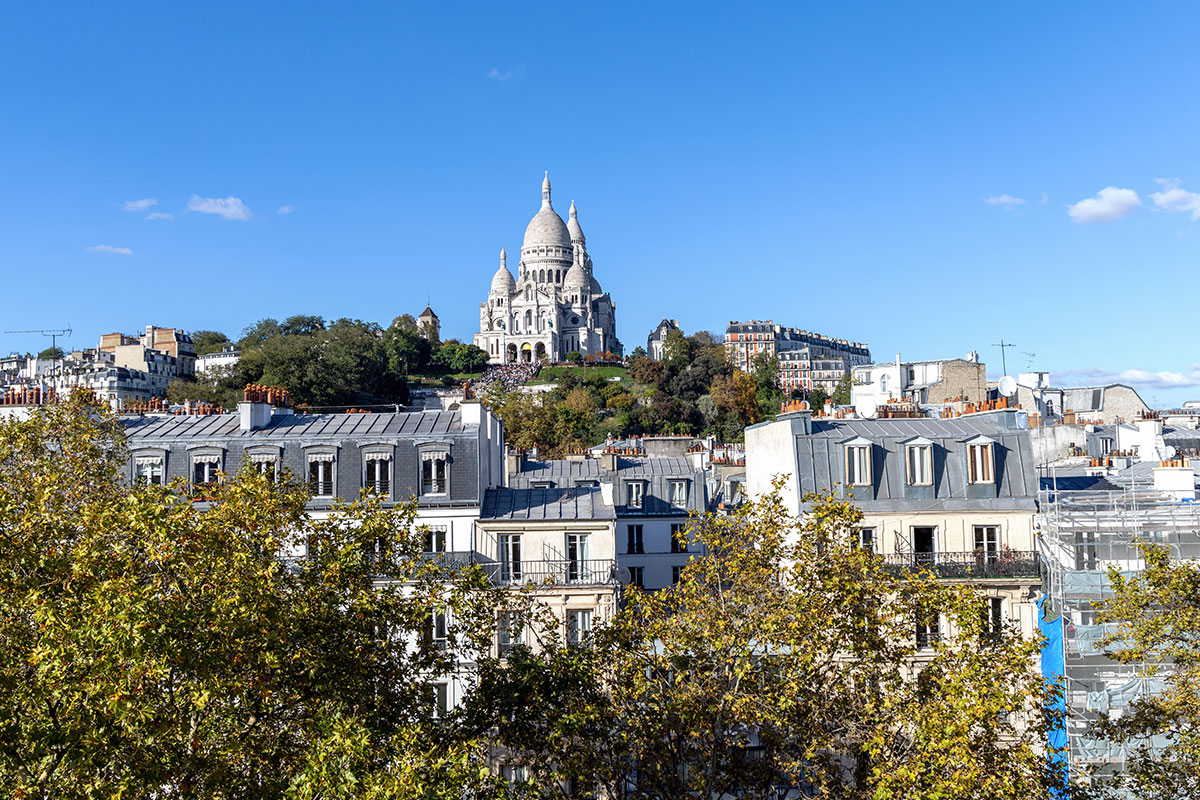
Organizing your days by sectors changes the game completely. You can allocating a slot for the Ile de la Cité and the Latin Quarter, Then plan for a Quickly guided from Montmartre and of the Basilica of the Sacred Heart over another half-day. The travel times become shorter and you avoid having to cross Paris several times to visit selected locations separately.
This logic also offers more freedom on site. Does a street catch your eye? Have you spotted a terrace or a small museum nearby? You can modify the schedule without disrupting the entire day.
It remains to be seen how far these distances are actually covered, and not just as they appear on a map.
Not measuring the real travel times between two visits
A metro time displayed on an app only represents a part of the journey.
And... rarely the reality.
You still have to get to the station, find the right line, walk through the corridors, make any necessary transfers, and then walk the final few meters to the entrance of the site.
In Paris, these intermediate times count a lot. Some stations are large, some connections are long, and two points located at a short distance by foot can require a rather inconvenient journey.
Before scheduling two consecutive visits, please check the full itinerary. Compare the metro, the RER and walking, Then, especially when it comes to short distances, consider walking rather than taking the subway. Walking can be easier than going underground, waiting for a tram, and then walking a few more blocks.
Leave no gap between the reserved slot and the next step
Too tight schedules create most of the problems. A visit scheduled for 10 a.m. can start a little later, last longer than expected, or simply make you want to stay longer.
Plan for a real margin before the next appointment. It will absorb a delay in transport, a longer queue, a necessary break, or a few extra minutes spent in a museum.
This flexibility also changes the way you enjoy your stay. You stop constantly checking the time and avoid leaving a place in a hurry, speeding up the end of the visit. In Paris, where many days combine walking, transportation, and indoor visits, this small space between two stages quickly becomes precious.
Booking too late
Some places lend themselves very well to improvisation. You can decide on the same morning to go for a walk in the Marais or to join the Seine quays. For museums, monuments and activities that operate on a schedule, waiting for the last moment can, however, seriously complicate your program.
The Louvre is a perfect example of this. The museum recommends booking a time slot and specifies that a prior reservation guarantees entry, while a purchase on the spot remains subject to availability on the day.
And the problem goes beyond just access. A late booking can leave you with a schedule that’s not ideal, for example in the middle of the afternoon. The whole day must then be organized around that appointment, with sometimes little time to plan another significant visit before or after.
The simplest way is therefore to prioritize the sites subject to reservation. Once these schedules are set, you can build the rest of your stay around them. The walks, neighborhoods, and places that are more freely accessible find their place with much less constraint.
Improvising your transportation when you leave
Looking up every route in front of a metro station may seem trivial. Repeated several times throughout the day, this reflex ends up taking up time and creating unnecessary hesitation.
There is no need to plan every resort several days in advance. On the other hand, knowing the day's main connections really helps: where to start, which area to head to next, and which resort is near the next planned location.
Paris has a dense network, which certainly offers multiple possibilities for the same journey. But the route with the fewest kilometers is not necessarily the most practical. A long connection can cancel out the gain obtained on paper, while a short walk sometimes avoids two line changes.
Traffic conditions may also change. Checking the route shortly before departure remains relevant, especially in the event of a disruption or temporary traffic change. You thus keep a prepared framework while retaining enough flexibility to adjust the route.
Underestimating the time it actually takes to visit a large museum or monument
Major Parisian sites often take more time than one might think. And this is most often true in museums: even with a specific selection of works or rooms, you have to factor in getting around inside the building, finding your way, and potential security checks.
At the Louvre, for example, the arrival time must be coordinated with the museum's schedule and the time actually available before closing. The tour may also require more walking than expected, especially if the desired works are located in distant wings.
The same caution applies to monuments comprising multiple levels, areas, or routes. The pace varies greatly from one person to another. Some visitors prefer to head directly to a few specific points, while others take the time to read the signs or stop for a long time.
In your program, consider the visit as a broader block than just the time spent in front of the works or in the rooms. Access to the site and departure for the next stop must also find their place. This calculation avoids itineraries that are theoretically possible, but exhausting once faced with the reality on the ground.
At what point can a tour guide in Paris simplify your itinerary?
A Paris tourist guide can be particularly useful for a first discovery of the city or for a day with little margin. Its value lies primarily in the coherence of the tour: the itinerary, the stops, and the time devoted to each place are already structured.
During a guided tour of Paris, you spend less time figuring out which street to take, which spots are worth a stop, or in what order to discover a neighborhood. The guide also provides context directly on-site, which avoids having to do multiple searches during the visit.
This formula is well suited for families and groups, for whom spontaneous travel quickly becomes more complicated. It can also serve as a starting point for the stay: a guided tour of a neighborhood in the morning, followed by a free afternoon in the same area.
Tour guide lecturers mobilized by Guides Tourisme Services are working precisely on this type of itinerary logic, in Paris as in other French cities. Their local knowledge helps tailor a tour to the available time and the participants' profile, without trying to accumulate as many stops as possible.
You can also choose a themed tour focusing on history, heritage, art, or gastronomy. The program then gains greater consistency around a specific guiding thread, with less hesitation on-site.
Forgetting to keep free time slots to absorb unexpected events
A packed schedule from morning to night works as long as everything goes exactly according to plan and every minute is accounted for. Which is optimistic, but a bit risky. Or at the very least, rather restrictive.
A lunch goes on and on, a visit interests you more than expected, fatigue sets in or a trip takes more time. A shift of just a few tens of minutes can be enough to put the rest of the schedule under pressure.
Leaving time slots without reservations provides a real breath of fresh air. They serve to absorb these discrepancies without sacrificing an activity planned for later. They also give you the opportunity to take a break, stay in a neighborhood longer, or modify your itinerary according to the whim of the moment.
It is often during these less structured moments that Paris reveals itself most naturally: a street you hadn't noticed, a café terrace, a few minutes by the Seine, or simply the choice to stay longer wherever you feel good.