
An iconic monument at the heart of history
The architecture of Notre-Dame de Paris: a Gothic masterpiece
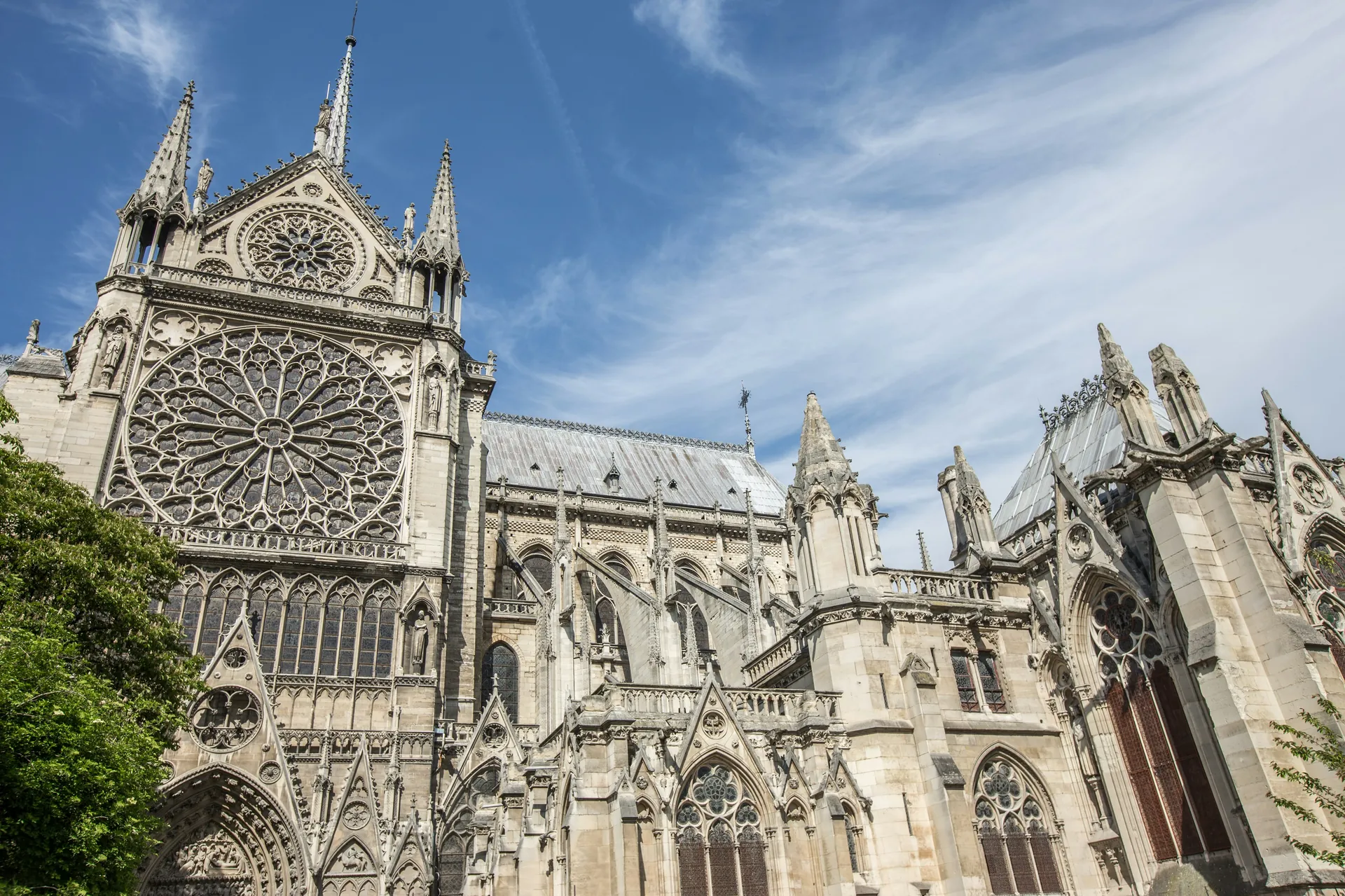
Notre-Dame de Paris remains one of the most remarkable active Gothic buildings. Constructed starting in 1163 under Bishop Maurice de Sully, the cathedral masterfully combines verticality and light. The flying buttresses supporting the nave are a testament to a technical feat that defied the laws of gravity from the 12th century onwards. The quadripartite vaults, formed by delicately sculpted ribs, carry a sacred space toward the sky where stone becomes a setting for light. The three large rose windows – north, south, and west – punctuate the facade and offer a play of colors that evolves throughout the day. Each one, designed according to a precise iconographic program, is a visual manifesto of medieval faith. The gargoyles and chimeras, stone reliquaries, dot the exterior galleries and celebrate the alliance of the fantastic and the sacred, giving the edifice a character that is both solemn and enigmatic.
Key Dates in the Cathedral's History
The history of Notre Dame reads like the story of a nation. In 1163, the foundation stone was laid, marking the beginning of Notre Dame's construction; in 1182, the nave began construction; around 1272, the main structure of the building was completed. The 14th century saw the addition of the Kings« Gallery. During the French Revolution (1789-1799), the cathedral was looted and renamed the Temple of Reason. Under Emperor Napoleon I, in 1804, it was the setting for his coronation ceremony, highlighting the building's political and symbolic role. The Second Empire (1852-1870) saw the intervention of Viollet-le-Duc, who rebuilt the spire and restored sculptures and stained glass. The Notre Dame de Paris fire in 2019 caused the spire to collapse and the loss of the original roof structure, nicknamed »the Forest.’ The solemn reopening in 2025 marks the latest chapter in a thousand-year saga, making Notre Dame, located at Notre Dame de Paris on the’Island of the City, the’a living treasure of memory belonging to UNESCO World Heritage.
The Zero Point of French Roads: Where It All Begins
On the parvis, facing the western facade, the Zero Point slab marks the geographical origin of French roads. This marker, carved in granite, reminds us that Paris is not only the political capital, but also the ancient center of the kingdom's and then the Republic's road networks. Distances to cities in the provinces are measured from this point, a discreet but powerful symbol of the city's place in French territorial organization. For centuries, travelers and pilgrims have contemplated it, aware that at this precise moment, their journey truly began.
The Evolution of the Parvis: From the Medieval City to the 2026 Development
In the Middle Ages, the parvis extended into a true urban agora, lined with shops, merchants, and temporary chapels. Under the Ancien Régime, fairs and markets were still held there, while the Revolution and the rise of automobile traffic in the 19th century transformed the square. Successive developments included roadways, taxi stands, and underground parking, at the cost of fragmenting the pedestrian space. Today, as part of the Cité's enhancement project, the parvis has regained its breathing room. Controlled greenery, discreet architectural lighting, and the elimination of motorized traffic have brought this historic parvis back to life. Scholars and visitors now wander across a calmed pavement, where one can appreciate the dialogue between stone and natural light.
The phoenix of the’Island of the City The restoration of Notre-Dame
The 2019 fire: a memento etched in memory
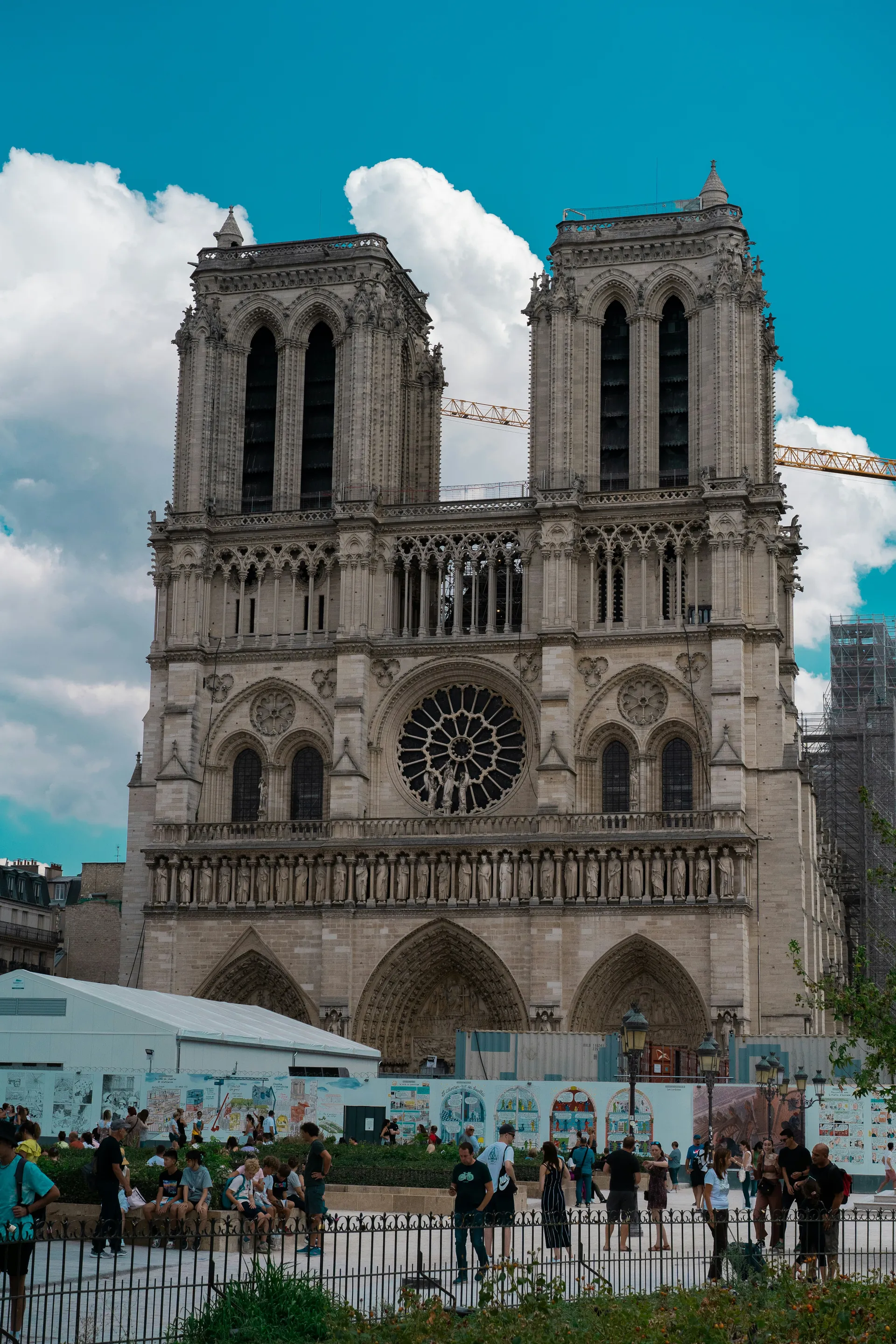
On April 15, 2019, the Parisian twilight was set ablaze by a catastrophe of unexpected proportions. A fire, likely originating in the roof structure, ravaged «the Forest,» the legendary medieval timber framing made of oak. This Notre Dame de Paris fire deeply marked the history of this emblematic UNESCO World Heritage monument. The spire designed by Viollet-le-Duc toppled, a witness to a damaged cathedral. Firefighters, anonymous heroes, managed to preserve the structure of the vaults and the western towers. The emotion stirred by this event transcended borders, reinforcing the importance of history and Gothic architecture embodied by this masterpiece.
The challenge of reconstruction and artisans
The heritage reconquest mobilized over 200 companies and art workshops. Carpenters, stonecutters, stained glass artists, sculptors, and engineers collaborated to restore every detail. This project provided an opportunity for fruitful exchange between traditional know-how and contemporary regulatory requirements. Ancestral techniques, such as mortise and tenon joinery or limestone chiseling, were reactivated. Engineers designed temporary scaffolding to consolidate weakened sections and plan the installation of discreet stainless steel reinforcements. Each stored stone block was strictly identified to ensure its original placement during reassembly. Master craftsmen were dedicated to identifying the same grain of stone and the same patina as the historical elements, ensuring a homogeneity of tone and material.
The rebirth of «The Forest»: the secrets of the new framework
The medieval framework, known as «the Forest» for the multitude of oaks it contained, has been rebuilt identically, but using carefully selected oaks from the Meuse and Sologne regions. Over 1,200 solid pieces of wood were cut, pegged, and assembled using medieval techniques validated by dendrologists and art historians. Each piece was selected by ONF (National Forestry Office) experts and hand-hewn with axes by master carpenters, respecting the wood grain for optimal density and resistance. The reconstruction of Viollet-le-Duc's spire, reinterpreted while respecting the original drawings, now rises again towards the sky. Concealed automatic watering systems and temperature sensors continuously monitor the wood's resilience, protecting the edifice against any future damage. Thus, the new framework combines authenticity with enhanced safety.
Stone carving and statuary: bringing lost details back to life
The restoration of the statuary, a pillar of Notre-Dame's visual identity, required the intervention of master stone sculptors. The gargoyles, chimeras, and statues on the portals were recreated based on existing casts, photographic archives, and 3D surveys from before the fire. Every eyebrow, every drape, every sculpted petal has been returned to its original orientation. The medieval grotesques, hybrid figures of humans and animals, were restored just as the 13th-century stonemasons had imagined them. Lime mortar was used for the joints to allow for natural stone respiration, ensuring increased longevity.
The latest advancements and the steps to come in 2026
The partial reopening of the edifice in 2025 marked a historic moment. The apse and the exterior sacristy regained their splendor thanks to the installation of the first new stained-glass windows, along with the restoration of the flying buttresses. In 2026, the completion of the phase dedicated to the chapels and upper galleries is planned. The program includes the reinstallation of the historic clock and the restoration of the mural paintings in the north transept chapels. The final scaffolding will be removed during the year, revealing a restored, vibrant silhouette ready to welcome pilgrims and lovers of sacred art once more.
A Visit to Notre Dame: What Not to Miss
The towers of Notre-Dame: a historical perspective on Paris
Ascending the towers, accessible only on foot under the guidance of a tour guide from Guides Tourisme Services, remains a rare experience. During this Private guided tour of Notre-Dame Cathedral, you will climb a centuries-old spiral staircase to reach the upper galleries. From this vantage point, the view stretches over the Seine, the Île de la Cité, and the blue rooftops of Paris. The bells, including the famous Emmanuel, ring beside you, testaments to a tradition that has marked each hour for centuries. You can also admire the sumptuous Notre-Dame de Paris rose window and discover the historical anecdotes that reveal the secrets of the’Island of the City.
The western facade: a portal rich with stories
The south facade and the Last Judgment portal form a veritable stone catechism. The sculpted archivolts depict the resurrection, the weighing of souls, and the salvation of the righteous. The side portals, dedicated to the Virgin Mary and Saint Anne, offer a more intimate iconographic journey. The column-statues of prophets and kings of France, repositioned during the 19th-century restoration and refined in 2025, speak of a medieval theology where temporal and spiritual power merge.
The Mysteries of Biscornet and the Secrets of the Île de la Cité
The legend of Jehan Biscornet, the presumed master craftsman of the western facade, fuels a mystery that spans the ages. It is said that the sculptor, accused of consorting with dark forces, is at the origin of gargoyles with demonic features. Whether this is a mere apocryphal tale or a testament to a medieval fascination with the supernatural, these anecdotes bring the stones to life. Île de la Cité, the historical crucible of Lutetia, remains dotted with Gallo-Roman remains and remnants of medieval ramparts, revealing a fragment of the original city beneath every flagstone.
The interior of the building: between spirituality and art
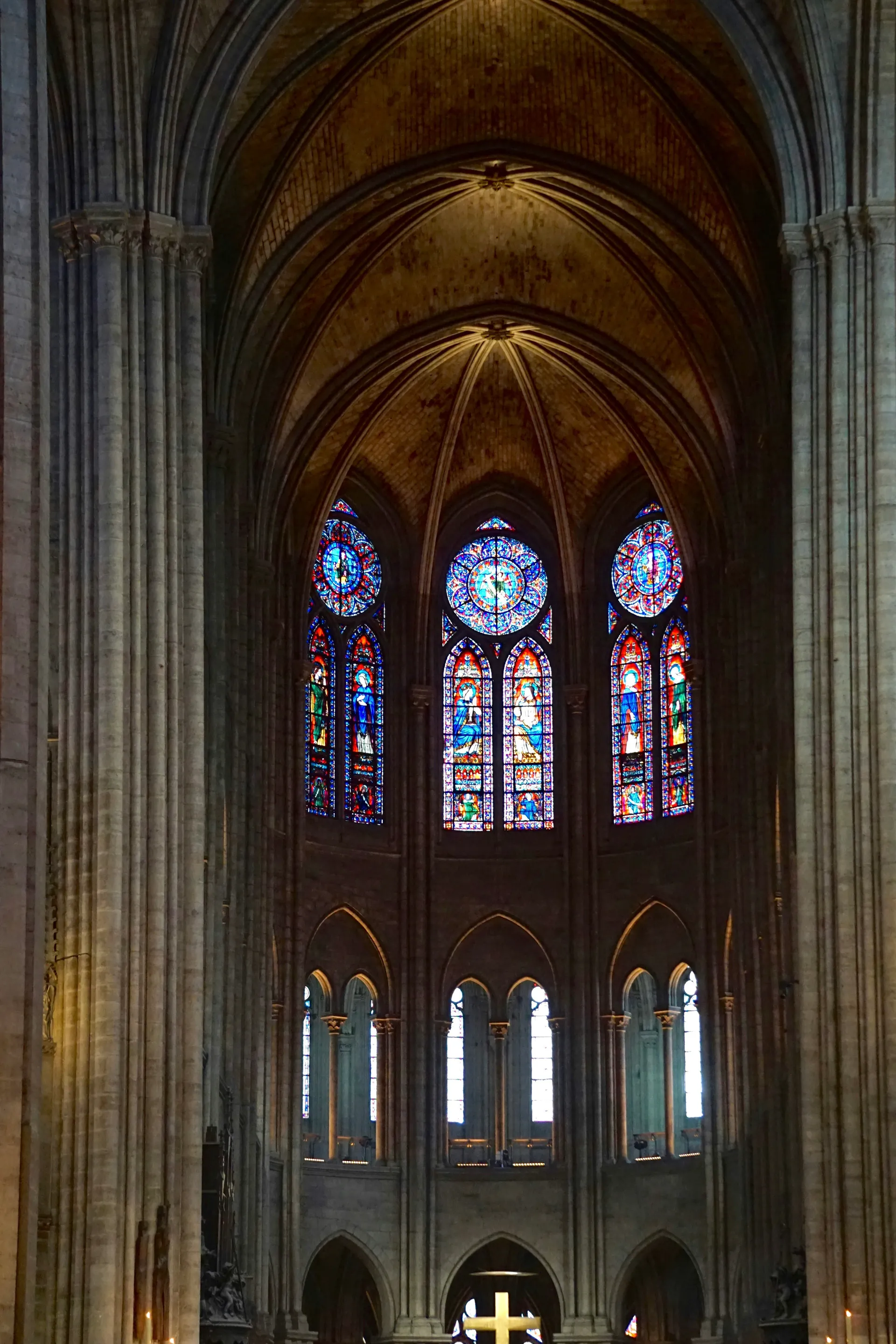
Inside, the naves unfold like a jewel box. The stained-glass windows, restored after the 2025 reopening, cast a colored light that caresses the pillars. The side chapels, dedicated to various saints, offer an architectural contemplation: volutes, colonnettes, and ogives intertwine to tell the story of faith in a thousand forms. The axial chapel, which houses the precious Crown of Thorns and the Holy Relics, is distinguished by its starry ceiling and its intimate sanctuary, sanctified by centuries of devotion. Whether for a mass at Notre-Dame de Paris or to experience the unique acoustics of this edifice, the interior remains a place of spirituality and sacred art of rare intensity.
The Crown of Thorns and the Holy Relics: a thousand-year-old treasure
Housed in a carved crystal reliquary, the Crown of Thorns rests at the center of a sanctuary framed by stained-glass windows illustrating the Passion. The fragments of the wood of the Cross, the nails, and the thorn pointing towards the sky are presented as relics of rare emotional intensity. Acquired by Saint Louis in the 13th century, these sacred adornments passed through Constantinople before reaching Paris. Their presentation, renewed for the 2025 reopening, benefits from a modern setting: sensors measure humidity and light, ensuring optimal preservation without detracting from their mystical perception. Pilgrims and history enthusiasts feel, on the threshold of the visible and the invisible, this direct link with the foundational events of Christianity.
The Cathedral Treasury Exhibition in the sacristy
The recently restored neo-Gothic sacristy houses the Treasury of Notre-Dame. In a refined display, reliquaries, chalices, and liturgical vestments are presented under regulated display cases. A series of explanatory plaques, featuring medieval iconography, draw the eye to ornamental details: enamels, filigree, and gemstones. These goldsmith creations, dating from the 14th to the 19th century, illustrate the evolution of taste and devotion through the ages.
The archaeological crypt: a journey beneath the foundations of Paris
Beneath the square, the archaeological crypt offers a dive into the layered history of Lutetia. Remains of Gallo-Roman baths, remnants of Merovingian ramparts, foundations of medieval churches, and conduits from the modern era are superimposed. Excavations help us understand how the city flourished around this sacred island. The hushed atmosphere of the crypt, under soft lighting, invites archaeological contemplation.
Stained Glass and Rose Windows: Luminous Works of Art
The Meaning of Medieval Stained Glass
Far more than simple decorations, medieval stained glass windows constitute a visual theology. The colored light, filtered through the glass, is perceived as a divine manifestation. The bays tell the stories of the lives of Christ, the apostles, and the saints, offering the faithful a true «bible in color.» Shades of blue, symbolizing the divine, and red, evoking the Passion, dialogue with rarer hues, such as emerald green and shimmering gold, reserved for celestial figures. Each panel is an iconographic program where symbolic rigor and artistic virtuosity unite.
The great south rose window: a symbol of geometric perfection
Suspended in the south facade, the great rose window unfolds into a network of circles, trefoils, and quatrefoils, forming a Gothic mandala. The central motif, dedicated to the Virgin, is surrounded by twelve compartments evoking the apostles, then by niches where prophets and angels stand side-by-side. The structure, designed according to calculations of force balance, rests on a network of cast iron mullions refined after the fire to improve their resistance. The south rose window embodies the union of sacred geometry and Christian theology, an image of an ordered and harmonious universe.
Restoring stained glass windows: when light rediscovers its colors
The restoration operations, concluded in 2025, involved the meticulous dismantling of each stained glass window. The master stained glass makers separated the glass panes, cleaned them with pure water, and restored the silver-yellow painted sections. The old lead cames were replaced with the original profile, while more efficient saddle bars now support the panels. Spectral analyses made it possible to re-establish the 13th-century palette with exceptional color fidelity. When the sun bathes the edifice, the cathedral is transformed, offering a kaleidoscope of reflections with rediscovered tones, like a colorful memory awakened after centuries of trials.
The organ of Notre-Dame de Paris and sacred music
A historic instrument with 8,000 pipes
The grand organ, a monumental instrument with nearly 8,000 pipes, symbolizes the alliance of architecture and music. The pipes, made of tin and copper alloys, some reaching several meters, are distributed across five keyboards and a pedalboard. Built in the 17th century, the instrument has evolved over the centuries, incorporating new stops and mechanisms to adapt to musical sensibilities. After the fire, each pipe was dismantled and restored at the Cattiaux-Chevron workshop. Following a microtonal overhaul, the organ regained its voice in 2025, capable of ranging from the deep breath of the trumpet to the delicate song of the harmonic flute.
Concerts and musical events during the 2025 reopening
To celebrate the reopening, a series of master concerts was organized, blending classical works, contemporary creations, and organ improvisations. The internationally recognized titular organists inaugurated this new musical era with a solemn mass in honor of the restoration, followed by recitals where the masterpieces of Bach and Duruflé will dialogue with new pieces, conceived specifically for the unique resonance of the building.
These musical events allow for a rediscovery of the power of the Grand Organ, a historic instrument with 8,000 pipes, whose restoration was one of the most complex projects. The unique acoustics of the nave, with its seven-second reverberation, offer an incomparable soundscape where each note seems suspended in history. It is a total sensory experience, where the vibration of the instrument blends with the majesty of the architecture to offer a moment of pure contemplation and emotion.
The nave's unique acoustics: an exceptional sonic setting
The nave of Notre Dame Cathedral in Paris currently generates a reverberation time of up to eight seconds on certain low frequencies, thanks to the combination of the height of the vaults and the dense stonework of the pillars. Acoustic engineers, consulted as early as 2013, digitally modeled the sound wave to anticipate the impact of restorations. Discreet micro-sensors constantly monitor sound quality, allowing for adjustments to microphone placement or sound diffusion during major concerts. This sonic halo, enveloping the listener, lends sacred music an almost ceremonial dimension, elevating each note into a bridge between earth and the divine.
Your tailor-made experience with Guides Tourisme Services
Why choose a private guided tour for the reopening?
Faced with the large influx of visitors, the private guided tour organized by Guides Tourisme Services offers a real escape. For the reopening of Notre-Dame de Paris Cathedral, you will receive a personalized welcome to explore architectural marvels such as the medieval “La Forêt” (The Forest) roof structure or the cathedral towers. The bilingual lecturer-guide, equipped with impressive knowledge, will enrich your experience with historical anecdotes and captivating stories, while revealing the importance of the artisanal know-how that contributed to the restoration of this UNESCO World Heritage masterpiece.
A personalized itinerary in Paris: from the Cité to the Latin Quarter
Your discovery isn't limited to the cathedral. Tourisme Services Guides develops a Itinerary designed around your interests. On foot, starting from the Cité, you'll explore Gallo-Roman ruins, cross the medieval alleys of the Marais, then reach the Latin Quarter to admire university cloisters. Each stage is punctuated by stops in old bookstores, breaks in private inner courtyards, and impromptu encounters with heritage historians. This narrative progression reveals the continuity of Paris, connecting eras and monuments through vibrant stories.
The comfort of a private driver for your transfers
Whether your stay begins at Paris-Charles de Gaulle or Orly, your chauffeur A driver will meet you outside the baggage claim area. This transfer from CDG airport will take you to your hotel or directly to your first visit. Onboard your premium vehicle, you will enjoy optimal comfort while your bilingual guide punctuates the journey with historical insights, mentioning elements such as the construction date of Notre Dame or its various restorations. This tailor-made service is part of a VIP Paris experience, combining luxury and cultural discovery in complete serenity.
The expertise of a bilingual tour guide
Guides Tourisme Services selects professionals holding an official tour guide license and fluent in French and several foreign languages. Their training combines academic rigor with the art of storytelling. Far beyond linguistic mastery, they prioritize an intimate, tailored dialogue capable of illuminating the technicality of stonework as well as the liturgical symbolism of stained glass. This lively narration, adapted to your interests, transforms the discovery of masterpieces into an artistic and historical conversation of rare elegance.
Comparison with Paris's other Gothic jewels
To highlight Notre-Dame's uniqueness, we have created a detailed comparative table:
| Building | Location | Construction period | Architectural style | Key features | Recommended approach |
|---|---|---|---|---|---|
| Sainte-Chapelle | Palais de la Cité | 1242-1248 | Rayonnant Gothic | Vertiginous stained glass covering 600 m², royal chapel | Guided walking tour |
| Basilica of Saint-Denis | Town of Saint-Denis | 1135-1144 (nave), 13th-15th c. (apse) | Early Gothic | Necropolis of the Kings of France, sculpted portals, complex vaults | Chauffeur Private until the basilica, then a walking tour |
| Notre-Dame de Paris | Island of the City | 1163-1272 (construction), restoration 2019-2025 | Classic Gothic | Reconstructed spire, millennial frame rebuilt identically, Crown of Thorns | Walk with a guide or chauffeur private |
Notre Dame Cathedral: Beyond Religion
A place of universal culture and hospitality
Besides its liturgical role, Notre-Dame has become a major hub for cultural convergence. Concerts, recitals, charity events, and tributes are organized there, demonstrating its influence beyond religious beliefs. Every pilgrim, curious visitor, or art lover can experience a moment of personal reflection there, regardless of their faith.
Notre Dame in Literature and Cinema: From Victor Hugo to the Present Day
Victor Hugo's novel, published in 1831, gave the cathedral unprecedented literary fame. Quasimodo and Esmeralda immortalized its towers and galleries, paving the way for film adaptations ranging from silent films to the 2022 feature film, which revisits the fire and restoration. In every era, Notre Dame reinvents itself on screen, reflecting the cultural and artistic concerns of its time.
The Influence of Notre Dame on World Art (Painting, Photography, Symphonic Music)
Romantic painters, modern photographers, and symphonic composers have all favored the cathedral as a subject. The soft morning light on the flying buttresses, the monumental silhouette at dusk, the reflections on the Seine: these are all motifs that have inspired artists and musicians. The Notre Dame school, a pioneer of medieval polyphony, continues to influence liturgical and contemporary music, weaving a bridge between centuries.
Conclusion
Notre-Dame de Paris, a Gothic masterpiece and witness to a thousand years of history, is being rediscovered today with renewed intensity. The 2025 reopening has breathed new life into the spire, timber frame, and stained glass windows, symbols of exemplary resilience. To experience this rediscovery in the best possible conditions, Guides Tourisme Services offers a private tour service, accompanied by an expert lecturer-guide and a private driver, so as to compose a journey at your pace and expectations. Each stone, each sculpture, and each organ note will then find their true dimension, in an elegant and personalized narrative. Contact us today the team of Guides Tourisme Services to create your tailor-made itinerary and immerse yourself in the epic of one of France's greatest monuments.