
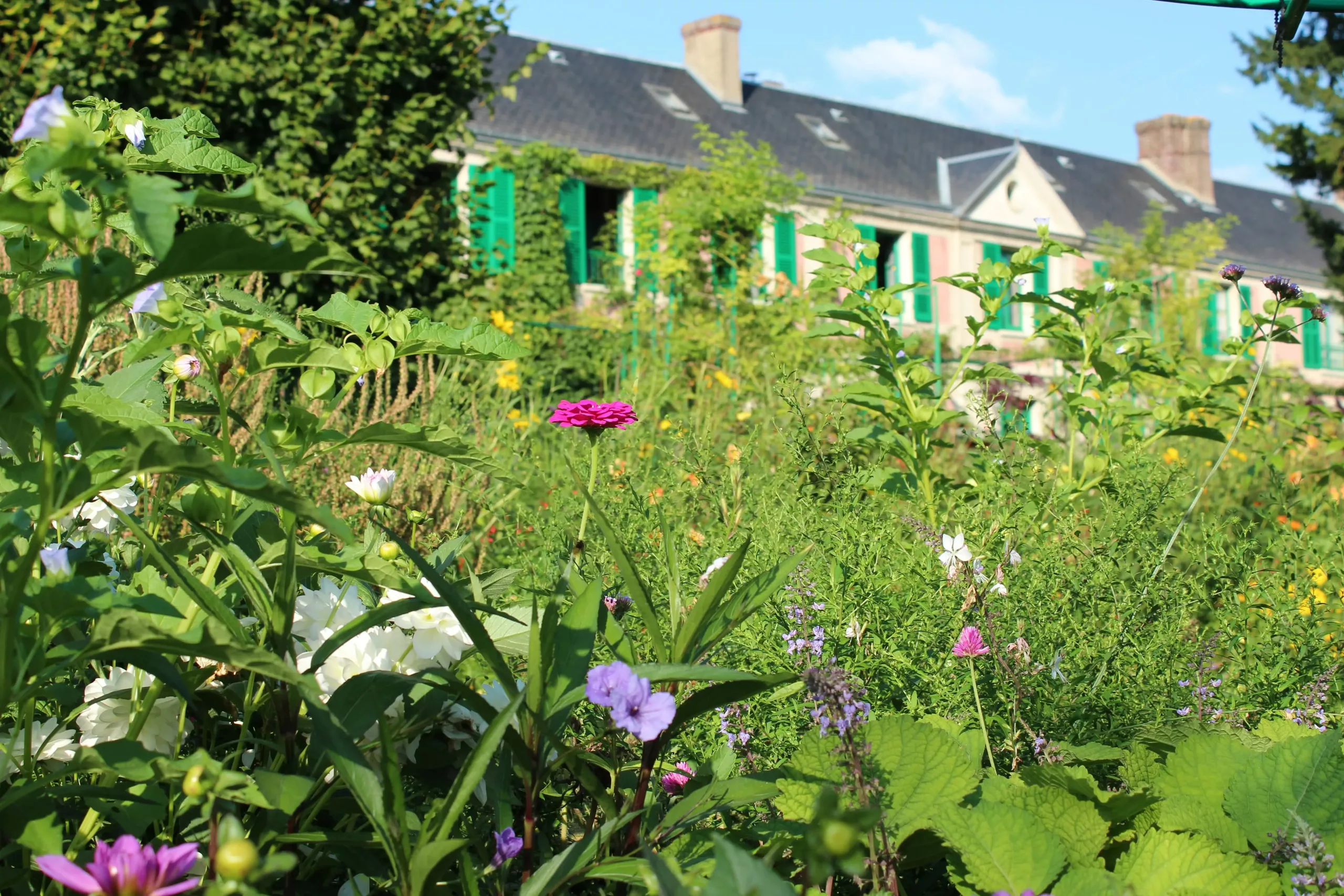
A few steps from the capital, where the Seine valley unfolds in shimmering meanders, lies Giverny. The home of Claude Monet from 1883 to 1926, this small Norman village, the original cradle of Impressionism, was transformed by his hand into a poetic space of absolute elegance. Today, a private access protocol, combined with a private chauffeur transfer along the peaceful riverbanks, offers a rare privilege: the opportunity to cross the threshold of the artist's home and immerse yourself in Claude Monet's garden, a vast palette of colors and a floral paradise. The visitor, invited to become a delicate spectator, glides over the threshold of the chrome-yellow dining room, admires the Rouen tiles of the kitchen, before exploring each microcosm that Monet so carefully composed, from the dim light of the studio to the dreamlike reflection of the water garden.
Giverny, a jewel enhanced by Monet's hand and eye
Giverny comes alive in this part of the French Vexin, shaped by light and morning mist, even before the brush comes to exalt its forms. Far beyond its fame as an exceptional garden, this place symbolizes the union between the Norman terroir and Japanese art, with its inspirations coming from the gardens of Kyoto. A landmark for American Impressionists and a field for chromatic experiments, the village became home to painters fascinated by the Master's audacity. Between the study of Ukiyo-e prints and the quest for an atmospheric perspective envisioned as a score of light, everything converges here to offer a narrative where flora, architecture, and sky converse in a suspended harmony.
The emergence of an artistic sanctuary and the American colony
In 1883, Monet's silhouette appeared at the threshold of his home, inaugurating the framework of the studio and beginning the writing of a major chapter in art history. Very quickly, his aura radiated throughout the entire village. Thanks to Parisian salons and circles of enthusiasts, painters from the United States rushed there, seeking to capture the alchemy of this changing light. They settled in discreet, charming vacation spots, absorbed the Impressionist touch, and forged a direct link between Honfleur, Giverny, and New York.
The American colony, under the patronage of avant-garde patrons, constituted a living laboratory for mutual influence. Their canvases, like those of John Leslie Breck or Theodore Butler, exported French Impressionism across the Atlantic while hybridizing it with typically North American naturalistic touches. This influence endures in the museums of Boston or Chicago, whose early Impressionist collections owe much to the relationships fostered here.
In the workshops lining the road to Vernon, creation unfolds like a new canvas: dense colors, more vibrant brushstrokes, a total commitment to capturing the moment. Giverny transforms into a crossroads where the creative act is reinvented in a transatlantic surge. The walls of these studios hold the imprint of sketches, the grey nuances of rainy mornings, and the sunny impasto of late summer.
This sanctuary that developed around Monet not only generated a microcosm of artists, but also established an international network of collectors, critics, and aesthetes. With each painting sold, the light of Giverny spread, revealing the house, the pond, and the Japanese Bridge in a new light, fueling a circle of enthusiasts dedicated to the memory of the place.
Claude Monet's Enduring Mark on the French Vexin
Before Monet, Giverny was merely a Norman village with understated charm, a constellation of grey houses and modest farmlands. Monet transformed it into an orchard of sensations, which he orchestrated with plays of mass, hue, and transparency. By opening the ground-floor windows, he invited the landscape to enter each room. Thus, the dining room, saturated with chrome yellow, receives the first rays of dawn, while the bedroom with purple drapes captures the mystery of twilight.
The French Vexin, a stage for his observations in the rain or under stormy skies, became his life-sized research notebook. He studied atmospheric perspective along the hillsides, noted the effects of mist on the hills, and worked to coordinate the palette of the sky with that of the meadows. Giverny transformed into a permanent laboratory where light breaks down like an infinite prism.
Monet's influence is not limited to the visual: it has sparked the creation of contemporary studios and artist residencies dedicated to the dialogue between painting and landscape. The paths he walked now attract painters and aesthetes, each seeking to capture the echo of his gaze. The valley stretching beyond the estate has retained the vibration of his steps and his hesitations before the mist or the low-lying sun.
The residence, managed by the Claude Monet Foundation, stands as a living conservatory. The rooms were restored by Gérald van der Kemp, under the patronage of the Rockefellers. The rigor of this restoration, inspired by the artist's notebooks, preserved the original colors and the spatial volume, thus restoring a domestic scene faithful to Monet's initial intention.
Patronage and the Renaissance: The Legacy of the Rockefellers and the Terra Foundation
In 1977, under the impetus of Gérald van der Kemp, a decisive chapter opened for the estate, then marked by the ravages of time. This masterful rescue, made possible by the legacy of Michel Monet to the Institut de France, was based on the vision of great American patrons. Walter Annenberg, alongside the Rockefeller family, orchestrated the rehabilitation of the house and the renaissance of the gardens, while the Terra Foundation for American Art contributed to establishing the site within a dynamic of excellence in conservation.
It was during this period that the methodical restoration of the Japanese Bridge was carried out. The original, weakened timbers were replaced with oak from high-stemmed trees, selected for its durability and worked using traditional expertise. This intervention restored the bridge's original lightness while ensuring its longevity. Private patronage emerges here as a model for preservation, uniting scientific rigor with a love for the landscape.
The Rockefeller's commitment restores the house to its former soul: the wallpapers are recreated identically from period fragments, the shutters regain their famous «Monet green,» and the dining room rediscovers its 1895 chrome yellow splendor. The Claude Monet Foundation meticulously oversees every nuance, from the selection of rare horticultural species to the precise color of the facades.
Thus restored, the estate is unveiled during a guided tour with a GTS guide. One then discovers the gardens in their purest expression, where creation and conservation dialogue in harmony. Giverny, through this renaissance, becomes a suspended space once more, faithful to the memory and spirit of Claude Monet.
The Master's Intimacy: The House and Gardens as a Total Work of Art
The thousand-colored residence: between chrome yellow and Rouen blue
The facade of Monet's house displays a vibrant palette, fluctuating between the brick pink of the walls and the brilliance of the woodwork. The painter adorned his home with a bold chromatic attire, breaking free from conventions to celebrate color at every angle. The famous shutters, an iconic green with a muted patina, frame the windows like open frames onto the landscape.
Inside, each room is presented as a learned composition of textiles, objects, and furniture. In the bedroom, a wall covered in small floral motifs dialogues with the water lilies visible through the window. The curtains, made from period patterns, still bear the subtle marks of successive restorations, where color retouching was used to respect the fidelity of Monet's colors.
The kitchen, with its walls adorned with hand-painted Rouen tiles, serves as a daily masterpiece. The faience tiles illustrate flowers and fruits, while the large glazed oak cabinets and polished copper utensils create a setting that is both picturesque and functional. This is where the famous lunches were concocted, served at the Master's table, in the company of Renoir or Clemenceau, around the renowned «Vert-Vert,» a spinach cake whose surprising color and perfect geometry testified to Monet's aestheticism, present even in the art of the table.
With every step, with every glance, the house tells the story of a life conceived as a canvas. The volumes are arranged so that light circulates, colors so that they vibrate, and each object so that it fits into a global harmony. This residence thus offers a rare testament to an art of living where architecture, decoration, and the pleasures of the senses merge in a single creative impulse.
The Workshop of Giverny: a sanctuary of creation and Great Decorations
At the far end of the garden, a vast building with tall glass panes opens to the sky. It is there that the Grandes Décorations, those monumental panels now admired at the Musée de l'Orangerie in Paris, came to life. In this studio, northern light filters through powerful structures, diffusing a constant clarity, essential for the study of the subtlest nuances.
There, Monet unfurled his enormous cycles of canvases where sky and water merge. It was here that his compositions of Water Lilies, presented in majestic triptychs, took their first form. Each panel was adjusted, turned, repositioned, until the artist deemed the transition between the delicate azure of the sky and the mirror-like depth of the water to be perfect. It was in this space that his brushstroke became liberated, tending towards an abstraction that would revolutionize 20th-century painting.
The interior walls still bear the traces of protective coverings, paint drips, and accidental smudges. It is a living space, where creativity is sometimes focused on the detail of a hollyhock, and sometimes on the articulation of a willow branch. The studio is not limited to the production of paintings: it is a laboratory of refinement, where Monet assembles, decomposes, and reconstructs nature as one composes a visual score.
In this setting, visitors can gauge the magnitude of this obstinate quest. The very ground seems to bear the imprint of the patiently crafted pigments and mixtures, a testament to the Master's perseverance in the face of light's complexity. To enter here is to traverse a vibrant fragment of art history, where Monet's gaze definitively embraced eternity.
Le Clos Normand, a botanical symphony through the seasons
Around the bend of the house, the visitor finds themselves in the Clos Normand, a floral eden that would be pointless to explore without grasping the pictorial dimension of its design. Monet, as a pioneer, orchestrated the flowerbeds there as one places brushstrokes on a palette of colors. Azaleas mingle with deep-toned irises and agapanthus, while dahlias echo peonies in a play of delicate chromatic resonances. Flower-laden arches, adorned with climbing nasturtiums, frame each path, amplifying the impression of a living painting.
Each pathway, punctuated by arches of old roses, offers a curated perspective, an angle that seems already composed for the artist's easel. The carefully coordinated bands of color create vibrant contrasts: the scarlet tulips of spring stand against the immaculate whiteness of spring corollas, while the lighter blooms echo the subtle shades of the foliage.
Each year, Monet made master adjustments: he observed the blooms, noted color shifts, and sought the saturation or softening of each hue. His botanical knowledge was the foundation of his art: he knew that daylilies only unfurl their corollas in mid-June, that wisteria reaches its peak in May, and that azaleas blossom as early as April, even before the multicolored tulips herald the renewal. These seasonal flowers formed a constantly transforming botanical architecture, turning the Clos Normand into a total work of art.
This floral symphony unfolds like a visual opera: the melody of bulbs in the opening, the cadence of asters at the end of the season. With each visit, the scenery shifts and offers a constantly renewed portrait, where horticultural cultivation fades to give way to pure artistic expression.
The Water Garden: Celestial Mirror, Poetry of the Japanese Bridge and Influence of Kyoto
At the end of the Clos Normand, a discreet door opens onto the water garden, an intimate sanctuary shaped from marshland. Claude Monet diverted a branch of the Epte, the Ru, to create this basin and introduced water lilies, aquatic flowers that became the main subjects of his iconic works, such as the Water Lilies series. The water serves as a celestial mirror for the clouds, weeping willows, and irises. This garden, with its Japanese Bridge and plantings inspired by the gardens of Kyoto, seems suspended between reality and artistic dream.
Above this body of water stands the Japanese Bridge, a true visual flourish. Inspired by Ukiyo-e prints, it serves as a frame for the gaze, an axis that structures the spatial composition. Its delicate structure, made of jade-green painted wood, is entwined with wisteria and ivy, whose floral cascades seem to invite the visitor to step into the painting itself.
Monet's fascination with Japanese culture wasn't limited to the shape of the bridge. He introduced bamboo, sapphire blue irises, and designed the banks according to principles borrowed from Kyoto gardens: layers of vegetation creating depth, asymmetrical arrangements, and breaks in perspective designed to surprise the eye. Here, each step alters the perspective, each glance composes a new image.
The pond, bordered by water lilies with tender green foliage, offers a continuous echo to the canvases it inspired. The reflections, the anchor of the series "The Water Lily Pond: Green Harmony," appear and disappear with the wind and light. It is a space where meditation becomes observation, where the rustling of leaves rivals the silence of pigments.
Dream Engineering: Monet's Hydraulic and Horticultural Genius
The diversion of the Epte River and the administrative battle for the water lily pond
In 1893, Monet embarked on a project of rare complexity: diverting an arm of the Ru, a small tributary of the Epte. He acquired a plot of land on the other side of the railway tracks, had an initial basin dug there, before considering tripling its surface area. This project aroused the concern of neighboring farmers, worried about the quality of the water for their crops, thus triggering a veritable administrative battle with the prefecture of the Eure.
Despite the reservations, the artist won his case by surrounding himself with hydrology experts and engineers. He installed a sophisticated network of discreet intakes and channels, designed to feed the basin without reducing the flow to the fields. This system, validated by a civil engineering expert, finally received the definitive approval of the prefect, sealing the birth of the Water Garden.
This complex system of valves, natural filters, and underground pipes remains in place today. It ensures clear, sediment-free water, essential for the shimmering surface Monet sought for his Water Lilies. Maintenance, carried on by gardeners who have inherited this know-how, constantly ensures the fragile balance of this ecosystem with unfailing precision.
This shadow engineering was the indispensable condition for the blooming miracle. The water lilies don't float by chance: they are supported by a calibrated hydraulic system, where human intervention is so subtle it never seems to disturb the wild and natural character of the place.
The Art of Atmospheric Perspective: Composing the Garden as a Living Canvas
Monet transforms his garden into a three-dimensional pictorial composition, multiplying the planes to create a vibrant atmospheric perspective. He placed the Japanese Bridge diagonally to break the symmetry, created elliptical banks, and planted clusters of water lilies at different intervals, so that the eye travels through the space as one discovers an impressionist painting.
Each season offered its variation: spring highlighted the lightness of primroses, summer the exuberance of dahlias, and autumn the orangey softness of asters. Monet tested the effects of mist and dew, choosing the hours when oblique light emphasized contours and intensified colors. Thus, he composed the garden like a shifting canvas, whose interpretation varied according to the moment.
The atmospheric perspective, which he already practiced in his Vétheuil or Sky series, finds a tangible continuation here. The stroller's eye wanders through backgrounds of bamboo, willows, and bushes, before returning to the horizon, sometimes suspended in mist, sometimes pierced by a ray of sunshine. It is a learned interplay of retreat and advance, stimulated by nature and tamed by the Master's hand.
The art of directing the gaze is not limited to plants: it also relies on the gradation of water surfaces, the curve of bridges, and the seemingly fortuitous alignment of a willow branch. Each framing, each perspective, is the result of an artistic intention. As visitors explore the Water Garden, they discover an aesthetic where reality is permanently tinged with the scent of painting.
The Museum of Impressionisms: The Heritage of a Transatlantic Dialogue
Exceptional exhibitions and a dialogue between French and American Impressionism
Nestled near the Baudy Farm, the Museum of Impressionisms highlights the ongoing exchange established in the late 19th century between French and American artists. Temporary exhibitions showcase major works by Monet, Renoir, and Pissarro alongside paintings by American Impressionists such as Childe Hassam and Joseph DeCamp. Contrasting palettes, a more pronounced use of shadows, or the presence of human figures sometimes stand against pure landscapes, revealing how Impressionism across the Atlantic broke free from its models to forge its own modernity.
The curators, in a desire for accuracy, ensure that each work is cited by its exact title: Water Lilies: Green Harmony, Interior at Giverny, Snow Effect in Vétheuil. They avoid grand, overused words, opting instead for historical precision and a nuanced analysis of influences. The visitor thus moves through a space where dialogue is embodied by the sole force of the arrangement of the paintings and the narrative they create.
Each room offers controlled lighting and subtle color correction to restore the original artist's touch. The soberly toned walls highlight the impasto, variations in pigment density, and the evolution of gesture from one medium to another. The understated labels indicate the date, technique, and origin.
This institution, born from a local association and the support of American patrons, continues the mission of extending the conversation inaugurated at Monet's table, with Renoir, Mary Cassatt, or Degas. The museum invites visitors to grasp how pictorial emotion was transmitted across the Atlantic, in a continuous exchange of skill and sensibility.
The transmission of artistic emotion and the passion for Ukiyo-e prints
The museum walls also host a collection of Japanese Ukiyo-e prints, illuminating the fundamental role these engravings played in the Impressionist movement. Monet himself collected these polychrome sheets, fascinated by their use of line, their fragmentation of landscapes, and their suggestion of movement. The prints by Hokusai and Hiroshige, displayed on the upper floor, demonstrate how much they inspired the composition of gardens, the structure of atmospheric perspectives, and the internalization of motifs.
The emotion they evoke arises from their apparent simplicity: a sketched tree trunk, a captured veil of rain, a wave frozen at twilight. The Impressionists adapted these lessons by modulating their brushstrokes, freeing up contours, and adopting asymmetrical compositions. The museum conveys this lineage with a sober exhibition design, where each print seems to echo a painting displayed nearby.
The displays recall the import routes of these leaves, traveling from Japanese ports to Parisian art dealers. The institution emphasizes the importance of these cultural exchanges, revealing how a centuries-old art form fertilized the European avant-garde, which in turn inspired American artists eager for visual innovations.
As the visitor walks among the prints and canvases, they perceive this shared emotion: a tremor before an isolated branch, a light softened by snow, or a silhouette crossing a bridge. Through this juxtaposition, the museum reactivates the aesthetic dialogue initiated over a century ago, inviting the eye to embrace the distant and the near, the intimate and the expansive.
Giverny Beyond the Garden: An Aesthetic Pilgrimage in the Seine Valley
The Church of Sainte-Radegonde and the Memory of the Monet Family
Far from the hustle and bustle of the gardens, the Church of Sainte-Radegonde offers a haven of reflection. This simple Romanesque building nestles in the greenery, next to the Monet family crypt. A plain stone, surrounded by flowers, marks the artist's grave. Beside him rest his loved ones, as well as Gérald van der Kemp, the passionate craftsman behind the estate's restoration.
This site, registered with the Bâtiments de France, exudes a quiet charm. Beneath the low vaulted ceilings, the semi-darkness encourages contemplation. Through the modest stained-glass windows, one can glimpse colored fragments, the first hints of a Norman palette. As the visitor approaches the crypt, they recall the unwavering friendship between Monet and Clemenceau, a union that allowed the Water Lilies series to come to life.
In the cemetery, Monet's tomb is surrounded by more anonymous graves: those of his neighbors, his models, or his passing friends. The simple harmony that connects these fates reveals the painter's deep roots in his community. Visiting the church is to understand that Monet, despite his international fame, wanted his legacy to be part of the continuity of this land.
A discreet plaque commemorates the memory of British aviators. fell during World War II, thus crossing great history with local memory. The pilgrim is invited to measure the collective dimension of Giverny, a land where artistic creation ends up merging into the silence of stone and landscape.
The Former Baudy Hotel: A Historic Stroll in the Footsteps of Renoir and Sisley
A few steps from the house, the sign of the former Hôtel Baudy resists time. Initially a simple café-grocery, the establishment became the meeting point for American artists in 1886, to the point of being nicknamed the «Hôtel des Américains.» Renoir, Sisley, Cassatt, and Pissarro came there to find modest rooms or makeshift studios in the courtyard. The walls, bathed in the morning light, seem to have retained the patina of brushstrokes and sketches scribbled on a tabletop.
The Baudy brothers enlarged the inn, set up workshops in the attic, and even installed a ballroom. Guests would have tea overlooking the valley, study the changing sky, and share secrets and culinary recipes. In this parlor, where earthenware dishes mingled with the scent of flowers picked from the Clos Normand, essential chapters of the Impressionist movement were written.
Today, the hotel, now a guest restaurant, retains the atmosphere of the era. The frescoes on the walls, the heavy curtains, the oak plank flooring, all evoke the artistic fervor. The stroller can still imagine Renoir correcting a sketch, Sisley adjusting his easel, or Cassatt discussing light with Monet during a lunch accompanied by the famous «Green Cake» and local cider.
The former Baudy Hotel is a true cabinet of curiosities: abandoned studio objects, worn paintbrushes, and glazed pottery tell a forgotten story. Strolling through this place is like stepping into a setting created for the pleasure of creation and conviviality, a space where art is practiced above all as a way of life.
The Seine's viewpoints and hillsides: hiking in the footsteps of painters
Leaving the village for its hillsides means stepping off the tourist map and entering a landscape of folds and creases, of "drawer" villages and secret hamlets. The paths, laid out on ancient rural routes, climb to natural viewpoints offering a panorama worthy of a Monet or Sisley painting. The silver ribbon of the Seine unfolds between meadows, groves, and wooded hills.
Each point of view reveals a pattern that may have inspired one of the series of «Côtes de la Seine.» Half-timbered houses punctuate the perspective, their wooden beams catching the light and creating an architectural rhythm. The riverbanks, edged with poppies or ripe wheat, offer a delicate weave of colors, rooted in rural tradition.
The trails, ranging from a few kilometers to a full day’s hike, allow visitors to explore a landscape of great beauty. Hikers occasionally come across rudimentary lookout points, stone benches overlooking the void, and orientation tables that name the hills. Even the air itself, filled with the scent of damp earth or floral fragrances, becomes part of the canvas that the painters once depicted.
These vanishing lines, these shifts in tone, these silvery reflections on the water – this is the living landscape that each walker recomposes in turn. On these wilder hillsides, the experience of Giverny continues and opens towards other horizons, not to dissolve the memory, but to amplify it through the act of walking and observing.
The art of traveling with serenity: your privileged immersion by GTS
The Confidential Approach: Joining Giverny via the Seine Valley
To access Giverny with peace of mind, GTS offers personalized assistance. The transfer from Paris takes peaceful routes along the Seine, thus avoiding congested routes. The route passes through authentic villages and Overlooked viewpoints, offering a gradual introduction to the landscape.
Our service anticipates peak hours and the best lighting for your visit. The driver, an expert in the region, adjusts their pace to let you appreciate the valley, creating a gentle transition to the universe of Claude Monet.
GTS takes care of all the arrangements: organizing the visit and providing a specialized guide to ensure total immersion from your very first steps in the garden.
This journey is not a simple transfer, but a true prelude to your discovery. Through the hills and forests, this approach favors slowness and observation to prepare you for the emotion of the place.
Rhythms and Lights: Choosing the Moment of Grace for a Private Tour
In Giverny, time unfolds according to chosen moments: the coolness of the morning or the softness of twilight. GTS masters these hourly variations to optimize the encounter between light and the gardens. At dawn, the water lilies awaken and the Japanese Bridge is revealed in a golden clarity, offering a serenity conducive to emotion.
The blue hour, when shadows lengthen, allows one to grasp the full fading of colors. The hollyhocks, wisteria, and irises then offer a poetic and silent atmosphere. Our guides can accompany this moment with insights on the influence of Japanese prints or the role of perspective, making the visit as instructive as it is sensory.
The pace of the visit is essential: it allows you to capture the spirit of the place without being rushed. A break in the Rouen tiled kitchen offers an immersion into Monet's daily life. It evokes Norman gastronomy, dear to the painter, and his famous Green Cake. For GTS, the culinary discovery and the artistic itinerary are part of the same convivial experience.
Finally, we propose an alternation between the interior of the house and escapades in the gardens. This dialogue between colorful architecture and orchestrated nature gives meaning to every moment of the visit, conceived as a nuanced variation for the discerning eye.
The Strategic Itinerary: Village Secrets and Invisible Logistics
Beyond ownership, GTS unveils Giverny from a new perspective. From Claude Monet street to the small market square, each house and each shopfront tells a part of the village's history. The colorful facades, artisanal signs, and discreet galleries make up the fabric of a village where art is woven into everyday life.
Your travel partner will point out the best stops: a farm-to-table grocery store, a café offering prestigious cider, or a ceramic workshop. We can also book a table at a tea room to enjoy the Norman biscuits that Monet loved. This attention to detail is part of our invisible logistics, designed to transform a simple visit into a complete experience.
Finally, the return journey is organized around a last look at the valley. The car heads down a path lined with poplar trees, skirting fields of rapeseed or poppies, to allow you to capture one last image. GTS then fades away, leaving you with a fragment of emotion, like a mental watercolor of this day.
The aesthete's experience: local flavors and prestigious retreats
Gastronomy and recipe books: the artist's table and the famous Green Cake
Normandy cultivates an art of dining that echoes Monet's gardens. Among the local specialties is the Gâteau Vert, a dessert created by the painter's wife. Its color is reminiscent of water lilies, and its delicate balance perfectly illustrates this dialogue between nature and indulgence.
When Monet received his friends, such as Renoir or Clemenceau, lunches were true moments of creation. The painter's recipe books are full of recipes: omelets with fresh herbs, veal medallions with cream, or wild mushrooms. Every detail counted, from the choice of glasses to the arrangement of the tablecloth, to extend the visual harmony of the garden to the table.
Today, some local chefs draw inspiration from this heritage to recreate the menus of yesteryear. They compose their dishes like works of art: a scallop carpaccio or finely arranged sea herbs, all paired with a premium cider. Every bite evokes the freshness and elegance of an Impressionist painting.
Upon request, GTS can integrate these enjoyable steps into your itinerary. These meals allow you to relive the conviviality that animated the Giverny artistic colony.
The Norman art of living: terroir tastings and premium cider
Normandy is a land of flavors that ideally complements the Giverny experience. In the orchards of the Seine Valley, cider remains an exceptional product. Carefully crafted, this golden-hued beverage offers a balance between liveliness and roundness, reminiscent of the freshness of the surrounding landscapes.
GTS can organize, upon request, discovery sessions focused on local specialties. A stop at a village inn or a craft producer allows you to taste Norman classics: raw milk cheeses like Camembert or Pont-l'Évêque, artisanal charcuterie, and farm-made apple juice.
The local gastronomy here is a natural extension of the visit. The fruity notes of artisanal cider or the sweetness of an apple pastry echo the colors and light of the gardens. Each local product is an invitation to prolong your stroll through taste.
Exceptional Residences: extending the enchantment of an authentic stay
Giverny is not just a few hours' visit. For those who choose to linger, the village reveals a more secret side once the Foundation's gates are closed. It is in this peaceful atmosphere that one can truly grasp the soul of the place, far from the tourist bustle.
The village is home to characterful residences, old manor houses, or restored farmhouses, which allow for a prolonged immersion. These charming retreats, nestled in walled gardens or orchards, offer a relaxing stopover where time seems to have stood still.
Enjoying an evening in Giverny is to treat yourself to the luxury of silence and the changing light over the Seine valley. It's an opportunity to savor local cuisine in a village inn or simply wander through deserted lanes. This travel extension transforms a simple excursion into a timeless interlude, bringing you closer to the spirit of the painters.
Conclusion
Imagine an itinerary where each step invites emotion: the discreet glide of a car along the meanders of the Seine, the peaceful arrival at a house with bold colors, and the discovery of a studio where giant canvases seem to dialogue with the landscape. In the garden, orchestrated like a floral symphony, time stands still to give way to contemplation and the flavors of an authentic region.
Giverny is a universe where life resembles a painting. Through this approach, GTS invites you to rediscover this mythical place by opening your senses to new visions. We ensure the fluidity of your journey so that each moment remains a living memory, vibrant with Monet's nuances.
To transform your next getaway into an exceptional moment, contact GTS. Let our expertise assist with your project and discover how we can bring your Norman dream to life, ensuring your journey is meticulously planned at every step.
FAQ: Prepare Your Giverny Experience
What are the best galleries on Rue Claude Monet in Giverny? Visit Claude Monet Street is the artistic heart of the village. In addition to the renowned Foundation, be sure to wander among the various local shops. Among the best galleries on Claude Monet street in Giverny, people often remember the Demarez Art Gallery for its luminous works, or the small workshops of independent artists lining the road leading to the Museum of Impressionisms. It's the ideal place to bring back an authentic souvenir away from the usual souvenir shops.
What is the best time to visit the gardens? Claude Monet's estate evolves with the seasons. Tulips and azaleas mark the spring, while the famous water lilies are at their peak between July and September. GTS advises you on the best times of day to enjoy the light so dear to the Impressionists.
How does the trip from Paris with GTS go? The experience begins as soon as you are picked up by your private driver. The journey (approximately 1 hour and 15 minutes) is designed as a peaceful prelude through the landscapes of the Seine Valley, far from the hustle and bustle of public transport, to arrive in Giverny in the best possible frame of mind.
Do you accompany visitors inside the estate? GTS handles all aspects of your trip's logistics and can provide a specialized guide. This guide will share insights into Monet's work, the history of the house, and the unique structure of the gardens.
Can we schedule a lunch break during the excursion? Absolutely. Giverny offers places steeped in history like the’Old Baudy Hotel. Your driver or guide will be able to point you to the best spots in the village according to your desires, in order to extend this immersion into the Norman art of living.
Which exhibition to see in Giverny right now? To enrich your visit, be sure to discover a Expo à Giverny within the Museum of Impressionisms. These temporary events offer a fascinating glimpse into the village's artistic heritage.