
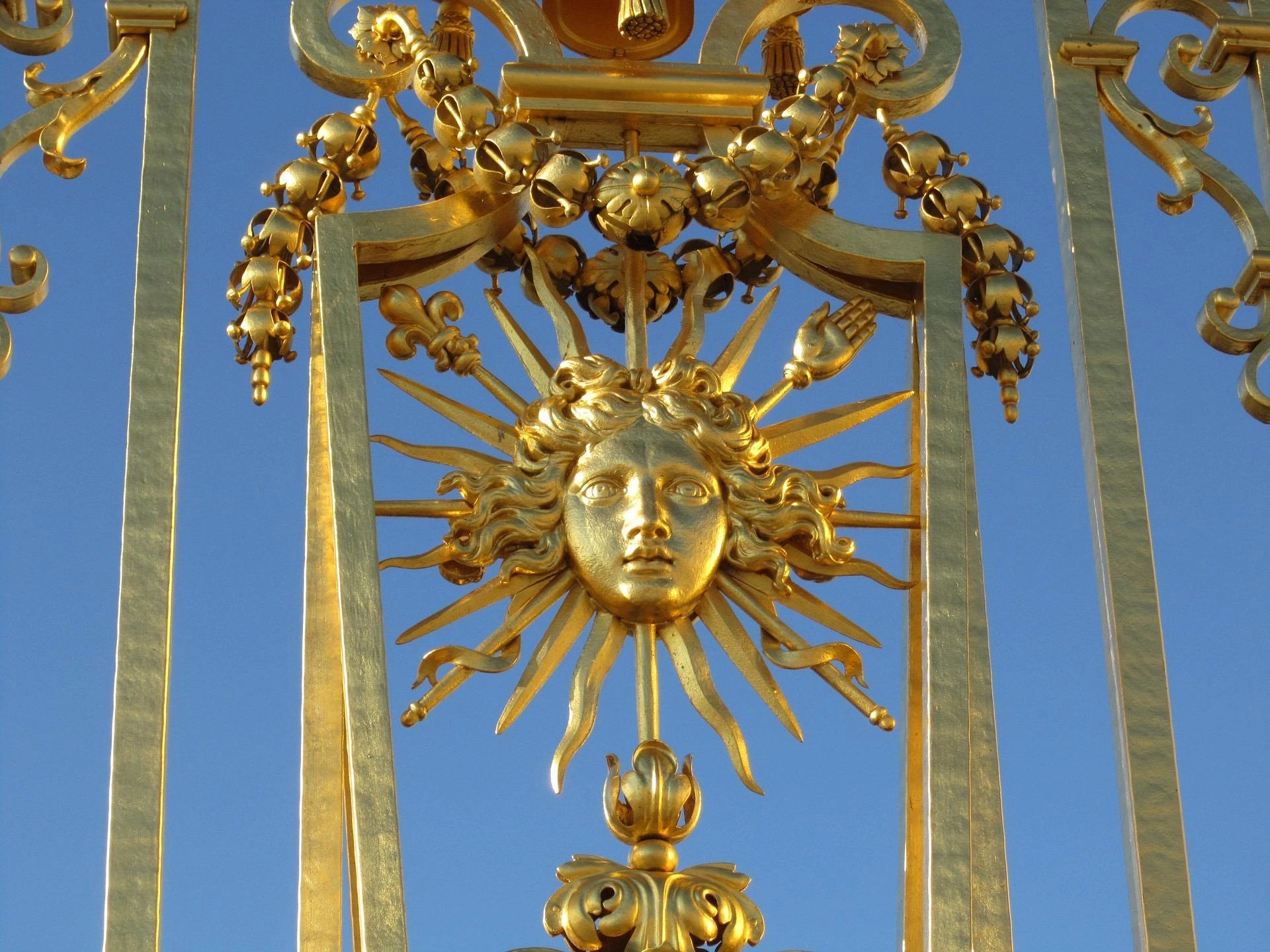
When one speaks of the Palace of Versailles and its gardens, one immediately thinks of an emblematic ensemble of France, where architecture, nature, and history blend in majestic harmony. Located about thirty kilometers from Paris, the Versailles estate covers over 800 hectares, including the palace, its French gardens, the park, the Grand and Petit Trianon, as well as the Queen's Hamlet, a veritable bucolic retreat where the itinerary enchants visitors seeking a change of scenery. For families, a Guided tour of Versailles for children constitutes a fun and engaging way to discover history and iconic landmarks.
Designed in the 17th century under Louis XIV, the site showcases both royal power and the modernity of the era, with Baroque facades like that of the Hall of Mirrors, masterful perspectives imagined by gardener Le Nôtre, and a host of architectural gems such as the groves or fountains of Versailles. Among these masterpieces are the famous basins – the Latona Basin, the Apollo Basin, and the Neptune Basin – which integrate perfectly into the plan of the Gardens of Versailles. Today, the palace and gardens form a place of memory, a spectacular visit, and a grandiose promenade, featuring the pink marble of the Grand Trianon, musical waters, and fascinating exhibitions.
At the Origins of Versailles: From Hunting Lodge to Royal Apotheosis
Louis XIII's modest relay
In 1623, Versailles was still just a small, isolated village in the middle of marshes, far from the hustle and bustle of Paris and located a few kilometers from the court's main residence. Fascinated by this hunting ground discovered during his childhood near Saint-Germain-en-Laye, Louis XIII decided to have a simple pavilion built there, under the direction of architect Philibert Le Roy. It would be a brick and stone hunting lodge, arranged for quick rest after the hunt. This small château, described by some contemporaries as too modest a building for a King, reflected both a desire for withdrawal from the world and a craving for a private refuge, far from the splendors of the Court.
Between 1631 and 1634, this first structure was enlarged and heightened, foreshadowing what historians would later call the «small château.» It featured more comfortable apartments and a more structured layout, while remaining a pleasure estate far from major cities. Today, you can enjoy a guided tour of the small apartments to immerse yourself in royal intimacy and explore the fascinating nooks and crannies the sovereign had reserved for his daily life.
Louis XIV, out of filial piety, refused to destroy this primitive core, choosing instead to envelop it in a marble adornment, thus creating the famous Marble Courtyard, the beating, intimate heart of the future palace.
The ambition of Louis XIV or the creation of an absolute symbol
The day after Mazarin's death in 1661, Louis XIV decided to transform this modest estate into a brilliant symbol of absolute monarchy: the spark for the grandiose Versailles sprang from political trauma and aesthetic rivalry. Marked by the Fronde and the insubordination of the great nobles, the young Louis XIV saw the isolation of Versailles as an opportunity to confine the nobility in a gilded cage. But it was the sumptuous fête at Vaux-le-Vicomte in 1661, given by Superintendent Nicolas Fouquet, that sealed the fate of the estate. Jealous of the splendor of Le Nôtre's garden and Le Vau's architecture, the King appropriated the genius of these masters to build an edifice that would tolerate no rival. Versailles then became the manifesto of the Divine Right Monarchy, a stage where every stone was to proclaim the absolute sovereignty of the Sun King over all of Europe.
In 1682, the definitive establishment of the Court in Versailles consecrated the location as the true heart of French power, an instrument of social control, and a stage for European influence.
Location choices and early architectural challenges
The selection of Versailles as the future royal residence was not insignificant: located about fifteen kilometers from Paris, it offered a strategic distance from urban uprisings while ensuring easy access for court movements. However, building the center of absolute power on this windswept plateau was considered pure technical madness in the 17th century. The site, devoid of natural springs, was merely a jumble of fetid marshes and unhealthy land that had to be tamed before any construction could begin.
This challenge against the elements constitutes the true first act of the Le Nôtre Perspective. Under the direction of Le Vau and the King's renowned gardener, titanic drainage works were undertaken: draining thousands of hectares, filling in ditches, and moving mountains of fill to stabilize shifting soil. Even before designing the parterres, it was literally necessary to «tame the mud.» The project managers' choices reflect this desire to conquer nature to demonstrate that royal power can impose a harmonious order where only uncertainty and stagnant water reigned.
To transform this ungrateful desert into a jewel capable of supporting the millions of tons of Rance marble and Saint-Leu stone, engineers had to invent unprecedented pumping and drainage systems. This display of technical prowess today allows us to admire masterpieces like the Ballroom Grove, a true theater of rockeries and waterfalls, which remains a testament to absolute mastery of space and sovereign engineering.
The Architecture of the Sun: Masters of the Grand Style
The staging of royal power under Louis XIV is embodied in new architecture, conceived as a true language of glory. In Versailles as well as in the capital, buildings were designed to impose verticality and a continuity of gaze, symbols of absolute order. The Grand Style, often inseparable from the style of the Sun King, is distinguished by its classical rigor, its hierarchical facades, and its monumental ensembles that organize space as much as the movement of courtiers.
It is through this architectural mastery that the sovereign makes the depth of their authority visible. Here, the décor is no longer a simple ornament, but a direct extension of political will, transforming each stone into an instrument of sovereignty.
The founding trio under the aegis of Le Vau, Le Brun, and Le Nôtre
At the heart of this architectural system lies a triad of artists who shaped the physiognomy of the realm: architect Louis Le Vau, painter-decorator Charles Le Brun, and gardener André Le Nôtre. Under their joint direction, gems like the Bosquet de l’Encélade or the Bosquet des Trois Fontaines come to life; there, fountains and statuary integrate gracefully into a majestic geometry.
Le Brun fills the walls and ceilings with solar allegories, while Le Nôtre imposes perfect symmetry upon nature, notably illustrated by the Flora Basin and the Ceres Basin. Together, they transform the gardens into a grandiose theater in service of the sovereign. Their collaboration creates a rare coherence between architecture, decoration, and landscape, where every detail, from molding to fountain, contributes to the exaltation of the royal image.
Jules Hardouin-Mansart and the Verticality of Power
It is to Jules Hardouin-Mansart, the King's First Architect, that we owe the definitive look of the estate. Taking over from Louis Le Vau's projects, he transformed the château into a centralized palace-monument. His intervention on the forecourt is strategic: by connecting the isolated pavilions to form the Ministers' Wings, he created an architecture of governance where everything converges towards the sovereign's chamber.
This mastery of space does not stop at the castle grounds. Mansart imposes a monumental order that anchors royal presence even in the capital. His Parisian achievements, notably the Dome of the Invalides and Place Vendôme, follow the same logic of prestige as Versailles. Through his use of colonnades and majestic domes, he transposes the symbolic verticality of absolute power into stone. Each facade and each perspective thus becomes a permanent reminder of Louis XIV's supremacy, orchestrating a constant dialogue between the King's residence and the horizon of his kingdom.
The Royal Chapel: The Sanctuary of Divine Right
A symbol of the verticality of power, the Royal Chapel reveals the architectural acuity of Jules Hardouin-Mansart. On the noble floor, the royal tribune stands before the altar like a promontory of Divine Right, testifying to the immediate relationship between the Monarch and the Creator.
The vaulted ceiling, a collective work by Antoine Coypel, Charles de La Fosse, and Jean Jouvenet, displays celestial frescoes where the brilliance of angels and the polychromy of heavenly clouds celebrate the elevation of the soul. The pigments, blending ochres and lead whites, capture a transcendent light.
On the ground floor, the nave is anchored by a Corinthian colonnade inspired by antiquity. The Clicquot family's organ case stands majestically, its engraved tin pipes reflecting the chromatic richness of the marble floor: Rance, Carrara, and Sarrancolin. Each stone slab, polished with a bow, forms a checkerboard whose reflections mingle with the volutes of the gilded bronze balustrade.
The chapel expresses a precise visual program: placed in the gallery, the King stands at the height of the celestial orb, resonating his praise in an acoustic setting designed to amplify the liturgy. The trompe-l'oeil decor reveals, from the nave, a choir of stucco and bronze, like a sanctuary sanctioning the victory of faith. Finally, the King praying in the gallery stands as a mediator between heaven and earth, fulfilling the dialectic of temporal power and the sacred.
The Royal Opera
Designed by Ange-Jacques Gabriel, the Royal Opera plays on illusion: its apparent marble purity is merely a cunning trompe-l'oeil painted wood treatment. This choice, far from being an economy, is the secret to exceptional acoustics. The oak paneling, treated to imitate mineral veins, vibrates like a violin's soundbox, ensuring unique sound clarity. The sculptures by Jean-Baptiste Pigalle and Augustin Pajou unfold within leaf gilding whose matte sheen highlights every flourish. Beneath the stage, ingenious machinery allowed the orchestra pit floor to be raised to stage level, transforming the theater into a monumental ballroom or banquet hall.
The balconies, with their ornate balustrades, welcomed noble families according to a strict hierarchy, each box reflecting the rank of its occupants.
The ornamentation, directed by Pajou based on Gabriel's sketches, reconciles the emerging neoclassical rigor with the last flares of Baroque opulence. The ceiling, a painted canvas by Louis-Jacques Durameau, hints at polychrome clouds where the artist's gesture meets that of the sovereign. The acoustic composition was so skillfully studied that every spectator, from the parterre to the third balcony, receives the sound waves with a rare homogeneity. In this, Gabriel triumphs: his masterpiece proves that faux stone can become the supreme instrument of royal harmony.
Thus, the Royal Opera presents itself as the ideal interface between the discreet luxury of the 18th century and the theatrical grandeur characteristic of absolute rule.
Cabinetmaking and the Art of Bronze at the Heart of the Workshops
If the facades engage the eye, it is the interiors and their ornamentation that make power palpable to the touch. In the time of Louis XIV, cabinetmaking workshops and bronze foundries constituted the laboratory of courtly art. Consoles and cabinets were crafted with surgical precision, while bronze mounts—candelabras, candlesticks, and sconces—interacted with light to magnify the rooms of the château.
These workshops, led by masters like André-Charles Boulle, contributed to the creation of an unprecedented French style. Boulle revolutionized furniture making with his famous tortoiseshell and brass marquetry, creating chromatic contrasts that captured the glow of candles. The art of bronze was not to be outdone: the use of ground gold (mercury-gilded) gilding gave ornaments unparalleled finesse and depth. Cabinetmaking and bronze thus became vectors of prestige, where every meticulously sculpted detail served, within the grammar of daily life, to enhance the image of the Sun King.
The Royal Apparatus: The Staging of Power
The large apartments and reading of astronomy
The King's and Queen's State Apartments, sometimes called the «Planets Apartments,» are based on a political theology strongly marked by astronomy. This prestigious suite of rooms associates each one with a planet known in the 17th century—Venus, Diana/Moon, Mars, Mercury, Jupiter, Apollo/Sun—following a cosmic order inherited from antiquity. This arrangement is not merely decorative; it offers a heliocentric view of the world where the stars organize society and where the King, assimilated to Apollo, occupies the heart of this universe.
The painted ceilings under the direction of Charles Le Brun, the polychrome marbles, and the gold and silver pieces are part of an intellectual program that makes Versailles a true cosmic palace.
As the courtier moves through the salons, they follow an initiatory path that goes from the «lower» stars towards the Sun, like an ascent toward the center of authority. This journey reflects an absolute hierarchical vision: each Olympian deity serves to justify the Monarch's preeminent position. Even though the creation of the Hall of Mirrors altered the original layout, the stellar logic persists in the iconography of the place.
Versailles thus becomes a place where one deciphers the sky on the ceiling and the immutable order of the kingdom in the arrangement of the planets.
The Hall of Mirrors as a theater of light and mirrors
The Hall of Mirrors embodies the triumph of light as an instrument of power. Designed by Jules Hardouin-Mansart and decorated by Charles Le Brun, this immense prestige nave does more than just connect the King's and Queen's Apartments: it stands as a unique stage where the mystique of the absolute Monarch is enacted. Sunlight, filtered through seventeen windows facing the gardens, refracts in the mirrors arranged opposite them, multiplying reflections and abolishing the limits of space.
This dialogue between natural light and reflections transforms the gallery into a moving theater. During grand receptions, the King appears amidst a thousand images of himself, like a star whose brilliance is infinitely multiplied.
The painted ceiling recounts the military victories of Louis XIV, while the mirrors—produced by the young Royal Manufactory to break the Venetian monopoly—demonstrate France's audacious technological power.
The visitor who enters finds themselves caught between the image of the King in the painting, his reflection in the mirror, and the physical presence of the sovereign.
Versailles doesn't just display the Monarch: it installs him everywhere, as a total spectacle, in a space designed to be remembered and disseminated long before the invention of photography.
Protocol and Etiquette in the Wake of Courtiers
Behind the splendor of the apartments and the majesty of the Hall of Mirrors, another, less visible but equally rigorous spectacle unfolds: that of protocol and etiquette. At Versailles, every gesture—approaching the King, bowing, crossing an antechamber—is codified by precise rules that determine who can be seen, where, and at what distance. Etiquette outlines an invisible network of precedence, titles, and ranks, within which courtiers orbit like planets around a central star. Being granted a "carreau" (a precious ceremonial cushion) in the King's chambers becomes a political favor, while immersion in a meticulous ceremonial dictates access to decisions and positions.
The King's body, adorned according to immutable rituals, itself becomes an object of staging. The ceremonies of the Grand Lever and the Coucher, the promenades in the gardens, or the meals at the Grand Couvert are spectacles arranged in the smallest details, where each participant embodies a «role» in the play of power.
The courtier learns not only how to conduct himself, to remain silent or to speak, but also to read between the lines of etiquette: a shift of a chair, obtaining a folding stool, or a simple change of seat at the table can signify a sudden favor or an irreparable disgrace. Versailles thus becomes a theater without wings, where daily life transforms into a permanent representation of sovereignty.
Engineering Wonder: Water, Gardens, and Perspectives
André Le Nôtre and the Mastery of Anamorphosis
This «hidden distortion» transforms gardens into a mathematical mirror of grandeur, where Le Nôtre's secret calculation creates the illusion of momentum. In Versailles, André Le Nôtre did not merely organize the landscape; he redrew it for the eye. By implementing anamorphosis abscondita—an optical technique that subtly distorts lines and planes—he altered the perception of distance and depth. Oval basins, viewed from the château's terraces, appear perfectly circular; sloping paths, depending on the spectator's position, seem to stretch into infinity or draw closer.
This «hidden distortion» transforms gardens into a mathematical mirror of grandeur, where Le Nôtre's secret calculations make it seem as if space naturally surges toward the sovereign. Nature, thus corrected by science, becomes the visual extension of royal authority.
The Orangerie and Gardens: Laboratories of Baroque Audacity
The Orangery of Versailles embodies the territorial laboratory of this baroque audacity. A gigantic vaulted stone gallery—capable of housing thousands of citrus trees brought from Italy—it is both a conservatory of rarities and a formidable machine for display. Through the almost religious rotation of the orange tree crates throughout the seasons, the park became a moving vegetal theater. Each shift of a pot, each relighting of these columns of foliage, orchestrated the victory of human will over the cycles of nature.
Between the rigorous geometry of the parterres and the theatricality of the perspectives, gardens transformed into a permanent backdrop of glory. Here, architecture did not stop at the palace walls: it continued in the shaping of the yews and the alignment of the hornbeams, where every plan could be read as a staging of absolute power.
Sovereign Hydraulics and the Challenge of the Machine of Marly
The true revolution of Versailles lies in its hydraulic sovereignty. To supply the ponds, waterfalls, and water features that punctuate Le Nôtre's vistas, the river had to be literally tamed. This was the immense task entrusted to the Marly machine: a colossal device conceived by the Liège engineer Rennequin Sualem and supported by the entrepreneur Arnold de Ville. Together, they designed a system to draw water from the Seine at Bougival and lift it in stages, via a series of reservoirs and aqueducts, to the Versailles plateau.
Composed of fourteen monumental wheels powering over 250 pumps, this mechanical ensemble, a true cathedral of wood and iron, symbolizes technological audacity in service of prestige. The slightest water jet in the gardens, like that of the Neptune Basin, then becomes the fruit of an unprecedented industrial effort. Here, water is no longer a natural resource, but a permanent aquatic theater, bending to the rhythm of royal festivities and testifying to the Monarch's absolute power over the elements.
The Groves: Between Green Lounges and Hidden Theaters
Nestled between the large solar expanses are groves, veritable «green rooms» of surprise and entertainment. Designed by Le Nôtre as open-air salons, these spaces are enclosed by high hornbeam hedges, revealing their intimate decor only to initiated strollers.
Hidden pools, the Grotto of Thetis, chapels of greenery, and water theaters follow one another behind the screen of artfully arranged foliage. These groves, true antechambers to pleasure, invite a freer sociability where the spectacle changes at every turn. They create a striking contrast between the mathematical rigor of the main avenues and the abundant fantasy of the enclosed spaces.
In this universe of «enclosed fountains,» wonder is no longer direct but gradual, like a orchestrated discovery of the secret of power.
Intimate Versailles
While the Palace of Versailles fascinates with the grandeur of its rooms and the theatricality of its grand ceremonies, another side is revealed in its more discreet spaces. As visitors explore the estate, they can discover the Bosquet de la Colonnade or the Bosquet des Bains d'Apollon, true havens for contemplation where stone feels more delicate. These hidden gardens, far from the bustle of the main avenues, reveal the gardeners' passion for a cleverly staged nature, enhanced by creations like the Dragon Basin or the mysterious Mirror Basin. This exploration offers a more sensitive interpretation of the estate, ideal for those who wish to visit the Gardens of Versailles and grasp the full poetry of this open-air masterpiece.
The Little Apartments and the Passion for Science
The Petit Appartements, refuges of the sovereign away from the tumult of receptions, offer a striking counterpoint to the splendor of the Grand Appartements. Furnished with refined sobriety, adorned with cabinets of curiosities and workrooms, they reveal the daily life of a Monarch attentive to his administrative and scientific concerns. It is within this private setting that some of the reign's intellectual ambitions were played out.
In Versailles, sciences are not merely tolerated; they are the driving force behind the decor. The work of the Royal Academy of Sciences, founded in 1666, finds an open-air laboratory in the domain: geodesy for surveying the gardens, hydraulics for taming the waters, and optics for orchestrating perspectives. The learned demonstrations, staged like true court spectacles, surround these places with an atmosphere of erudition and constant curiosity.
These spaces bear witness to the fusion of knowledge and aesthetics: precision measuring instruments and natural rarities become tangible proof of the mastery of reality. Versailles then asserts itself as a theater of reason where nature, tamed by technique, bends to the will of the sovereign.
The Queen's Estate: The Refinement of the Petit Trianon
A little set apart from the main château, the Queen's Estate offers another kind of intimacy: that of Marie Antoinette. The sovereign enjoyed isolating herself at the Petit Trianon or strolling through her Hamlet, amidst romantic gardens and picturesque buildings. In this serene place, far from the austerity of etiquette, the decor becomes more sensitive.
Le Petit Trianon, a masterpiece by Ange-Jacques Gabriel, embodies the sobriety of Neoclassicism. Its discreet facade and rational layout make it a true «pleasure house» where the Queen emancipates herself from the gaze of the Court. Inside, the mezzanine rooms, designed for daily comfort, bear witness to an unprecedented pursuit of refinement, shaping an environment tailored to her desires for freedom.
Here, the dialogue between architecture and nature is constant. The pathways and clearings are designed as changing scenes, where light sculpts the facades and the foliage. The Estate thus becomes a hybrid place: both a domestic space and a composed landscape, where every detail contributes to the fragile balance between the constraints of rank and the need for truth.
The Queen's Hamlet: The Pastoral Illusion
A few steps from the Petit Trianon, the Queen's Hamlet continues this quest for escape. Like a living painting, this village is organized around a large lake, extending the aesthetic of the Anglo-Chinese gardens. Following this bucolic route, visitors discover carefully composed genre scenes, from the Mill to the Dairy, as well as the Farm.
Beneath its Norman village facade—thatched cottages, vegetable gardens, and stables—the Hamlet is in reality an architectural choreography. Each artificial patina on the walls, each decorative detail is designed to evoke the feeling of «real,» spontaneous nature. Even the agricultural activity is a spectacle, intended to maintain the illusion of a peaceful life, far from the world's clamor.
A veritable domestic theater, the Hameau allowed Marie Antoinette and her inner circle to escape, for the duration of a pastoral comedy, from their burdensome status as sovereigns. Here, nature is no longer subjected to rules; it is reinvented as a refined theatrical set, where the rural world becomes the ultimate luxury of the Court.
The Domain's Legacy and Renaissance
In the shadow of revolutions, the estate has long borne the scars of a tumultuous past, marked by symbolic clashes and material dismemberment. Lands, buildings, and collections were swept away by the winds of confiscation, dismantling, and neglect. This fractured legacy, however, has never faded, leaving a silent memory lingering, inscribed in the stones and ancient trees.
It is only over centuries, through titanic restoration efforts and an extraordinary will for preservation, that Versailles has begun its transformation. From a forbidden residence, it has become a sanctuary of the art of living, where each restoration seeks to heal the wounds of history to restore the domain to its original brilliance. Versailles is no longer just the palace of one man, but the mirror of a nation that has chosen to protect its creative genius.
The scars of the Revolution and the safeguarding of Louis-Philippe
The revolutionary upheavals profoundly marked the domain, which was confiscated, looted, and then threatened with dismantlement. The gardens, once calculated symmetries, were sometimes left to ruin, while the buildings underwent functional transformations to the detriment of their splendor. It was in this context of peril that Louis-Philippe, the «Citizen King,» intervened as the providential protector of the heritage.
By deciding in 1837 to transform the palace into a museum dedicated to «all the glories of France,» he proposed a new mode of transmission. The estate was no longer defined by aristocratic lineage alone, but by a political will to preserve a common civilizational foundation.
Thanks to this commitment, Versailles escapes definitive sale. Louis-Philippe's decisions thus inaugurate an early form of heritage preservation: the place's value now surpasses its royal use to become a symbol of national continuity in a Europe undergoing rapid change.
Contemporary Restorations: The Breath of the Present
More recently, the estate has benefited from extensive restoration campaigns carried out with exemplary scientific rigor. Chief architects of historic monuments, art historians, and exceptional craftsmen are mobilizing to bring the original decor back to life and reintegrate the gardens into their classical design. Each intervention, from the restoration of gilding to the replanting of groves, contributes to an overall coherence: to rediscover the essence of the ancient atmosphere without ever falling into pastiche.
These projects are part of a transmission strategy where the estate becomes a living laboratory of culture. Light, colors, and materials are studied to recreate a sensory continuity with previous centuries, while also meeting the demands of contemporary audiences.
The result is a subtle balance, a mindful response to the passage of time, where technical modernity becomes the humble servant of bygone splendor. Versailles no longer merely endures; it is reborn with each architectural gesture.
The Experience GHeritage in the present
Finally, the GTS Experience today embodies the most contemporary expression of this complex relationship with time. By transforming the estate into an orchestrated journey, GTS goes beyond mere presentation: it offers an immersive navigation where past and present dialogue at every stage. Visitors, far from being mere spectators, become actors in a fabric blending history, sensations, and reminiscences.
The labyrinth, both topographical and symbolic, becomes the model for this exploration. Between reconstructed narratives and echoes of memory, the experience invites visitors to rediscover the domain as a living continuum, where each moment refers to another era.
GTS doesn't just restore the luster of yesteryear; it invents a new way of bringing heritage to life. The estate becomes a place open to dreaming, to re-enchantment, and, above all, to the responsibility of passing on this genius to future generations.
Conclusion: Your one-day dwelling
No longer see Versailles as a mere monument, but as an invitation to an exclusive journey orchestrated by GTS. Here, you are not a visitor, but the distinguished guest for whom the estate awakens. Our invisible logistics—ticketing, private chauffeur, privileged access—ensure your absolute serenity.
The King has left the premises, but for you, the Hall of Mirrors regains its splendor and the estate unveils itself for you for a day. Contact our concierge service now for a tailored quote request (family, private group, or corporate event) and transform your visit into a truly royal experience.
FAQ: The Secrets of Versailles
Louis XIV played a central role in the architectural design of the Palace of Versailles, transforming it from a hunting lodge into the most magnificent royal residence in Europe. He was deeply involved in every stage of the palace's expansion and embellishment, from the initial grand vision to the minute details of decoration. His primary architectural contributions include: * **The Grand Design and Vision:** Louis XIV envisioned Versailles as a symbol of absolute monarchy and the ultimate expression of royal power and prestige. He aimed to create a palace that would inspire awe and demonstrate his wealth and authority to France and the world. * **Expansion and New Buildings:** He commissioned significant expansions, most notably the construction of the vast main body of the palace, including the State Apartments, the Hall of Mirrors (Galerie des Glaces), and the Royal Chapel. He also oversaw the creation of the Grand and Petit Trianons as more private retreats. * **Choice of Architects and Artists:** Louis XIV was the ultimate decision-maker regarding the architects and artists he employed. He famously worked with Louis Le Vau and Jules Hardouin-Mansart for the architecture, and André Le Nôtre for the gardens, and Charles Le Brun for the interior decoration and painting. He guided their work and approved their designs. * **Emphasis on Grandeur and Symmetry:** Under his direction, the palace became a masterpiece of French Baroque architecture, characterized by its immense scale, axial symmetry, and lavish ornamentation. He insisted on a level of opulence that would reflect his magnificence. * **Integration of Gardens:** Louis XIV understood the importance of the gardens as an integral part of the palace's overall design. He closely collaborated with Le Nôtre to create the extensive formal gardens, with their precise geometric patterns, elaborate parterres, fountains, and sculptures, which were designed to complement and extend the grandeur of the palace itself. * **Interior Decoration and Furnishings:** He was heavily involved in the selection and design of the interior decoration, including tapestries, paintings, sculptures, and furniture. The lavishness and symbolic meaning of the decor were carefully curated to reinforce his image and the monarchy's power. * **Functionality for Royal Life:** While focused on grandeur, the expansion also aimed to accommodate the increasingly complex court life. The palace was designed to house thousands of courtiers, servants, and officials, and to facilitate the rituals and ceremonies of the French monarchy. In essence, Louis XIV was not just a patron; he was an active director of the architectural and artistic enterprise at Versailles. His personal taste, ambition, and relentless pursuit of perfection shaped Versailles into the monumental testament to his reign it remains today.
Louis XIV acted as the true master builder, overseeing every detail from 1661. He transformed his father's hunting lodge into a monumental masterpiece. The château is not just a residence; it is the physical expression of his vision of absolute power and glory.
What are the hidden secrets in the architecture of the Gardens of Versailles?
Le Nôtre's genius lies in invisible elements: a complex 35 km hydraulic network to supply the basins, perspective and optical illusion effects via the terraces, and groves designed like open-air salons for courtly intrigues.
How did the royal court evolve at Versailles over three centuries?
The decor adapted to the needs of the time: from the triumphant Baroque style of Louis XIV (Hall of Mirrors), it transitioned to the more intimate Rocaille under Louis XV, finally ending with the refined Neoclassicism of the Petit Trianon under Louis XVI. Each era sought a balance between public prestige and private comfort.
What architectural innovations marked the genius of Versailles?.
The architectural genius of Versailles is marked by Le Vau's ’Enveloppe« (1668), which enhances the noble stone château, the extensions by Hardouin-Mansart, and the projects by Ange-Jacques Gabriel (the Grand Design, Government wing, Marble Courtyard dome). These innovations, symbols of boldness under Louis XIV and Louis XV, made Versailles the laboratory of French classicism, subsequently imitated by all European courts.