
Visiting the D-Day landing beaches in Normandy is a unique memorial journey that Guides Tourisme Services (GTS) helps you organize with prestige and comfort.
Everything you need to know to visit the D-Day landing beaches: context and stakes
The German occupation of Normandy: between the Atlantic Wall and civilian life
Since 1941, Nazi Germany has transformed the Normandy coastline into a fortress against the Allied threat, ordering the construction of the Atlantic Wall under the direction of the Organisation Todt. This network of bunkers, coastal batteries and obstacles such as Czech hedgehogs or Rommel's asparagus stretches for thousands of kilometers, with thousands of structures and 2 million mines laid in Normandy before D-Day.
Rommel, inspector of fortifications since January 1944, accelerated the work, fortifying the beaches and inland areas in particular, while the local population lived under requisition and daily constraints. .
The Allies' secret preparations: Exercise Tiger and training in England
Under the command of General Eisenhower at the head of SHAEF, the Allied forces are meticulously preparing Operation Overlord from England, with intensive training including Exercise Tiger, which claimed the lives of several hundred American soldiers in April 1944. Landing craft such as the Higgins boat and LCVP were tested, while paratroopers from the 101st Airborne and 82nd Airborne trained for night drops, in absolute secrecy, to deceive the Germans about the landing site. .
The decisive role of the French Resistance in the success of D-Day
The French Resistance played an important role, providing intelligence, sabotaging communications, roads and railroads before June 6, 1944, and attacking German positions to slow their reaction on D-Day. These actions, coordinated with Allied bombing raids, helped to disorganize the defenses of the Atlantic Wall, facilitating the breakthrough of Allied forces on the Normandy beaches.
Why visit the D-Day landing beaches: strategic importance
Normandy's choice of Pas-de-Calais: Operation Fortitude
The Allies opted for Normandy rather than the more fortified and guarded Pas-de-Calais, thanks to Operation Fortitude, which deceived the Germans with a fictitious army in the south of England, keeping the German 15th Army away from the Normandy sector. This strategic deception, combined with the proximity of England and the lower density of defenses, led to the initial success of the operation. .
Operation Overlord: an unprecedented logistical and human feat
Operation Overlord, the code name for the invasion, mobilized over 150,000 men on D-Day, supported by 4,000 ships and 10,000 aircraft in the largest amphibious operation in history, aimed at establishing a bridgehead and then widening the front towards Caen and Cherbourg. These Herculean logistics transported three million Allied soldiers from England, overcoming critical challenges between D+3 and D+9 in the face of German counter-attacks. .
The crucial role of D-Day in the Liberation of France and Europe
D-Day opened up a second Western front, weakening Nazi Germany and accelerating its defeat: after the Battle of Normandy in August 1944, Paris was liberated on August 25, and the Allies reached the German borders within a few months. This strategic turning point complemented the Soviet effort in the East, marking a decisive step towards the end of the war in Europe. .
The various Allied forces involved (USA, UK, Canada, France)
Americans (notably the Big Red One), British under Montgomery, Canadians, as well as Free French, Poles, Belgians and others contributed to the effort, with divisions such as the French 2nd DB going into action at the end of August to liberate Alençon and support the Falaise pocket. This multinational coalition ensured the decisive breakthrough in Normandy. .
Why visit The D-Day landing beaches: vestiges of the Atlantic Wall
Bunkers, machine-gun nests and beach obstacles: a wall of iron
Following the Soviet invasion of December 1941 and the entry of the United States into the war, Hitler shifted his strategy in the West towards pure defense, ordering the construction of a line of fortifications capable of repelling any Allied invasion attempt. Begun in March 1942 by the Organisation Todt, a military company specializing in defensive construction, fortification intensified particularly after 1943. In Normandy, before June 1944, the Germans installed 2,000 structures, 200,000 obstacles and 2 million mines along the beaches and inland.
These defenses include various blockhouses, *Widerstandsnester* (resistance nests) consisting of casemates equipped with medium-caliber guns, concrete tobrouks housing soldiers, MG 34 or MG 42 mortar and machine-gun positions linked by networks of trenches. Rommel added beach defences: concrete tetrahedrons bearing flat mines, flooding of marshes, planting of stakes in fields to prevent gliders from landing, and mining of the dunes and hinterland. .
The Longues-sur-Mer battery and its original marine guns
Between Barfleur and Le Havre, six major coastal batteries reinforced the Atlantic Wall: Merville, Longues-sur-Mer, Pointe du Hoc, Maisy, Azeville and Crisbecq. These heavily-armed coastal artillery batteries, protected by strongpoints, were capable of firing up to 30 kilometers, giving the Allies considerable cause for concern. On the eve of D-Day, 23 German batteries were operational in Normandy, including those at Saint-Marcouf, Pointe du Hoc, Longues-sur-Mer and Merville, which posed a real obstacle to the Allied forces. .
Field Marshal Rommel and German coastal defense strategy
Hitler entrusted Field Marshal Rommel with the task of organizing the coastal defenses, since Rommel considered the system initially ineffective. Rommel transformed the defensive concept, massively reinforcing the beaches and rear areas with obstacles and traps, convinced that the Allies would seek to seize a port as soon as the landings took place or in the first few days, to ensure logistics.
Under his impetus, construction accelerated: the Atlantic Wall, 4,000 km long, required some 13 million cubic meters of concrete. Field Marshal Von Rundstedt, commander of German land forces in the west, had to defend almost 5,000 km of coastline with infantry divisions positioned along the coast, three armored divisions and a parachute regiment to counter-attack in the event of a landing. .
A Good Visit to the D-Day Landing Beaches: Guide to the 5 Key Sectors
Utah Beach: parachute drops on Sainte-Mère-Église and American amphibious assault
The Utah Beach sector, to the west of the Cotentin peninsula, saw the paratroopers of the 82nd Airborne dropped on the night of June 5-6, 1944, with intense fighting around Sainte-Mère-Église, where Sergeant John Steele clung to the church as a symbol of American parachuting. The amphibious troops of the 4th US Infantry Division landed at 6.30 a.m., deflected by 2 km of strong winds but taking advantage of weaker defenses, quickly linking the bridgehead with Pointe du Hoc and the paratroopers. .
Omaha Beach: A Poignant Stop on the D-Day Landing Beaches Tour
Indeed, visiting the D-Day beaches allows one to grasp the magnitude of the Allied troops' sacrifice at Omaha Beach.
Omaha Beach, nicknamed Bloody Omaha, was the scene of the bloodiest assault of D-Day, with 2,400 US casualties in just a few hours, in the face of steep cliffs, hedgerows and well-positioned machine-gun nests. The Big Red One (1st US Infantry Division) and the 29th US Division, supported by Sherman DD tanks, finally broke through the defences after hours of heroic fighting, establishing a vital bridgehead despite the obstacles of the Atlantic Wall.
Pointe du Hoc: the vertical feat of Colonel Rudder's Rangers
At Pointe du Hoc, between Omaha and Utah, 225 US Rangers commanded by Colonel James Rudder climbed 30-metre cliffs under enemy fire at 7.10 a.m., to neutralize six 155-mm guns supposedly threatening the beaches. They discovered the missing guns, but destroyed the positions, holding the site for 48 hours in the face of counter-attacks, while pushing back the defences of the h671 bunkers on site, at a cost of 135 killed or wounded.
Gold Beach: the British and the genius of Arromanches' Mulberry artificial harbour
The artificial port of Arromanches is a fascinating technical feat when you visit the D-Day landing beaches.
Gold Beach, a British sector in the center-east, saw the 50th British Infantry Division land at 7:25 a.m. in the face of moderate defenses, capturing Arromanches where the artificial port Mulberry A had been set up, an engineering masterpiece enabling the landing of 400,000 men and 100,000 tons of equipment despite a destructive storm on June 19. .
Juno Beach: Canadians face the defences of Courseulles-sur-Mer
Juno Beach, the Canadian sector stretching from Courseulles-sur-Mer to Bernières-sur-Mer, welcomed the 3rd Canadian Infantry Division from 7:35 a.m., facing heavy fire despite naval bombardments; the Regina Rifles and North Shore Regiment broke through the bunkers after heavy losses (340 killed), advancing up to 9 km inland despite tidal delays. The Juno Beach Centre at Courseulles commemorates this effort, with guided tours of the bunkers and exhibitions on the 21,400 Canadians involved. .
Sword Beach: the Green Berets of the Kieffer Commando and the liberation of Ouistreham
Sword Beach, a British sector to the east of Ouistreham, saw the landing of the British 3rd Division at 7.25 a.m., supported by the French Commando Kieffer (177 fusiliers marins commandos), the first Free French to set foot on Normandy soil, who liberated Ouistreham house by house despite strong resistance. Fierce fighting against the 21st Panzer Division slowed the advance towards Caen. .
Everything you need to know to visit the D-Day landing beaches: key inland sites
Pegasus Bridge: the heroic mission of the 6th Airborne at Bénouville
In the British sector, the 6th Airborne Division carried out Operation «Coup de Main» at 00:16 on June 6, 1944: three Horsa gliders landed less than 100 meters from the Pegasus Bridge at Bénouville on the Caen Canal, and three others near the Ranville Bridge on the Orne, enabling 181 men commanded by Major John Howard to capture both bridges in 10 minutes, despite German resistance. Lieutenant Brotheridge, the first Allied casualty on D-Day, fell crossing the bridge; the positions were held against eight counter-attacks throughout the day, reinforced by the 7th Parachute Battalion, until relieved by the Royal Warwickshires in the evening. .
The Merville Battery: a crucial objective neutralized at dawn
Another priority mission for the 6th Airborne was to neutralize the Merville Battery, threatening Sword Beach with its four 150 mm guns; only 150 of the 600 paratroopers planned reached the dispersed drop zone, but Lieutenant-Colonel Terence Otway launched the assault at 4.30 a.m., destroying the guns in hand-to-hand combat at the cost of heavy losses despite the obstacles and the minefield. .
Sainte-Marie-du-Mont and the Barquette locks: locking in the area
In the American sector at Utah Beach, elements of the 101st Airborne secured Sainte-Marie-du-Mont and the Barquette locks on the River Douve to prevent flooding and German reinforcements towards the beaches, completing the objectives of the paratroopers scattered in the bocage. .
How to visit the D-Day beaches: sites of remembrance and reflection
Colleville-sur-Mer American Cemetery: a solemn tribute
The contemplation at Colleville-sur-Mer is often the most powerful moment for those who choose to visit the D-Day landing beaches.
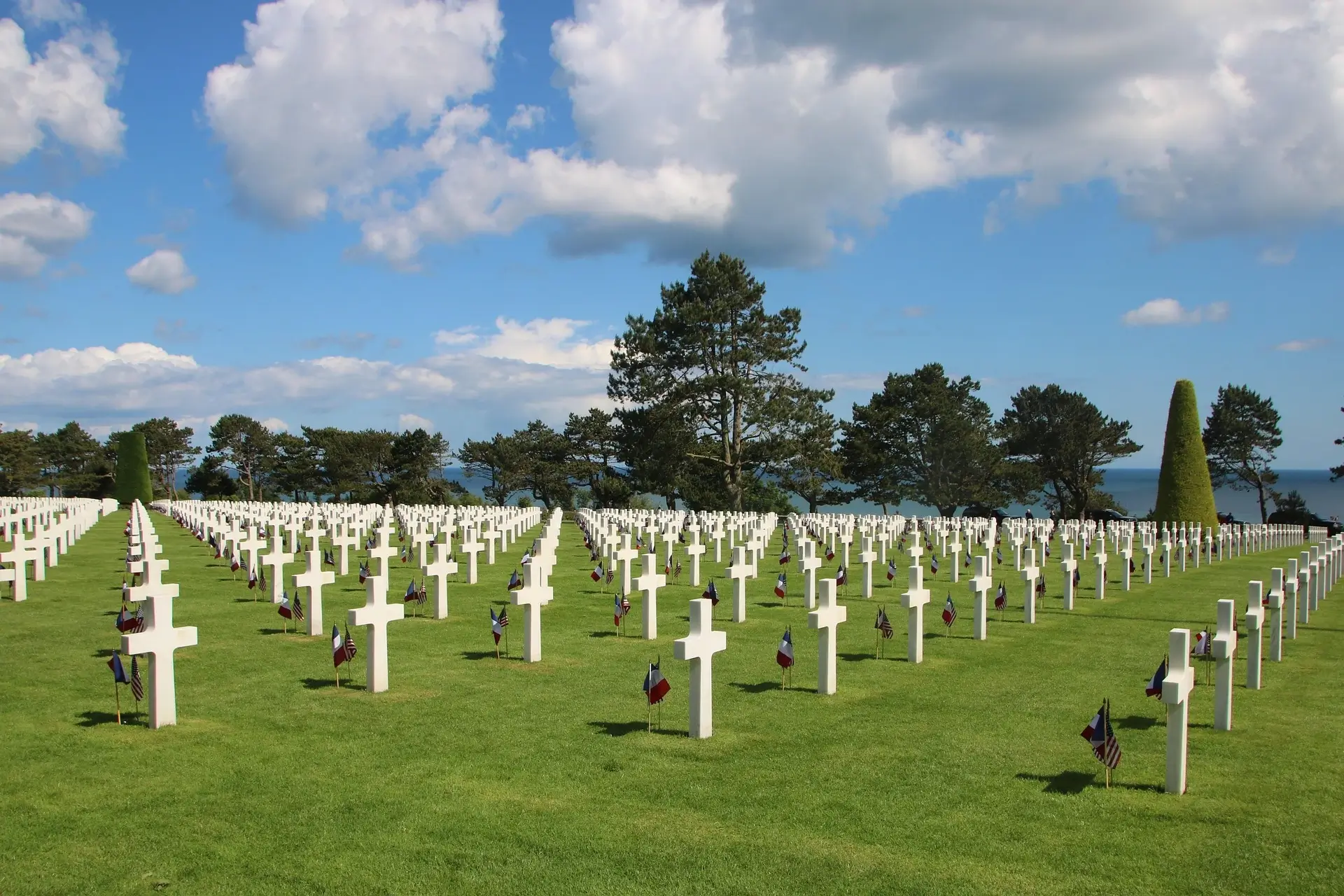
The Colleville American Cemetery majestically overlooks Omaha beach, dominating the English Channel from its 70 hectares of greenery, where 9,387 American soldiers who fell in the Normandy campaign are laid to rest. No one enters this place of remembrance by chance: each visit is a deliberate act of meditation, an invitation to honor the sacrifice of these young men, most of whom came to defend freedom in Europe. Beyond the reception building stands a magnificent semi-circular memorial, at the center of which is a bronze statue representing «the Spirit of American Youth rising from the waves», while the central aisle serves ten squares of soberly aligned graves, among which lie four women and 307 unknown soldiers.
The Visitor Center, which is free to enter, pays tribute to the values and sacrifices of the Second World War generation, explaining Operation Overlord in detail through exhibits and films, while the chapel, the garden of the missing and a daily color ceremony (at 4 or 5 p.m. depending on the season) complete this solemn setting. Maintained by the American Battle Monuments Commission (ABMC), an independent agency created by the U.S. Congress in 1923, this cemetery is one of 25 permanent U.S. burial sites on foreign soil, representing a perpetual concession granted by France to the United States.
Every year, more than one and a half million visitors pay their respects to those who lie here; free guided tours in French (11am and 3pm from April to September, 3pm from October to March) and English (11am and 2pm from April to September, 2pm from October to March) enhance the discovery, and take around 1h30. .
The German Cemetery at La Cambe: a necessary historical perspective
Close to the D-Day landing sites, the German cemetery at La Cambe offers a complementary and necessary historical perspective, housing the remains of German soldiers who fell in Normandy, a reminder that the war caused losses on both sides of the conflict. This mutual recognition of sacrifice contributes to the transmission of memory as a force for peace and reconciliation in Europe.
Commonwealth cemeteries: focus on Bayeux, Douvres-la-Délivrande and Hermanville
Beyond the American and German cemeteries, Commonwealth cemeteries dot Normandy, notably Bayeux, France's main British war cemetery with over 4,000 graves, and those at Douvres-la-Délivrande and Hermanville, honoring the sacrifices of British, Canadian and other Commonwealth soldiers who fell during the Liberation. These meticulously maintained memorial sites embody shared mourning and transnational solidarity in the face of the horrors of war.
Top 7 Museums to Visit the D-Day Beaches
The Caen Memorial: an international center for peace
The Caen Memorial, an emblematic international museum, retraces the Second World War from 1914 to the fall of the Berlin Wall through immersive exhibitions covering the rise of Nazism, the D-Day landings, the Cold War and peace, with films, authentic objects and historian-guided tours to contextualize the strategic importance of D-Day. .
Utah Beach Museum: D-Day history and technology
The Utah Beach Museum in Sainte-Marie-du-Mont immerses visitors in the history of the Utah sector, from parachuting to amphibious assault, with a focus on technologies such as DUKW and LCVP, interactive exhibits and authentic relics to relive the operations of the 101st Airborne and the 4th US Division. .
The Airborne Museum in Sainte-Mère-Église: at the heart of the airborne troops
The Airborne Museum in Sainte-Mère-Église, in the heart of the village liberated by the 82nd Airborne, recreates the world of the paratroopers, with reconstructed gliders, uniforms, weapons and personal accounts. The museum also showcases historic vehicles, such as the famous Willys jeeps used during operations and honoring the night drops on June 6, as well as the legend of John Steele hanging from the bell tower.
The Juno Beach Centre: a tribute to memory and the Canadian Forces
The Juno Beach Centre at Courseulles-sur-Mer pays tribute to the 21,400 Canadian soldiers of Juno Beach, with multimedia exhibitions on their battles against the bunkers, eyewitness accounts and interpretation trails linking the remains and the beaches to immerse you in their decisive role. .
Musée du Débarquement d'Arromanches-les-Bains: Mulberry port engineering
The Musée du Débarquement d'Arromanches-les-Bains deciphers the logistical genius of the Mulberry artificial harbor, a technological challenge installed post-D-Day at Gold Beach, with models, films and relics visible in the Baie de Seine explaining how millions of tons of material landed. .
The Overlord Museum at Omaha Beach: an exceptional collection of armoured vehicles
The Overlord Museum at Omaha Beach, near Colleville-sur-Mer, exhibits more than 10,000 items including 40 authentic vehicles, tanks and cannons from the Battle of Normandy, with life-size reconstructions of the six armies involved right up to the liberation of Paris. .
Pegasus Memorial and Merville Battery Museum: the British airborne assault
The Pegasus Memorial in Ranville and the Merville Battery Museum commemorate the exploits of the 6th Airborne, with the original Horsa glider, eyewitness accounts and reconstructed pillboxes recounting the capture of Pegasus Bridge and the neutralisation of the cannons threatening Sword Beach. .
Our top tips for visiting the D-Day Landing Beaches
How long should I plan to visit the D-Day beaches?
There's no set rule: it all depends on your wishes and the time you have available. The Norman coast is vast, and each sector tells a different part of history.
If your time is limited, it is entirely possible to focus on the most striking places in a single day. It's the ideal format for Capture the essence of the emotion and magnitude of D-Day in a reduced timeframe.
To make sure you don't miss anything: To explore the five sectors (from Utah to Sword Beach) and take the time to visit museums or military cemeteries, plan for several days. This allows you to travel at a leisurely pace from one site to another without feeling rushed.
For a complete immersion: If you also want to discover the treasures of the countryside, like Bayeux, or unearth more secret memorial sites, an extended stay offers total freedom.
Regardless of the length of your stay, Guides Tourisme Services will handle the organization. We will build your itinerary to balance sightseeing with moments of reflection, so that your time in Normandy is primarily a stress-free experience filled with shared moments and history, without logistical worries.
What time of year is best to visit the D-Day landing beaches?
Spring (April-June) or autumn (September-October) offer a mild climate (15-20°C), low crowds and the greenery of the bocage, ideal for outdoor activities; avoid July-August (crowds, heat) except for the D-Day Festival at the end of May/beginning of June with re-enactments, parades and immersive animations. The 80th anniversary in 2024 has boosted events, but annual commemorations continue in June around June 6, 1944. .
Transportation and mobility: the serenity of a private chauffeur
Hiring a private driver is the ideal solution for a stress-free visit to the D-Day landing beaches.
Organizing your trip to the historical sites of Normandy is a key step to a successful stay. To fully enjoy the experience without logistical constraints, choosing private chauffeur service is the ultimate comfort solution.
Choosing a private driver allows you to fully immerse yourself in history, with complete peace of mind:
Comfort and relaxation: Avoid driving fatigue and parking difficulties at the busiest coastal locations.
Expertise and anecdotes: Enjoy a journey enriched by local knowledge and exciting exchanges along the way.
Total flexibility: Your itinerary adapts to your desires of the moment, without the stress of navigation or complex routes in the Norman bocage.
Whether you're arriving from Paris or are already based in Normandy, this package guarantees smooth and secure logistics.
For an exclusive experience and a perfectly organized journey, rely on the expertise of Guides Tourisme Services. We take care of your entire mobility so you can focus on what matters most: the emotion and discovery of the places of remembrance.
Local expertise: Why choose a guided tour with a professional guide?
A professional tour guide provides historical context, exclusive anecdotes, live answers, and optimized tours, creating an immersive experience versus often rushed and superficial self-guided tours. This is ideal for groups or families, offering priority access and personalized focus on heritage sites like blockhouses or ruins. .
Build an itinerary to visit the D-Day landing beaches
Because each visit to the D-Day beaches is unique, it is essential to be able to adapt your itinerary to your interests. Whether you wish to focus on a specific sector or explore all the iconic sites, flexibility is the key to a successful experience.
A personalized approach by sector:
Western Sector: Dive into the history of the airborne landings at Sainte-Mère-Église and discover the immensity of Utah Beach.
Central Sector: Walk on the sands of Omaha Beach, climb Pointe du Hoc, and pay your respects at the Colleville-sur-Mer Cemetery.
Eastern Sector: Explore the remains of Mulberry Harbour, as well as the areas of Juno Beach, Sword Beach and the famous Pegasus Bridge.
These routes can include the many museums and military cemeteries along the Normandy coast.
For an itinerary perfectly tailored to your expectations and flawless organization, entrust your project to Guides Tourisme Services. Our experts design a tailor-made experience for you to make your trip to Normandy unforgettable.
Global Reconnaissance: UNESCO and the Importance of Visiting the Landing Beaches
The 80th anniversary and the scale of international celebrations
The 80th anniversary of D-Day in 2024 brought together heads of state, veterans and millions of visitors for worldwide events on the beaches of Normandy, with solemn ceremonies, parades and tributes highlighting the legacy of the European Liberation, reinforcing collective memory beyond the annual commemorations .
The D-Day Festival: annual events and celebrations on June 6
The D-Day Festival, an annual event since 2007, brings to life from May 30 to June 14, 2026 the coastal sites from Pegasus Bridge to Sainte-Mère-Église, offering nearly 100 events: parachute drops, parades of 150 period vehicles, camp re-enactments, liberation balls, swing/jazz concerts, fireworks, exhibitions and outdoor projections for all audiences. .
The importance of transmission and remembrance tourism for young people
Remembrance tourism in Normandy, through festivals and visits, transmits to younger generations the values of freedom and peace that emerged from D-Day, with immersive activities that promote historical understanding and the prevention of future conflicts. .
Why does UNESCO recommend visiting the D-Day landing beaches?
The Normandy landing beaches, collectively nominated to UNESCO as a World Heritage site, aim to recognize their universal value as emblematic sites of the Second World War and symbols of international reconciliation. .
Conclusion: An unforgettable journey in the footsteps of History and Liberty in Normandy
To visit Normandy is to follow in the footsteps of the heroes of June 6, 1944, from the landing beaches to the serene cemeteries, from the vibrant museums to the remains of the Atlantic Wall. You, the reader, will find not only an immersion in the history of Operation Overlord orchestrated by Eisenhower, Montgomery and the Allied forces, but also a profound reflection on the Liberation, memory and the lessons of peace. Whether for remembrance tourism, the D-Day Festival or a simple remembrance visit to Colleville or La Cambe, this tailor-made trip with a guide or private driver forges an eternal link with Liberty, making each site - from Sainte-Mère-Église to Arromanches-les-Bains - a living chapter in our world heritage. .
Conclusion
History buffs from across the Channel - Americans, British, Canadians - relive the emotion of D-Day on the landing beaches (Omaha, Utah, Juno, Gold, Sword) and the Longues-sur-Mer battery. To grasp the strategic details and the heroism experienced, a guide-lecturer is essential. Guides Tourisme Services, a local expert, offers you a top-of-the-range private chauffeur service for a tailor-made itinerary, with complete peace of mind.
Book now: contact us here to organize your private tour and pay tribute to the heroes of Normandy!
FAQ
What are the 5 D-Day beaches and which Allied countries landed there on June 6, 1944?
The 5 landing beaches are Utah, Omaha, Gold, Juno and Sword. On June 6, 1944, the Americans landed at Utah and Omaha , the British at Gold and Sword , and the Canadians at Juno . French commandos also took part in Sword Beach .
When is the best time of year to visit the Normandy landing beaches?
The best time to visit the D-Day landing beaches is April, May or October: sites open, moderate crowds, mild weather. June-September is pleasant but crowded; avoid January-February (museums closed).
What are the must-see sites on a visit to the D-Day landing beaches?
Must-see sites on the D-Day landing beaches: Omaha Beach and American Cemetery, Utah Beach and Museum, Juno Beach and Juno Center, Sword Beach and Pegasus Bridge, Gold Beach and Arromanches with Port Mulberry.
Where are the D-Day landing beaches located geographically, and how can I find them easily?
The D-Day beaches are in Normandy: Utah Beach (Manche, Cotentin), Omaha Beach (Calvados), Gold Beach, Juno Beach, and Sword Beach (Calvados, west of Orne). Easily locate them from west to east via Google Maps.