
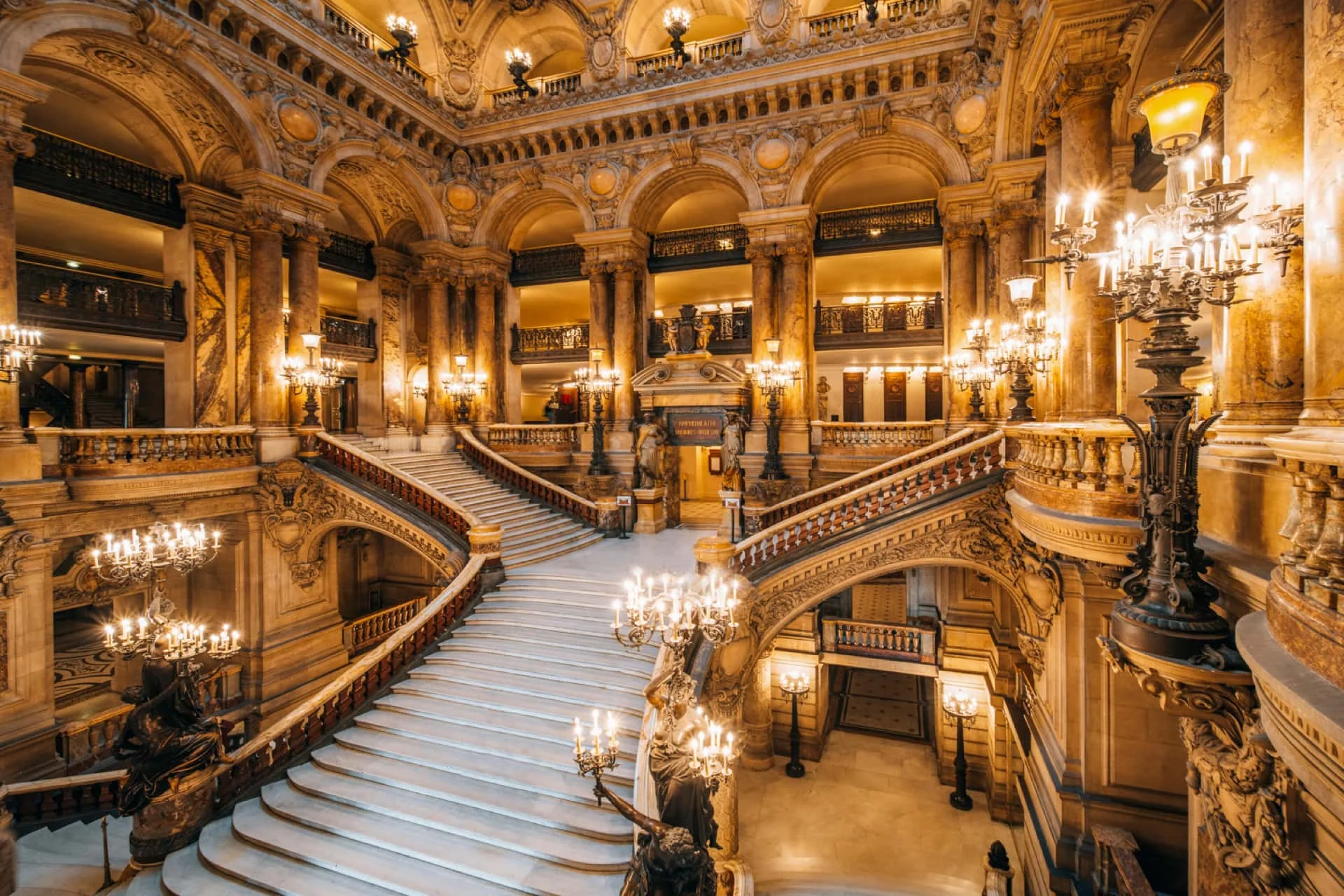
The guided tour of the Palais Garnier is one of the most sought-after cultural experiences in Paris.
Between the grand Haussmannian boulevards and the Opera Square, the Palais Garnier stands out as one of the most monuments most spectacular in Paris and France. A masterpiece of the Second Empire, this building embodies an aesthetic that is both classical and bold, the fruit of an innovative architect's imagination and the combined talents of renowned artisans. Inaugurated on January 5, 1875, it remains the iconic home of the Paris Opera Ballet today, hosting opera and dance performances each season that perpetuate a tradition of European excellence.
To grasp the scale of this edifice and unravel its mysteries, the guided tour of Opéra Garnier with GTS offers a unique journey through the history, art, and daily life of a legendary theater. Whether exploring the public spaces of the Palais Garnier, descending backstage, or following in the footsteps of the Phantom of the Opera through the underground passages, each visit reveals a place of unsuspected richness. Guides Tourisme Services accompanies families, groups, and culture enthusiasts in discovering this Parisian jewel, with the expertise and discretion that define the agency.
History and Birth of the Palais Garnier
Charles Garnier and the 1861 competition
In 1860, Napoleon III decided to equip Paris with a new opera house befitting the imperial capital. The old building on Rue Le Peletier, which had been temporary since 1821, no longer met the requirements of a regime concerned with its image. A competition was launched in December 1860 and closed in January 1861: one hundred and seventy contestants participated, including the most prominent architects of the time. A young man of thirty-five, Charles Garnier, then little known to the general public, won with a remarkably bold design. His style, which he himself called «Napoleon III» – an eclectic synthesis of Baroque, Italian Renaissance, and French Classicism – contrasted with the academicism of his rivals. Empress Eugenie, disconcerted by this abundant ornamental vocabulary, is said to have asked Garnier what style his project belonged to. His answer became famous: «It's Napoleon III, Madame.»
The construction site during the Second Empire and the Third Republic
Construction began in 1861 under particularly difficult conditions. The chosen site, located between Boulevard des Capucines and Rue Scribe, rested on an abundant water table that required months of continuous pumping before the foundations could be laid. It is this groundwater that would later form the famous subterranean lake, fueling the imagination of Gaston Leroux. The building's metal framework, invisible beneath the thick layer of marble and stucco, showcases new engineering capable of supporting considerable volumes. The construction site was interrupted by the Franco-Prussian War of 1870 and the Paris Commune in 1871—the unfinished building then served as a food depot and a prison. Despite these setbacks, seventy-five sculptors, fourteen painters, and hundreds of artisans from all over Europe contributed to the construction of this monument, under the rigorous direction of Charles Garnier, who oversaw every detail of the decoration.
The inauguration of January 5, 1875, and the founding myth
On January 5, 1875, under the presidency of Patrice de Mac-Mahon, the Palais Garnier officially opened its doors to the public. Napoleon III, for whom the building had been designed, had died in exile three years earlier without ever having seen his opera completed. The inauguration ceremony brought together dignitaries of the nascent Third Republic, representatives of European courts, and the Parisian elite of arts and letters. The inaugural performance included excerpts from Halévy's La Juive, Auber's La Muette de Portici, and Léo Delibes' La Source—three works from the French lyric repertoire that immediately anchored the Palais in the national tradition. With its 11,000 square meters of surface area, its 2,000 seats, and its sixteen varieties of marble imported from the four corners of Europe, the Palais Garnier immediately established itself as the largest opera house in the world by surface area, a title it still holds today, making it the ideal setting for a guided tour of the Opéra Garnier.
Architecture and Remarkable Spaces: Guided Tour of the Opéra Garnier
The facade and the grand staircase
The facade of the Palais Garnier is the very manifesto of the eclectic aesthetic of the Second Empire. Its alternating rhythm of columns, balustrades, and niches housing allegorical statues evokes an open-air stage, where stone becomes an actress. Sixteen varieties of marble—from white Carrara to Spanish red, including green Swedish and yellow Sienese—combine to give the ensemble a subtle polychromy, enhanced by the gilding and bronzes adorning pediments and cornices. Four monumental sculpted groups frame the projecting sections: among them, The Dance by Jean-Baptiste Carpeaux, completed in 1869, unleashed a resounding scandal upon its unveiling—some Parisians deemed its female figures too sensual and doused it with black ink at night. The original is now preserved at the Musée d'Orsay, and a faithful copy occupies its place on the facade.
Upon entering the grand staircase, visitors step into a space designed to impress and direct the eye towards the upper levels. Nearly thirty meters high, this monumental staircase splits into two symmetrical white marble ramps, framed by green and red marble balustrades. At the corners, majestic female torches created by Pierre-Jules Cavelier and Louis-Ernest Barrias cast their golden light. The side walls are covered in polychrome paneling, complemented by gilded friezes highlighting the cornices, while vast mirrors framed by moldings amplify the perspective and reflect the gleam of stone and metal. Seventy-five sculptors contributed to this ensemble, making the staircase a true museum of 19th-century French sculpture, which GTS guides elucidate with the precision and passion of great lecturers during every guided tour of the Palais Garnier opera house.
The Grand Foyer and its gilding: gem of the guided tour of the Opéra Garnier
Upon reaching the top of the staircase, the visitor enters the Grand Foyer, a long gallery of one hundred fifty-four meters bathed in natural light from large bays opening onto the Avenue de l'Opéra. The gilded stucco, polychrome mosaics, and white marble statues dialogue with the paintings by Paul Baudry, applied between 1866 and 1874 to the vault, where seventy-five panels of allegorical figures celebrate music, dance, and poetry. The comparison with the Hall of Mirrors at Versailles is natural: Baudry had, moreover, studied Le Brun before undertaking this titanic work. The monumental mirrors placed opposite each other create a striking refraction effect, while the innumerable crystal chandeliers capture every ray of light to convert it into an almost supernatural brilliance.
Under the Second Empire, the Grand Foyer was the ultimate social gathering place, where aristocrats, diplomats, and enlightened bourgeois met during intermissions to see and be seen. Even today, this space for passing through and contemplation retains its character as a social theater, where the audience strolls between acts in an atmosphere that has hardly changed since its inauguration. The dark oak paneling creates an elegant contrast with the shimmering gilding, while the bronze candelabra, directed towards the ceiling, diffuse a soft light that preserves the integrity of Baudry's pigments. GTS offers a guided tour of the Opéra Garnier focused on this architectural gem, allowing you to decipher every detail with an expert's eye.
Chagall's Ceiling: Masterpiece of the Paris Opera House Guided Tour
The auditorium of the Palais Garnier is one of the most famous and photographed spaces in the world. Built according to the traditional horseshoe plan of the so-called «Italian» opera houses, it accommodates nearly two thousand spectators spread across five levels of boxes and balconies draped in red and burgundy velvet. The omnipresent gilding, bronze candelabras, and monumental chandelier—weighing nearly eight tons and containing over three hundred light bulbs—create an incomparably rich setting for the opera and choreography productions of the Paris Opera Ballet.
When it opened in 1875, the dome was adorned with an allegorical fresco by Jules-Eugène Lenepveu depicting the Muses and the Hours surrounding Apollo. But in 1964, at the request of the Minister of Culture André Malraux, Marc Chagall radically reinterpreted this space by suspending a painted ceiling of four hundred and fifty square meters above the hall, divided into twelve panels representing fourteen major composers — from Mozart to Tchaikovsky, from Wagner to Berlioz. The deep blues, vibrant reds, luminous greens, and ethereal silhouettes of this creation bring an unexpected poetic breath to the hall's classical rigor. This dialogue between the 19th and 20th centuries, between Garnier and Chagall, between marble and pure color, is one of the most striking sights that Paris offers on a guided tour of the Opéra Garnier.
State Rooms: Hearth of the Moon and Hearth of the Sun
A few steps beyond the Grand Foyer lead to the two state reception rooms flanking the main gallery: the Moon Salon and the Sun Salon. Their octagonal ceilings, painted on canvas and then restored in the 20th century, display a complex and refined iconography: winged women playing lyres, cherubs draped in diaphanous hangings, and imperial emblems from the Haussmann era. These intimate and hushed spaces once hosted private receptions and were the scene of political or artistic conversations, a discreet extension of the major public events held a few meters away.
The hearth of the Moon and the hearth of the Sun alone embody the identity of the Palais Garnier: a place where art and social life blend in an setting of absolute elegance.
The Opera Library-Museum and the Subscribers' Rotunda
Less known to the general public but cherished by opera history enthusiasts, the library-museum of the Paris National Opera occupies an entire wing of the Palais Garnier. It houses over six hundred thousand documents—manuscript scores, set designs, period costumes, photographs, and programs—which constitute one of the most complete archives in the world on the history of opera and ballet. Among its treasures are annotated scores in the handwriting of composers like Berlioz or Meyerbeer, original costume sketches, and set designs that bear witness to the creative genius of the scenographers who have worked for the house.
The Subscribers' Rotunda, located at the corner of the building facing Auber Street, was once the entrance reserved for opera subscribers – wealthy patrons who had their own year-round boxes and treated the Opera house as their private salon. This circular rotunda, adorned with marble columns and gilded coffered ceilings, perfectly illustrates the care Charles Garnier took with every space in the building, even those intended for quick passage. This is where "Tout-Paris" (high society) would pass each evening before heading to their boxes to attend the most popular shows of the season.
Guided tour of the Palais Garnier: behind the scenes and its mysteries
The machinery and the undertones of the scene
Beneath the main stage, a parallel world operates with clockwork precision. Between moving floors, aerial grids, and multi-level stage bridges, a network of sturdy metal structures is laid out, invisible from the audience. The stage machinery at the Palais Garnier is one of the most complex in Europe, allowing entire sets to appear and disappear in seconds, and creating trapdoor, flying, or metamorphosis effects that are an inseparable part of the mystery of live performance. Counterweights, pulleys, winches, and aerial walkways form an invisible mechanical ballet, orchestrated by technical teams who work in the shadows with absolute rigor.
The stage area alone has six underground levels, each serving a specific function in organizing performances. Technicians maneuver trapdoors, trolleys, and retractable sets with millimeter-precise accuracy, while above them, dancers and singers perform under the spotlights. These underground passages form a fascinating labyrinth that visitors on backstage tours organized by GTS can explore with an expert guide-lecturer, discovering the hidden side of a show that the audience will never see from the auditorium. The backstage tour of Paris's two opera houses—Garnier and Bastille—offered by GTS provides a comprehensive and comparative view of two radically different stage systems, separated by a century of technological evolution.
The underground lake and the Phantom of the Opera
Six meters below the main stage, a vast water tank, approximately fifty meters long and twenty meters wide, occupies the foundations of the Palais Garnier. This artificial lake, created during construction to stabilize the foundations by capturing groundwater from the Parisian subsoil, has never been developed as a stage or tourist space. It remains one of the building's most secret places, accessible only to members of the technical management and a few rare insiders. The water is dark and still, the gloom almost complete, and the silence absolute—a timeless space that has fueled the most persistent legends about the Opéra Garnier for over a century, which only a guided tour of the Opéra Garnier with GTS allows you to approach.
It is precisely this underground lake that inspired Gaston Leroux for his novel The Phantom of the Opera, published in 1910. The author took the figure of a masked man living beneath the Palais to build one of the most famous stories in world popular literature—the Paris Opera House Phantom, as the Anglo-Saxons call it. While the presence of a ghost remains a matter of fiction, certain historical incidents have contributed to embedding the legend in the collective imagination: the partial collapse of a counterweight for the monumental chandelier in 1896, which caused a fatality in the auditorium, rumors of apparitions in the narrow galleries, or unexplained noises that sometimes echo in the underground passages at night. Leroux's novel enjoyed extraordinary worldwide success, notably thanks to Andrew Lloyd Webber's musical created in London in 1986, which made the Phantom of the Opera one of the most watched shows in the history of musical theater.
Paris Opera Ballet
Far from the spotlight and gilding, artistic creation is born in the workshops of the Palais Garnier and the adjacent buildings that revolve around the institution. The costumes worn on stage emerge from spaces where seamstresses, embroiderers, and feather workers toil for weeks, sometimes months, to give dancers and singers costumes that are as functional as they are visually stunning. Each production by the Paris Opera Ballet can require the creation of several hundred costumes, some of which incorporate materials as precious as silk, velvet, or ostrich feathers hand-dyed using ancestral methods. In other workshops related to the institution, carpenters, set painters, and sculptors build the large canvases and three-dimensional structures that unfold during performances—all secrets revealed by the guided tour of the Opéra Garnier offered by GTS.
The Paris Opera Ballet is one of the oldest and most prestigious dance companies in the world, founded in 1661 under Louis XIV—the Sun King himself was a dancer. Its strict hierarchy, inherited from the 17th century, distinguishes between quadrilles, coryphées, sujets, first soloists, and étoiles—dancers at the pinnacle of their art who embody the excellence of the French school. In the Palais's training studios, discipline is paramount: daily warm-ups, classical technique classes, and rehearsals for performances, alongside medical care, follow one another with monastic regularity. Pointe shoes wear out at a dizzying rate—an étoile can go through several pairs a week—and every movement is repeated until the perfection that the audience perceives from the auditorium is achieved, without ever imagining the colossal effort hidden behind the apparent lightness of the movement.
The Palais Garnier in global popular culture
The Palais Garnier is much more than an opera house—it's a global cultural symbol whose reach extends far beyond the borders of France and Europe. Gaston Leroux's novel and the film adaptations of The Phantom of the Opera—from Rupert Julian's silent version in 1925 starring Lon Chaney to contemporary productions—as well as Andrew Lloyd Webber's musical have made this building one of the most recognizable places in the international collective imagination. Millions of American, British, Japanese, and Australian visitors come to Paris each year with the Palais Garnier as a top destination, drawn by its legendary aura that transcends mere architectural interest.
The building has also served as a backdrop for numerous film and television productions, from adaptations of Leroux's novel to fashion films that use its spaces as a prestigious setting. Edgar Degas, although primarily associated with the old opera house on Rue Le Peletier, immortalized the world of Parisian ballet in dozens of canvases and pastels that today constitute irreplaceable testimonies of 19th-century Parisian artistic life. The Paris Opera House tour—as English-speaking visitors call it—is consistently ranked among the most memorable cultural experiences of a trip to Paris, alongside the Louvre, Notre-Dame de Paris, and the Musée d'Orsay. GTS accompanies this international clientele on their guided tour of the Opéra Garnier with multilingual guides, capable of conveying all the richness of this venue in its universal dimension.
Guided tour of Opéra Garnier or Bastille: two architectures, one same excellence
Charles Garnier versus Carlos Ott: two architectures, two eras
When the Opéra Bastille opened its doors on July 13, 1989, for the bicentennial of the French Revolution, Paris gained a second major opera house that complemented, rather than replaced, the Palais Garnier. Uruguayan architect Carlos Ott won the international competition launched in 1983 with a resolutely modernist design: a facade of glass and gray granite that radically contrasted with Charles Garnier's ornamental exuberance. Where Garnier had multiplied polychrome marbles, gilded bronzes, and allegorical sculptures, Ott opted for clean lines, industrial materials, and functional architecture designed to optimize acoustics and technical production conditions. The two buildings thus embody two radically different conceptions of what an opera house should be: the aristocratic temple of the 19th century on one hand, and the democratic people's house of the 20th century on the other.
The capacity of the two halls also reflects this philosophical difference: the Palais Garnier accommodates about two thousand spectators in an intimate and luxurious setting, while the Opéra Bastille can host up to twenty-seven hundred people in a hall designed to maximize visibility and acoustics from every seat. The Place de la Bastille, steeped in French revolutionary history, offers the new opera house a strong symbolic anchor in national identity, just as the Place de l'Opéra anchors the Palais Garnier in the Haussmannian, bourgeois Paris of the Second Empire. GTS offers a guided tour of the Opéra Garnier and the backstage areas of both Parisian opera houses, allowing visitors to concretely appreciate these architectural and technical differences, led by guides who are intimately familiar with both institutions.
Directory, acoustics, and identity of each house
The distribution of the repertoire between the two houses of the Opéra national de Paris follows a logic that is both artistic and technical. The Opéra Bastille, equipped with ultramodern stage machinery and an orchestra pit that can accommodate up to 130 musicians, handles the majority of major opera productions—operas by Verdi, Wagner, and Puccini—which require imposing sets and considerable acoustic power. The Palais Garnier, with its more intimate auditorium that favors nuance and sound precision, is more dedicated to ballet and works from the chamber or baroque repertoire, where the proximity between the artists and the audience creates a particular emotional intensity.
The acoustics of the Palais Garnier have been the subject of numerous studies and some controversy since its inauguration. The velvets, gilding, boxes, and balconies create a warm reverberation that envelops the sound and gives it a particular color, different from the clinical precision sought at Bastille. Some singers and conductors prefer the Garnier hall for this reason, believing that its «lively» acoustics favor vocal and orchestral expression. Others, on the contrary, appreciate the acoustic neutrality of Bastille, which allows for a faithful reproduction of the composer's intentions. This complementarity makes the Paris National Opera one of the richest and most diverse opera institutions in the world, capable of offering an exceptionally broad repertoire each season.
The Opéra district: extending the guided tour of the Opéra Garnier
The Palais Garnier cannot be visited outside of its urban context—the Opera district is one of the most characteristic areas of Haussmannian Paris, with its wide boulevards, luxury shops, and covered arcades stretching north to south between the Grands Boulevards and the Tuileries. The Place de l'Opéra, designed by Haussmann to showcase Garnier's facade, is one of the busiest intersections in the capital, where several major avenues converge—Avenue de l'Opéra, Boulevard des Capucines, Boulevard des Italiens—forming the backbone of 19th-century bourgeois Paris.
A stone's throw from the Palais, the covered arcades of the district—Galerie des Panoramas, Galerie Vivienne, Passage des Princes—offer a dive into Paris's commercial and architectural history before the era of department stores. Boulevard Haussmann, with its iconic department stores, Printemps and Galeries Lafayette, borders the district to the north. Rue de la Paix, which connects Opéra Square to Place Vendôme, is one of the most luxurious shopping streets in the world, lined with internationally renowned jewelers and leather goods shops. GTS often integrates this urban dimension into its guided tours around the Opéra Garnier, offering visitors a complete vision of Second Empire Paris that extends beyond the walls of the Palais to encompass an entire district, an entire era, and the very identity of the City of Light.
Garnier Opera Guided Tour: The GTS Experience
A tailor-made experience for aesthetes
Guides Tourisme Services offers an approach to the Opéra Garnier that is radically different from the classic self-guided tour. Each tour is designed as a complete cultural experience, led by official lecturers from the Opéra national de Paris whose knowledge of the building, its history, and its secrets far surpasses what explanatory signs can offer. These multilingual guides—French and English speaking—accompany French visitors and international guests, particularly Americans and Britons, with the same high standard. International visitors represent a growing segment of patrons for the Paris Opera House Tour. The goal is not to skim over the remarkable spaces of the Palais, but to understand their architectural, artistic, and social logic, from the buried metal foundations to the painted ceilings and the hushed salons.
GTS manages the entire logistics of the visit—access, itinerary organization, and duration tailored to the client's wishes—so that the guest has only one thing to do: immerse themselves in the beauty and history of the site. This operational discretion, this invisible logistics that is the agency's signature, transforms a simple cultural outing into a memorable experience. Connoisseurs and enthusiasts of architecture, art history, or opera will find in these bespoke tours a level of information and quality of guidance that makes a guided visit of the Opéra Garnier with GTS a benchmark among high-end Parisian cultural offerings. To organize your visit, simply contact GTS and specify your interests—the agency will take care of the rest.
The Palais Garnier for families
The Opéra Garnier is a place that fascinates children and adults alike, provided you offer them an approach tailored to their curiosity and imagination. GTS has developed specific family-friendly tours that transform the visit into a true adventure through the Palace's spaces, punctuated by anecdotes, riddles, and discoveries that keep the youngest ones engaged throughout the tour. The grand honor staircase becomes a fairytale setting, Chagall's ceiling an invitation to a poetic journey, and the legend of the Phantom of the Opera a thrilling tale that guides recount with consummate skill in suspense.
These guided tours of the Palais Garnier for children and families are designed to be both fun and educational, providing young visitors with an introduction to the opera house's architecture, painting, and history that can spark their curiosity long after the visit. Children often leave with specific anecdotes—the weight of the chandelier, the depth of the underground lake, the number of marble varieties—which attest to the educational quality of the guidance offered by GTS. The guided tour of the Palais Garnier for families is one of the most comprehensive and accessible Parisian cultural experiences for school groups and traveling families, regardless of the season.
Behind-the-scenes tour of the two Parisian opera houses
Behind-the-scenes tour of the two Parisian opera houses — Garnier et Bastille — constitutes GTS's most exclusive opera offering. This immersion into the technical spaces, workshops, and artist-only areas provides a complete comparative overview of the stage machinery in two institutions which, although part of the same Opéra national de Paris, operate according to radically different architectural and technical logics. The underbelly of the Palais Garnier, with its subterranean levels and its partially modernized 19th-century machinery, dramatically contrasts with the ultra-modern facilities of the Opéra Bastille, where digital technology now governs set movements and stage effects.
Tech, architecture, and performing arts enthusiasts discover the invisible framework that makes every performance possible — the artists' dressing rooms, rehearsal spaces, costume workshops, and the immediate backstage areas of the stage, from which one perceives the auditorium from an angle the audience will never imagine from their seats. This tour backstage tour, as English-speaking visitors call it, is one of the most sought-after experiences for GTS's international clientele, who sometimes specifically come to Paris to enjoy this behind-the-scenes immersion at the Parisian operas. To book this exceptional tour, simply contact GTS, who will organize every detail according to your availability and interests.
The Palais Garnier for Groups and Private Events
The Palais Garnier offers an exceptional setting for private events and guided tours for organized groups—company committees, cultural associations, school groups, diplomatic delegations, or art enthusiast circles. GTS coordinates these special moments with the care and precision that characterize the agency, from simple guided tours to customized thematic itineraries for company committees, cultural associations, or international delegations, including packages combining a discovery of the Palais Garnier with a backstage tour of both Parisian opera houses.
For international groups—notably American and British delegations, who represent a significant portion of GTS's clientele—the agency offers tours conducted entirely in English, with lecturers specializing in presenting the Palais Garnier to an English-speaking audience. These Paris Opera House tours custom-made systematically integrate cultural references that particularly resonate with Anglo-Saxon sensibilities—the Phantom of the Opera, the story of Marc Chagall, the romantic ballet of the 19th century — to create an experience that is both universal and personalized. Whatever the type of group or event envisioned, GTS has the expertise and network necessary to transform a visit to the Opéra Garnier into an exceptional moment — contacting GTS is the first step towards this unique adventure.
FAQ: Your questions about the guided tour of the Palais Garnier
When to visit the Palais Garnier?
The guided tour of the Opéra Garnier is accessible to the public year-round, but certain periods offer a particularly enriching experience. Spring, from March to June, is undoubtedly the ideal season: the natural light filtering through the grand bays of the Grand Foyer reveals the gilding and mosaics in all their splendor, and the crowds remain moderate compared to the peak summer months. Autumn, from September to November, offers similar conditions with the advantage of a particularly rich artistic program—the opera and ballet season is in full swing, and the atmosphere of the Opéra district takes on a special intensity when the Palace lights up in the evening to welcome its spectators.
Summer remains a pleasant time to visit the Palais Garnier; the long, bright days highlight its facade and outdoor spaces, but anticipate a larger influx of international visitors. Conversely, the holiday season offers a uniquely magical atmosphere: the crystal chandeliers in the Grand Foyer and auditorium sparkle with particular intensity, and the Christmas ballet program draws a large, family-oriented audience. GTS tailors its guided tours to all seasons and occasions. Contacting the agency well in advance ensures the best availability and a tour perfectly suited to your expectations.
How long does the guided tour of the Opéra Garnier last?
The duration of a guided tour of the Opéra Garnier varies depending on the type of tour chosen and the level of detail desired. A tour of the main public areas—facade, grand staircase, Grand Foyer, reception rooms, and auditorium—generally lasts between one hour and a half and two hours, which is a comprehensive and satisfying tour for the majority of visitors. For those passionate about architecture or art history who wish to delve deeper into each space, each artwork, and each anecdote, a duration of two hours and a half to three hours is more suitable.
Visiting the backstage areas of both Parisian opera houses—Garnier and Bastille—naturally requires more time, usually a full half-day, to allow for the discovery of technical spaces, workshops, and areas reserved for artists of both institutions. GTS systematically adapts the duration of its tours to the wishes and constraints of each group or individual visitor—a family with young children will not have the same needs as a group of architecture professionals or a couple of music lovers on a Parisian weekend. This flexibility in the duration and content of the tours is one of the distinctive features of the GTS approach, which places the visitor's expectations at the center of each experience.
Can we visit the backstage of the Opéra Garnier?
Yes, a backstage tour of the Palais Garnier is possible and is one of the most sought-after experiences for lovers of live performance and architecture. These areas — the understage, costume workshops, artists' dressing rooms, rehearsal rooms, and underground passages — are not normally accessible to the public during standard self-guided tours, but GTS has the expertise and contacts necessary to guide its groups through them under optimal conditions. The backstage tour reveals an unsuspected parallel world, where technology and art combine to make each performance possible.
It is important to note that backstage access depends on the performance and rehearsal schedule—certain areas may be inaccessible on show days or when artists are rehearsing. GTS manages this constraint by organizing tours at the most opportune times and adapting the route based on real-time availability, thus ensuring an always optimal experience even if conditions vary from one visit to another. For English-speaking visitors seeking an authentic backstage tour From the Palais Garnier, GTS offers tours entirely conducted in English with guides specialized in presenting the institution to an international audience.
Is the Opéra Garnier suitable for children?
The Opéra Garnier is a venue particularly well-suited for family visits with children, provided a tour designed for their age group and attention span is chosen. The spectacular spaces of the Palace—the grand staircase, Chagall's colorful ceiling, the giant chandelier in the auditorium, the underground passages, and the legend of the Phantom—are all visual and narrative elements that naturally capture the imagination of young visitors. Children aged six or seven and up can generally follow an adapted guided tour with sustained interest, especially when the guide knows how to balance anecdotes and questions to keep them engaged throughout the tour.
GTS has developed specific expertise in supporting families and school groups at the Opéra Garnier, with speakers trained to adapt their discourse and teaching methods to different audiences. Guided tours of the Opéra Garnier for children include participatory activities, adapted stories, and focuses on the most visually striking elements of the building, transforming the cultural visit into a memorable adventure. Teachers and parents who wish to prepare for this visit can contact GTS to receive preliminary educational information and adapt the tour content to the group's educational objectives.
What is the difference between the Opéra Garnier and the Opéra Bastille?
The Opéra Garnier and the Opéra Bastille together form the Paris National Opera, but they are radically different in terms of their architecture, repertoire, acoustics, and atmosphere. The Palais Garnier, inaugurated in 1875, is a listed historic monument whose decorative richness—multicolored marbles, gilded bronzes, allegorical paintings, monumental sculptures—makes it one of the most beautiful 19th-century buildings in Europe. The Opéra Bastille, inaugurated in 1989 on the Place de la Bastille, is, on the contrary, a work of contemporary architecture with clean lines, designed to meet the technical and acoustic requirements of modern opera productions.
In terms of repertoire, the Palais Garnier mainly hosts productions by the Paris Opera Ballet and chamber or Baroque operas that benefit from the warm and intimate acoustics of its auditorium, while the Opéra Bastille handles large-scale opera productions—Verdi, Wagner, Puccini—that require a huge stage and maximum acoustic power. For visitors who wish to discover both institutions in their heritage and technical dimensions, GTS offers backstage tours of both Parisian opera houses—a unique comparative experience that allows for a concrete appreciation of the evolution of opera architecture over more than a century of history, guided by speakers who are intimately familiar with both houses.
Conclusion
The Palais Garnier is one of those rare places in the world where every stone, every gilding, and every space simultaneously tells several centuries of history, art, and social life. From the grand staircase to the stage's underbelly, from Chagall's ceiling to the underground lake, from the Grand Foyer to the workshops where the Paris Opera Ballet costumes are born, this monument embodies the French ideal of beauty serving the performing arts with incomparable intensity. Visiting the Palais Garnier means traversing two centuries of European artistic creation in a few hours, from the stone sculpted by Carpeaux to the colors unfurled by Chagall, from Charles Garnier's metal engineering to the stage machinery that brings the Paris Opera's productions to life every evening.
To fully grasp the emotion and secrets of this exceptional place, the accompaniment of an expert guide-lecturer is essential. The spaces of the Palais Garnier are of such historical and artistic density that a self-guided tour, however attentive, can only reveal a tiny fraction. It is precisely for this reason that Guides Tourisme Services has established itself as the Parisian expert of reference for discovering the guided tour of the Opéra Garnier and its backstage—an agency whose signature is to transform each visit into a tailor-made cultural experience, conducted with the discretion and excellence that characterize the greatest heritage professionals.
Whether you are passionate about architecture, a music lover, a ballet enthusiast, a family seeking a memorable cultural adventure, or a professional group looking for a unique Parisian experience, GTS has the itinerary and the guide to meet your expectations. From the public spaces of the Palais to the behind-the-scenes of the two Parisian operas, from tours in French to Paris Opera House tours fully conducted in English for American and British clientele, the agency covers the entire spectrum of possible experiences around this unique institution in the world. To organize your guided tour of the Palais Garnier and discover the richness of Parisian history and art, contact GTS today — the agency's team of lecturers and logisticians is ready to build the experience that suits you best.