
The Louvre isn't just visited; it's experienced. Within the walls of this former royal palace, each gallery whispers a story of power and beauty. GTS opens the doors to a Private tour of the Louvre For sovereign immersion, where art meets exclusivity.
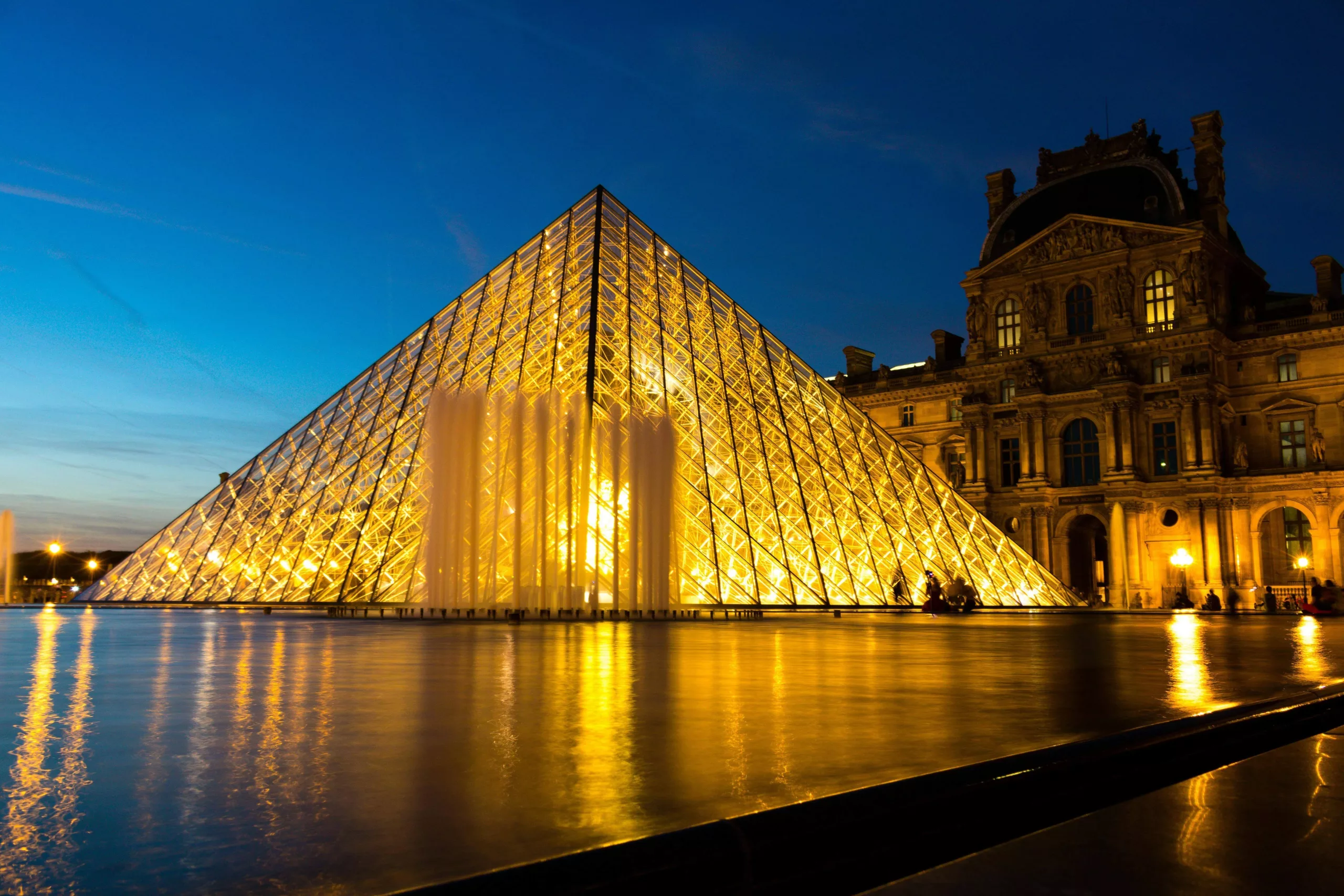
The Louvre Museum is one of the most iconic cultural institutions in the world. Located in the heart of Paris, in the 1st arrondissement, it occupies the former royal palace of the Louvre, a monument with medieval roots that has gradually transformed into a showcase for Western artistic creation. Today, GTS offers its guests the opportunity for a privatization of the Louvre for unique experiences, in the privileged silence of the galleries.
With collections covering Western art from the Middle Ages to 1848, as well as the great ancient Eastern, Egyptian, Greek, and Roman civilizations, the Louvre boasts over 500,000 works, with approximately 35,000 on public display. Among these masterpieces are universally known names: Leonardo da Vinci's Mona Lisa, the Venus de Milo, the Seated Scribe, a masterful work of the Egyptian Old Kingdom, the Winged Victory of Samothrace, and the Code of Hammurabi. Furthermore, legendary sarcophagi and the monumental Sphinx of Tanis bear witness to the richness of Egyptian antiquities, while the Eastern, Greek, and Roman antiquities offer a fascinating glimpse into ancient cultures.
It is within this exceptional heritage setting that a private Louvre visit unfolds, where the sovereign aesthetic of a millennia-old palace combines with the discovery of masterpieces such as Antonio Canova's Psyche Revived by Cupid's Kiss or Théodore Géricault's The Raft of the Medusa. Treat yourself to a personalized guided tour with a Louvre lecturer-guide to explore iconic galleries and delve into history, far from the crowds.
The Louvre: Eight Centuries of Historical Perspective
The Louvre did not establish itself as a mere isolated building, but as a landmark that was royally chosen for a long time, a focal point of several centuries of political, architectural, and urban planning decisions. From its birth around Philippe Auguste's keep to the most recent modernizations, each phase of its transformation has shaped a central monument in French history. This centuries-old heritage can be discovered today, enhanced during a private tour of the Louvre with GTS.
From the Medieval Fortress to the Pyramid: The Royal Axis of Paris.
The starting point of this long story is found in the medieval fortress commissioned by Philip Augustus at the beginning of the 13th centurye century, outside the walls of Paris, on the right bank of the Seine. Built as a fortress dominating river traffic and protecting the city from threats from the north, the Louvre was immediately part of a logic of control and representation of royal power. This fortress, with its massive keep and moats, was not designed for show, but for defense and the symbolism of an asserting monarchy.
Over time, the Parisian enclosure expanded, military threats shifted, and the Louvre's function evolved. The castle gradually ceased to be a mere stronghold and became an increasingly inhabited royal residence, particularly under Charles V, who made it one of the court's major palaces.
The edifice then became a place of government, ceremony, and demonstration of the dynasty's wealth and continuity. These transformations gradually established the Louvre as an axial landmark in the city, at the heart of the «royal» phase of its history.
The rise of the Renaissance marks a decisive turning point. Under Francis Ier, the medieval fortress gave way to a palace befitting the grandeur of the French monarchy. The Renaissance-style wings, designed by architects like Pierre Lescot, gave the Louvre an architecture that was now open, decorated, and conceived to charm and display the king's power.
The defensive walls disappear, the keep vanishes, replaced by bright galleries and facades adorned with classical sculptures and motifs. The Louvre transforms into a prestigious residence, but also a cultural symbol of a France opening to major Florentine and Roman influences.
The following centuries saw the Louvre continue to expand, connecting with other palaces like the Tuileries and aligning itself, through successive redevelopments, with a perspective that stretched westward across Paris. The idea of a «Royal Axis» or historic axis emerged clearly: from the Louvre, through the Tuileries, Place de la Concorde, the Arc de Triomphe, all the way to the Arche de la Défense, a straight line traversed the city, imposing an ordered vision of power and the new city.
The Louvre Palace then appears as the majestic starting point of this long trajectory, a monumental entrance to the renovated capital.
The Pyramid, designed by Ieoh Ming Pei and inaugurated in 1989, completes this dimension of axis and perspective. Made of glass and transparent steel, it is set in the heart of the Cour Napoléon, symbolically linking the ancient and the modern. Slightly offset from the historical axis, its presence nonetheless reinforces the idea of a Louvre that looks to the future while remaining rooted in the memory of the monarchy.
The Pyramid thus becomes the contemporary sign of a monument that continues to reinvent itself, without ever breaking with its long history, from the fortress of Philip Augustus to the heart of the royal and modern urban project of Paris.
Masterpieces of Antiquity: From Mesopotamia to Greece
In the vast mosaic of ancient civilizations, Mesopotamia, Persia, Egypt, and Greece stand out for the richness and depth of their artistic and intellectual creations. Each culture imbued its work with a particular vision of the world, the divine, and humanity's place in it, while also opening paths that Western thought would follow for a long time to come.
Mesopotamia, the cradle of urban civilization, produced works where monumentality and symbolic precision are combined. Narrative bas-reliefs, votive statues, and large painted wall panels not only recount mythical or royal stories but also convey the very structure of society and how it perceives the order of the world. Stone, terracotta, and metals were employed to embody a vision of the cosmos where gods, kings, and cities were inscribed in a rigorous order.
In Egypt, monumentality gives rise to funerary and religious architecture of unparalleled scope. The power of the pyramids, the solemnity of the temples, and the refined beauty of royal portraits convey a profoundly ordered conception of the world, where stability, permanence, and eternity are values that can be read in the pure line, symmetry, and solemnity of poses.
Sculpture, in the service of religion and memory, takes on a sobriety and intensity that give it a timeless dimension.
In Greece, thought comes to life, and the work of art becomes the vehicle for a search for balance between beauty and reason. Architecture, sculpture, painting, and mosaic are fueled by the same aspiration: to capture in form the ideal perfection of the human body, the harmony of proportions, the purity of lines.
The city, a place for debate, contemplation, and collective life, becomes the setting where this quest for beauty and measure is expressed.
The Code of Hammurabi, the Venus de Milo, and the Winged Victory of Samothrace
The Code of Hammurabi, carved on a large basalt monolith, stands as a masterpiece of Mesopotamian civilization. This legal monument, with its methodical inscriptions and depiction of the king receiving the law from the god Shamash, testifies to a conception of social order and justice that rises above all arbitrariness.
The vertical composition, the order of registers, and the precision of the details give this stele monumental dignity, where the letter of the law blends with the symbolic power of the image.
The Venus de Milo, originating from a late Greek context, illustrates with dazzling clarity the Hellenistic plastic ideal. The body, both firm and supple, the harmoniously distributed volumes, and the slightly splayed posture give this statue a presence that goes beyond a simple portrait of a woman. Venus embodies ideal beauty, not as mere prettiness, but as a principle that organizes form and guides it toward a kind of balanced perfection between sensuality and nobility.
Finally, the Winged Victory of Samothrace, a monument to naval victory, embodies the spectacular fusion of dynamism and structure. The winged figure, projected forward by the motion of the wind that seems to whip the drapery, unleashes an energy contained within a perfectly controlled composition. The sculpture stands as a hymn to victory, both gesture and thought, momentum and discipline, where matter itself seems to rise to embrace the power of the gesture.
Through these three works, from Mesopotamia to Greece, an itinerary of ancient thought emerges that sees art as a means of expressing the order of the world, human greatness, and the power of gesture. The circulation of these works, preserved in major museums, attests to their ability to transcend time and continue to question our relationship with beauty and truth.
The Department of Egyptian Antiquities: Through the Scribe's Magnifying Glass
In the hushed dimness of the Egyptian Antiquities department's halls, stelae, ostraca, and papyrus fragments weave together like words torn from time. The scribe, a discreet master of these spaces, rubs shoulders here with the objects that were once his tools: ink palettes, reed pens, papyrus rolls, portable altars. Each panel, each display case, tells a fragment of what writing has allowed us to save from the corruption of sands and centuries.
Within these walls, the scribe's gaze becomes an instrument of enhanced reading, capable of deciphering not only the engraved signs but also the gestures that produced them. He observes the clean incisions of hieroglyphs, the fluidity of cursive texts in Hieratic or Demotic, the way a colophon signs the end of a treatise, the chosen place for a god's name, where the untrained eye sees only ornamentation.
The museum, in this role, becomes a vast scriptorium where time has frozen, leaving the scribe the leisure to reread and reinterpret.
Scribe Engineering and the Art of Eternal Preservation
The engineering of scribes is not primarily that of machines, but of systems: lines of text drawn with strings, papyrus tiles arranged according to an invisible grid, protocols for copying and correction that guarantee faithful transmission of sacred and administrative texts. In the Department of Egyptian Antiquities, these processes appear as so many devices of stability, intended to contain the chaos of time and memory.
The scribe, whether in the temple workshop or the modern exhibition hall, becomes the engineer of a communicative architecture, where each stroke is a rivet, each line a frame.
Eternal preservation, as understood by Egyptian scribes, is not mere material survival but semantic continuity: that the text remains comprehensible, that the name is not erased, that the word finds its echo in the afterlife. In the museum halls, this quest takes on a renewed form. The scribe contemplates copied papyri, hieroglyphs reproduced on modern registers, and diagrams that break down texts into analytical blocks.
It is no longer the magic of Seshat or Thoth that guarantees permanence, but another kind of technique: conservation, digitization, cataloging. Yet, the intention remains the same: to prevent words from dissipating, to prevent the archive from being lost to silence.
Thus, in the Department of Egyptian Antiquities, the scribe oscillates between two registers: on the one hand, the architect of the text, who arranges the signs so that meaning resists the centuries; on the other, the restorer of knowledge, who stands on the brink of disappearance to prevent words from being carried away. Between frozen hieroglyphs and museological notes, between reed pens and digital cameras, he continues, without interruption, the art of eternal preservation. This knowledge engineering is precisely what our guided tour leaders reveal to our guests during our specialized tours.
Painting and Splendor: From the Renaissance to the Grand Century
The genius of da Vinci (Mona Lisa) and the brilliance of the Crown Jewels
The Italian Renaissance, an era of experimentation and rediscovery of classical models, saw the emergence of a new conception of art and luxury, where painting became a vehicle for glory as much as a mirror of power. Leonardo da Vinci embodies this dual movement: in the Mona Lisa, it combines the science of vision, psychological subtlety, and technical mastery to produce an image whose presence is almost physical, like a jewel suspended between reality and mystery.
This fascination with formal perfection is not unrelated to the attention paid to precious stones at European courts. At the same time, the kings of France and elsewhere competed in splendor: the Crown diamonds, symbols of sovereignty and fortune, sparkled in official portraits, fitting into this same logic of visibility and prestige. If Vinci shifted the value of the painting inward—toward the soul of the model—the courts continued to think of value in terms of weight of gold and size of stones, thus linking artistic excellence and monarchical excellence through the same language of the unique and the incomparable.
Between Vinci and the Crown's treasures, a tension emerges: on one side, art as spiritual and scientific exploration, on the other, art as a theatre of power. Yet, it is precisely in this conjunction that the grandeur of both centuries, that of the Renaissance and that, later, of the Grand Siècle, is revealed.
In 1682, Louis XIV made the historic decision to officially move the court and government to Versailles, marking the end of the Louvre as the monarch's principal residence. However, the new château would only be an architectural extension of the logic already at play in Paris: that of a unique, irreplicable decor, where each painting, each mirror, and each crystal chandelier became elements in a staging of absolute power. Far from extinguishing the Louvre, this royal departure would paradoxically allow it to reinvent itself by welcoming academies and artists, thus preparing its destiny as a future universal temple of art.
Monumental French Painting: The Pictorial Narrative of Power
19th-century monumental French painting serves as a showcase for the pictorial narrative of power, illustrating how artistic representation can galvanize political ideology and collective memory. Through vast canvases, artists of this era shape the imperial and national image, transforming historical events into visual epics designed to fascinate and instruct the public.
The Coronation of Napoleon and the Romantic Emotion of Eugène Delacroix
In this dynamic, Jacques-Louis David's *The Consecration of Napoleon* lays the groundwork for monumental art where neoclassical rigor and perspective management serve imperial legitimization. However, as early as the first half of the 19th century, Eugène Delacroix shifted this academic tradition by introducing the passion and drama characteristic of Romanticism.
His gigantic works, such as Liberty Leading the People, shift the center of gravity of the narrative: it is no longer solely about glorifying a sovereign, but about celebrating collective momentum, revolt, and freedom. Romantic emotion then shifts power, no longer to the sole figure of the leader, but to the moving crowd, investing monumental painting with renewed political and symbolic weight.
Privatization and prestige: your private, intimate visit to the Louvre
Visit privatization of the Louvre Museum is an exceptional opportunity to experience an unforgettable moment in the heart of history. Away from the tourist crowds, this emblematic place opens its doors for tailor-made experiences, whether it's a prestigious evening or a exclusive guided tour. For clientele seeking the absolute, privatizing the Louvre offers a majestic setting where every event becomes a total immersion in art.
Prestigious events, gala dinners, and privatizable cultural heritage
The Louvre stands out as one of the places privatizable cultural heritage the most exclusive in Paris. The Louvre Museum rental allows for the organization of receptions, gala dinners, or prestigious corporate events in mythical spaces such as the magnificent Square Courtyard or the sumptuous Hall under the Pyramid. These historic sites transform into exceptional settings to leave a lasting impression, combining prestige and modernity.
VIP Visit: An Exclusive Privilege
For art lovers, the VIP tour of the Louvre Museum represents a rare privilege. Accompanied by a dedicated guide who customizes the tour according to your preferences, you wander through the galleries to admire the Mona Lisa or the Venus de Milo in an intimate atmosphere. This personalized service can be enhanced with tailor-made offerings, including private cocktails or dinners, transforming a simple encounter with masterpieces into a unique and sovereign life moment.
The GTS logistics experience: the comfort of an exceptional visit
Private chauffeur, access to the Gate of the Lions, and expert tour guide services.
Embarking on a discovery of the Louvre with the GTS logistics solution means choosing the comfort of a tailored experience designed to enhance every moment of your visit. From the moment you arrive, you'll be met by a private driver who will take you to the Porte des Lions, the entrance reserved for groups and VIP visitors, allowing you to bypass queues and enjoy quick and stress-free access to the museum.
Once at the Louvre, your expert heritage guide will join you for a captivating cultural immersion. A tailored tour, historical anecdotes, and a contemporary perspective blend together to make your experience far more than a simple guided tour, but a true journey through time at the heart of French royal symbolism.
With the GTS logistics service, organization happens behind the scenes, discreet but effective: no stress about travel, parking, or connections. You are free to fully concentrate on the emotion of the moment, enjoying an exceptional setting and personalized support designed to transform your getaway into a memorable day at the Louvre.
Conclusion
No longer consider this experience a mere visit to the Louvre, but rather the grand entrance to an exclusive journey orchestrated by GTS. Far from crowded paths and queues, every detail – ticketing, private driver, privileged access through the Porte des Lions – is meticulously planned in advance to offer its guests only absolute serenity and uninterrupted moments of emotion. The Louvre then becomes not a museum, but a private palace whose keys GTS holds for its clients. Take the time to inscribe your name in this exceptional experience: contact GTS concierge services today for a personalized study of your project.
FAQ
What is a private tour of the Louvre, and how does it differ from a standard tour?
A private tour orchestrated by GTS is a tailor-made immersion, designed to offer an intimate and serene encounter with the palace's masterpieces. Far from the hustle and bustle of usual tours, this experience relies on the accompaniment of a dedicated guide who adapts each itinerary to the guests' aspirations. The privilege lies in complete care by our concierge service: from planning your tour to privileged access to the estate, GTS handles all logistics. This approach guarantees absolute comfort and total fluidity, allowing our guests to dedicate themselves exclusively to aesthetic emotion.
How to book a private tour of the Louvre for a sovereign aesthetic experience?
Access to this exceptional experience is exclusively arranged through GTS concierge services. To ensure complete personalization of your immersion, simply contact us for a tailor-made study of your project. Our experts will then take care of all the logistics: from selecting your dedicated tour guide to securing your privileged access, everything is orchestrated to offer you absolute seamlessness. Whether you wish to admire the Mona Lisa or the brilliance of the Regent Diamond during a private tour, GTS transforms your request into a unique itinerary, free from all organizational constraints.
How are your personal belongings managed during your visit with GTS?
To ensure a free and serene stroll through the galleries, GTS ensures your complete comfort from the moment you arrive. Your private driver and dedicated guide coordinate the handling of your personal belongings to respect the palace's preservation protocols without ever hindering your experience. Whether it's your luggage or your coats, every logistical detail is supervised by us, allowing you to enter the estate with a light heart. This comprehensive support ensures that nothing will disturb your contemplation of the masterpieces, from the beginning to the end of your immersion.
Does the visitor route allow for complete freedom of movement within the estate?
GTS's orchestrated immersion is designed as a suspended and continuous moment of contemplation. To preserve the exclusivity of your experience and the serenity of your journey, each session is conceived as a privileged unit of time within the palace. Your dedicated guide ensures that your itinerary is fluid and complete, avoiding any logistical interruptions. This tailor-made organization allows you to fully savor the majesty of the place, guaranteeing a total and uninterrupted immersion in the heart of the national collections.