
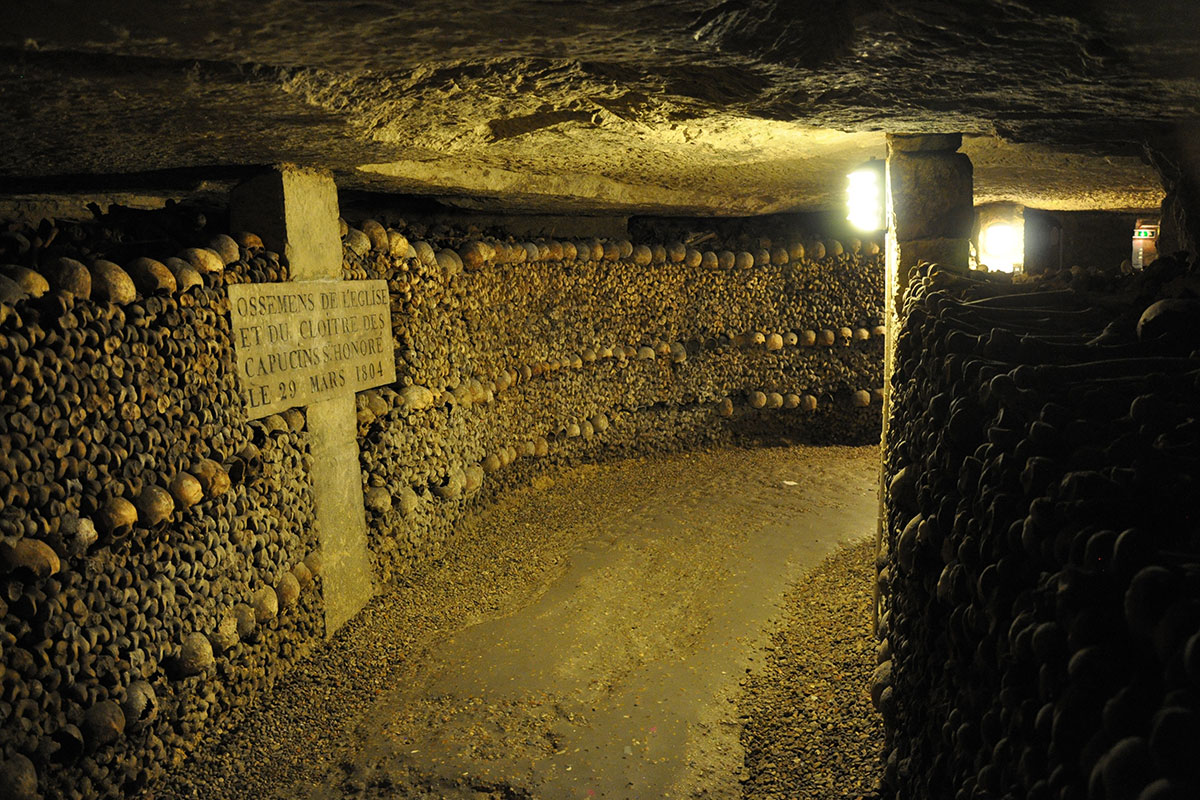
The Paris Catacombs offer an unusual tour of Paris, very different from the major surface monuments. You descend to understand a more underground part of the capital: old quarries, municipal ossuary, urban memory. To enjoy it fully, it's best to prepare your ticket, your schedule, your outfit, and your visiting pace.
Are the Catacombs of Paris really worth visiting?
Yes, provided you know what you're looking for. The Paris Catacombs are neither a neighborhood stroll nor a traditional museum. The path takes visitors about 65 feet underground, through former quarry tunnels, before reaching the municipal ossuary.
The site often attracts with its bone alignments, very famous in photos. On-site, the interest goes further: one better understands how Paris was built with its stone, then how the city managed Large-scale health and funeral issues. It is a dense, sometimes confusing, but very concrete visit for those who love urban history.
It is well-suited for travelers who want to visit Paris differently, for families with teenagers, for heritage enthusiasts, and for foreign visitors curious about a very Parisian spot. For young children or people uncomfortable in enclosed spaces, the experience requires more caution.
Book your guided tour: what to consider before going underground
It is better to anticipate a Guided tour of the Catacombs, as they welcome a limited number of visitors at a time, with timed tickets. During school holidays, weekends, or major tourist peaks, the most convenient time slots sell out quickly.
The Catacombs are part of the Unusual Paris tours the most requested.
Book in advance Avoid building an entire day around uncertain availability. The chosen slot also requires a minimum of organization: transport to Denfert-Rochereau, buffer time before entry, ticket check, and any reduced fare justifications.
The frequent error consists of thinking that one will be able to improvise on the spot, as for a walk. Access here is timed. An 11 AM ticket is not much use if you arrive at 11:25 AM after a rushed metro ride. It's better to allow plenty of time, especially with children, a group, or foreign visitors discovering Paris.
When is the best time to visit the Catacombs to avoid crowds?
The best slots are found Often on weekdays, preferably in the morning, outside of school holidays. It's not a guarantee of solitude, but the experience can be more comfortable with fewer visitors around.
In the galleries, the crowd is quickly felt. The passageways are narrow, the light remains dim, and the route advances in a single direction. A heavily frequented site on the surface can remain pleasant thanks to large open spaces. Underground, even the slightest slowdown weighs more heavily on the rhythm.
Weekends, long weekends, and summer naturally attract more people. For a quieter visit, avoid peak afternoons and days when you already have a busy schedule before your reserved time. Opening hours, closures, and last admission times can vary, so always check them before you go.
What to expect during the underground journey?
Visiting the catacombs requires a bit of stamina, even without athletic challenges. The route is about 1.5 km and lasts on average one hour. The temperature hovers around 14°C year-round, with noticeable humidity and sometimes uneven ground.
Take this tour as a guided underground walk. We descend, move through the galleries, and then ascend to the exit. The route is not suited for long breaks or backtracking. Once you start, you follow the planned path.
The descent, the galleries, and the atmosphere of the site
The entry begins with 131 marches. The break with the city happens quickly: the surface noises fade, the air becomes fresher, the stone walls tighten the scenery. Those who love raw places often find a memorable experience there.
The first galleries are a reminder that the Catacombs originated from a technical space. Paris drew stone from its quarries for some of its buildings. Consolidations, corridors, and inscriptions reveal an excavated, monitored, and developed underground space over time.
The setting can impress without needing to be dramatized. People who are claustrophobic or very sensitive to humidity should consider this before booking. For everyone else, the atmosphere is part of the site's appeal: you physically feel the distance from the Paris of boulevards and facades.
The municipal ossuary and the most notable rooms
The ossuary is the most anticipated part of the visit.. The bones were transferred there starting at the end of the 18th century, after health problems encountered in some Parisian cemeteries. The site was first an urban and sanitary response, before becoming a heritage site.
The arrangements of skulls and tibias are striking in their organization. They should not be approached as decoration, but as a space of remembrance. The remains of millions of Parisians rest in these galleries, which calls for a sober attitude: avoid inappropriate gestures, theatrical poses, and any contact with the bones.
Some inscriptions, plaques, and reinforcements can easily go unnoticed during a first visit. A rushed visitor will primarily notice the visual effect. A visitor who is better guided will understand more about the role of the quarries, the landscaping choices, and the progressive transformation of the site.
Is the route suitable for all visitors?
Not really. The tour is still accessible to many people, but it's not suitable for all profiles. The combination of stairs, narrow passages, and underground progression isn't suitable for many people.
Physical constraints to know before booking
The Catacombs are not recommended for people with reduced mobility, people with heart or respiratory problems, very sensitive visitors, and claustrophobic individuals. The site is not accessible by wheelchair or with a walker.
Before buying your tickets, especially keep these constraints in mind:
- 131 steps down and 112 steps up; ;
- Irregular soil, sometimes moist; ;
- narrow passages; ;
- dim light ;
- Cool temperature, around 14°C; ;
- No cloakroom during the hike.
Regarding attire, keep it simple and practical. Stable sneakers or closed-toe shoes will be more suitable than heels, flimsy loafers, or slippery sandals. Even in the summer, a light jacket can prevent you from shivering after twenty minutes.
Children, strollers, and accessibility
The visit can work very well with curious teenagers. For young children, the decision requires more attention. Partial darkness, bones, travel time, stairs, stroller not usable. Large bags are also prohibited.
The rules for accompanying minors must be verified at the time of booking, as practical information may specify age thresholds. In all cases, an adult must supervise the children and prepare them for the visit using simple words, without dramatizing the place.
For visitors with disabilities, access is severely limited due to the underground nature of the site. It is best to check the official conditions before purchasing tickets rather than discovering the problem upon arrival.
What should you prepare before coming to the Catacombs?
The visit truly begins before your arrival. The entrance is located near Denfert-Rochereau, on avenue du Colonel Henri-Rol-Tanguy, but the exit is on avenue René-Coty. This detail is important: do not plan to retrieve an item left at the reception, as there is no cloakroom along the route.
Travel light. Suitcases, large bags, motorcycle helmets, and strollers are not allowed. Small bags remain the simplest solution, with only what you need for an hour underground.
To plan before leaving:
- timed ticket, on phone or printed; ;
- justification for a special rate; ;
- comfortable shoes ;
- lightweight garment against the chill ;
- small compact bag ;
- Enough margin to arrive without rushing.
Also, please avoid bringing food or drinks during the visit. The route is not suitable for these activities and site regulations prohibit them. The objective is simple: arrive on time, walk comfortably, keep your hands free, and respect a fragile place.
Should you choose a guided tour of the Paris Catacombs?
A guided tour definitely changes the experience. for visitors who want to understand what they are seeing. A tour guide can adapt the presentation to the group, answer questions, and place the galleries within the history of Paris.
The site mixes several topics: careers, urban planning, public health, funeral practices, heritage conservation. Without explanation, one might miss part of the meaning. With clear interpretation, the visit gains depth without becoming academic.
Guides Tourisme Services, an agency offering multilingual guided tours, works with national licensed guides and adopts a professional approach: making heritage sites more accessible according to the audience, language, knowledge level, and pace of the group.
What a tour guide brings to the site
A tour guide in Paris first provides context. They connect the ancient quarries to the city's construction, explain the transfer of bones, comment on the inscriptions, and remind visitors of the specific rules for an ossuary.
It also helps avoid shortcuts. The Catacombs are often associated with dark, sometimes crude imagery. A guided tour sets the facts straight, without overplaying the eerie or making the visit cold.
For foreign visitors, language is very important. A tour in English, Spanish, Italian, German, or another language can make the experience smoother, especially with historical or heritage concepts that are difficult to grasp in French.
When to prioritize a private tour or a multilingual tour?
The private format is suitable for families, small groups, companies, travel agencies, or concierges who are looking for a more tailored pace. You can ask more questions, slow down on certain passages, and adapt the level of explanation.
A multilingual tour becomes relevant as soon as part of the group does not have a strong command of French. In an underground, dense, and sometimes impressive location, understanding what is being explained quickly makes the experience more comfortable.
For tourism professionals, the interest is also operational: managing schedules, access constraints, group expectations, the right tone in front of the ossuary. These details may seem minor on a program sheet. On-site, they often make the difference.
How to fit the Catacombs into a day of visiting Paris?
The Catacombs are located in the 14th arrondissement, near Denfert-Rochereau. To plan your day, start from this fixed point: the timed ticket dictates the time, the rest of the program must adapt.
Avoid planning an activity too far away Just before. A subway ride longer than expected or a delayed connection can be enough to make you late. After the visit, keep a freer moment instead: walk, have lunch in the neighborhood, head to Montparnasse, or go down towards Parc Montsouris.
It's also an opportunity to pair it with another guided tour of Paris to discover a different atmosphere, a neighborhood.
The sector pairs well with the Left Bank. Depending on your pace, you can continue towards the Montparnasse Cemetery., The Luxembourg Garden or the Latin Quarter. For a first visit to Paris, it’s better to avoid rushing too quickly to a monument located at the other end of the city.
A simple structure often works best: Catacombs in the morning, lunch break in the 14th arrondissement, an afternoon stroll. With children or a group, this type of day allows for more flexibility and limits fatigue.
Common mistakes that ruin an unusual tour of Paris
The first mistake is coming without a reserved ticket. This can sometimes be okay depending on the time of year, but the risk of wasting time remains real. To visit the catacombs under good conditions, an timed entry ticket is the safest choice.
Another classic mistake: underestimate the equipment. Heels, a large bag, a suitcase, and attire that's too light all unnecessarily complicate the visit. The rules are known before arrival, so it's best to follow them without improvisation.
It is also necessary Respect the nature of the place. The Catacombs are an unusual Paris visit, but they remain an ossuary. Photos should be discreet, bones should not be touched, and general attitude matters as much as curiosity.
Last point: Don't overload the day. One hour underground, with stairs and a particular atmosphere, can be more tiring than a museum visit. Plan for some real downtime after exiting, especially with a group or children.