
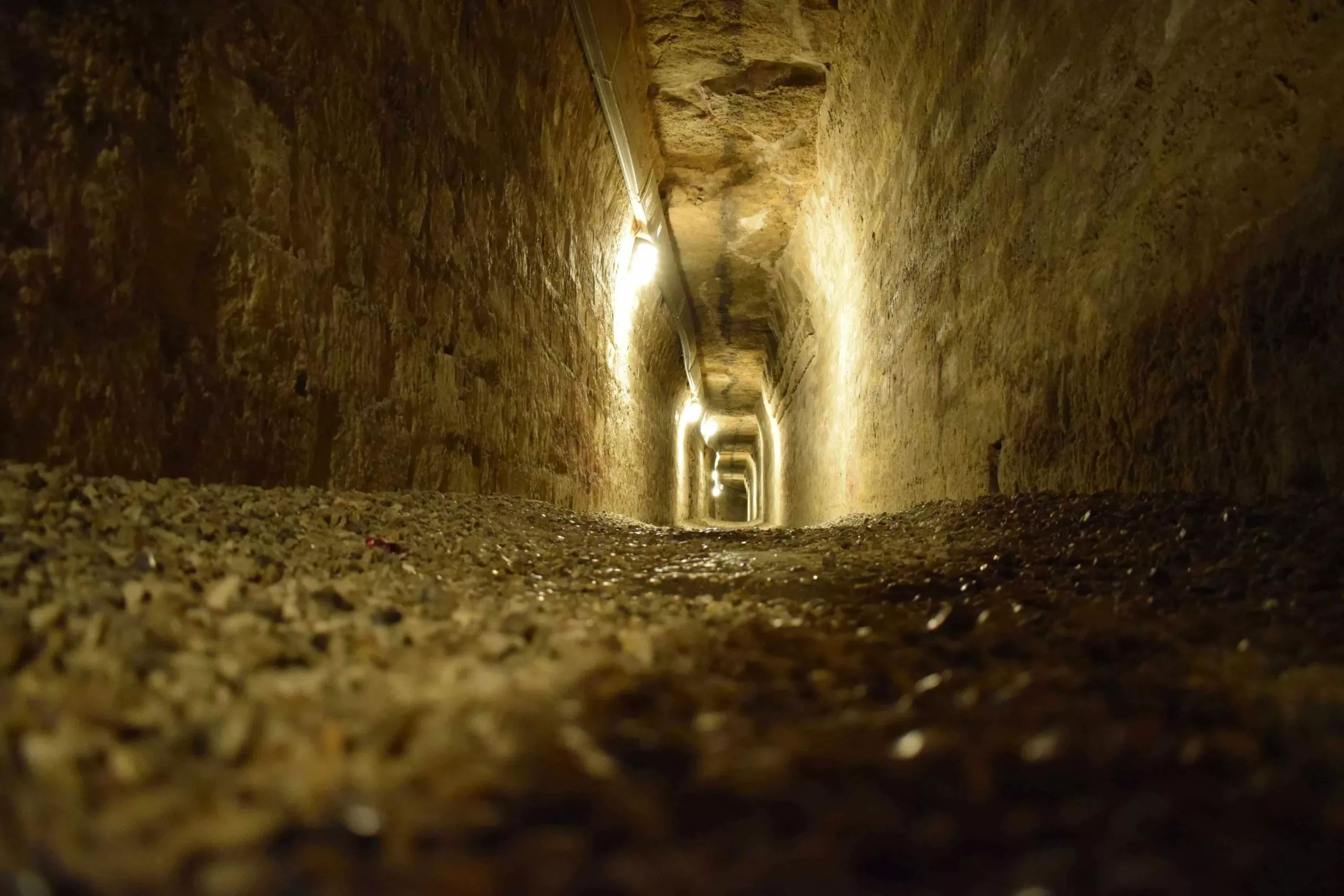
Visit Guided tour of the Paris Catacombs is one of the most unique experiences the capital can offer to those who know how to look beyond appearances. Just a few meters beneath the asphalt of the bustling streets of the 14th arrondissement, a world opens up—silent, mineral, holding six million souls and three centuries of underground history. It's not an ordinary museum. Nor is it a mere morbid curiosity. It is Paris in its geological and human depth, as only a expert guide-lecturer can restore it in all its complexity.
Since the first extractions of Lutetian limestone who supplied the stone for cathedrals and palaces, down to the revolutionary decision to transfer the bones from crowded cemeteries into these consolidated galleries, the Catacombs tell the story of a city that has never stopped transforming, even in its depths. Every pillar, every inscription, every carefully arranged row of bones is a document. A guided tour of the Paris Catacombs with a specialized guide is learning to read this document—and never looking at Paris the same way again.
The Catacombs of Paris: At the Origins of an Underground World
From Quarries to Ossuary: a Metamorphosis Over Three Centuries
The history of the Catacombs begins long before the bones. It begins with the stone. From the Middle Ages, and massively from the 12th century onwards, Parisian quarrymen extracted from the subsoil of the Left Bank a shell limestone of remarkable quality, Lutetian limestone, deposited about forty-five million years ago at the bottom of a shallow tropical sea. It is this blond, porous stone that will give its color to Notre Dame de Paris, the medieval Louvre, the Hôtel-Dieu, and hundreds of buildings that today constitute the capital's monumental heritage. Paris was literally built with its own entrails.
For centuries, these extractions were carried out without an overall plan, without systematic mapping, digging a network of galleries that gradually extended under a large part of the Left Bank. By the end of the 17th century, the quarrymen had long since abandoned these basements, which had become too deep and too dangerous for profitable exploitation, leaving behind a maze of poorly shored-up tunnels, collapsed chambers, and unsettling voids. The city, built above without regard for what supported it, begins to pay the price. Collapses occur, streets sink, houses disappear into sudden chasms. The Paris underground is a silent threat.
The metamorphosis that will transform these abandoned quarries into a municipal ossuary results from two simultaneous and distinct crises that the 18th-century city can no longer ignore. On one hand, the growing instability of the subsoil threatens the safety of the inhabitants. On the other, the Parisian cemeteries—and first and foremost the Halles of Paris, near Les Halles, in use for over ten centuries—are in a catastrophic sanitary state. The mass graves are overflowing, miasmas poison the surrounding neighborhoods, the wells are contaminated. Paris is suffocating between its dead and its emptiness.
The General Inspectorate of Quarries and the Consolidation of the Parisian Subsoil
It is in this context of urgency that King Louis XVI signs, in 1777, the edict creating the’General Inspectorate of Quarries. This institution, whose role is to map, consolidate, and monitor the entire Parisian underground network, undertook a titanic task that continues today in a modernized form. Its first director, Charles-Axel Guillaumot, the king's architect, would dedicate his life to this colossal task—and his name remains inseparable from the history of the Catacombs.
The engineers from the Inspection descend into the galleries with candles and measuring instruments, draw the first accurate plans of the network, identify collapse zones, and undertake to consolidate the galleries with a system of masonry pillars, retaining walls, and reinforced vaults. This painstaking work, carried out in extreme conditions—total darkness, constant humidity, rarefied air—will gradually transform a chaotic network into a relatively controlled system. The galleries consolidated by the General Inspection of Quarries represent approximately three hundred kilometers under Paris, only two kilometers are open to the public on the official Catacombs route.
The mapping undertaken by Guillaumot and his successors is in itself a masterpiece of precision. The plans superimpose the underground network onto the surface topography, making it possible to accurately identify which streets, buildings, and monuments rest on consolidated or unconsolidated voids. This exceptional documentation, preserved in the archives of the General Inspectorate of Quarries, constitutes a scientific and historical heritage of inestimable value—and one of the most fascinating narrative threads a tour guide can unfold during a guided tour of the Paris Catacombs.
Charles-Axel Guillaumot and the Birth of the Municipal Ossuary
The decision to transfer the remains from Parisian cemeteries to the consolidated galleries was made in 1786, under the joint impetus of Guillaumot and the lieutenant general of police Thiroux de Crosne. It responds to a logic that is both sanitary and practical: the empty galleries offer considerable space to receive the millions of bones that saturated cemeteries can no longer hold. The Cemetery of the Innocents is the first to be emptied, between 1786 and 1788. The bones are transported at night, in carts draped in black and blessed by priests, and deposited in the galleries through access shafts.
Initially, the bones are simply dumped in bulk into the galleries. It is only from 1810, under the impetus of Prefect Frochot and thanks to the work of the miner Louis-Étienne Héricart de Thury, that the bones are reorganized decoratively — arranged into walls of tibias and femurs, topped with rows of skulls, forming the funerary compositions that characterize the ossuary today. Héricart de Thury also authored the poetic and biblical inscriptions engraved in stone, which mark the path and give the whole a meditative and solemn dimension that the simple storage galleries of the early years did not possess.
He is also the one who had several remarkable rooms fitted out, including the Crypt of the Passion and Gilbert's Tomb, transforming what could have remained a simple sanitary facility into a veritable organized funerary monument, open to official visits from 1809. Napoleon III himself would make a historic visit to the ossuary, accompanied by the King of Sardinia—proof that the Catacombs had become, from the 19th century onwards, a place of prestige as much as of memory.
Architecture and Geology of the Paris Quarries
Lutetian limestone: the stone that built Paris
Going down into the Catacombs is first and foremost going down in geological time. The walls of the galleries are made of Lutetian limestone, a sedimentary rock formed forty-five million years ago, at a time when the Paris Basin was covered by a warm, shallow sea populated by mollusks, sea urchins, and nummulites—those microscopic foraminifera whose calcified shells still form inclusions visible to the naked eye in the stone today. An attentive tour guide will point them out, transforming the wall of a gallery into a page of a forty-million-year-old geology book.
Lutetian limestone appears in superimposed beds of varying thickness, separated by layers of marl and clay. Medieval quarrymen quickly learned to distinguish the different qualities of stone: the "liais," dense and compact, is suitable for sculpture and load-bearing elements; the "cliquart," softer, is used for infills and secondary masonry; the "vergelé," intermediate, offers a good compromise between resistance and ease of cutting. This empirical knowledge, passed down from generation to generation, attests to remarkable technical sophistication that unaccompanied visitors usually do not suspect.
The characteristic color of this limestone—that golden beige that tints Haussmannian facades and Paris's most emblematic monuments—takes on darker hues in the underground galleries, weathered by humidity and time. Where artificial light strikes the walls at a grazing angle, one can distinguish the horizontal striations of geological strata, the tool marks left by quarrymen, and sometimes fossilized imprints of shells that seem to emerge from the rock like silent witnesses of a submerged world. This is one of the most unexpected visual thrills offered by a guided tour of the Paris Catacombs.
The underground network: tunnels, pillars, and reinforcements
The network of galleries that makes up the former Parisian quarries is of a labyrinthine complexity that only meticulous mapping can help us understand. In the part accessible to the public, the official route of the Catacombs follows galleries with heights varying between 1.80 and 2.50 meters, and widths ranging between one and three meters. The vaults, carved in Full circle or basket handle depending on the eras and techniques used, bear witness to the care taken by the engineers of the General Inspectorate of Quarries in consolidating these spaces.
The consolidation pillars are the most characteristic architectural element of Guillaumot's work and that of his successors. Built of limestone rubble masonry bonded with lime mortar, they are arranged in a calculated mesh to support the loads from the ground and the buildings on the surface. Some of these pillars, particularly imposing, bear nameplates engraved, indicating the street or monument located above – a dizzying connection between the underground world and the city left a few dozen meters higher.
Along the way, some surveillance look — circular openings made in the vault — allowed quarry inspectors to monitor the condition of the galleries from the surface. Underground springs, fed by rainwater infiltrating through the geological layers, attest to the hydrological richness of the Parisian subsoil. The constant temperature of eleven to twelve degrees Celsius, regardless of the season, and the near-saturation humidity create a microenvironment that has contributed to the remarkable preservation of bones and inscriptions over the centuries.
Human bones on the walls: the funerary art of the ossuary
The transformation of the storage galleries into an organized ossuary constitutes one of the most unique chapters in the history of Western funerary art. When Louis-Étienne Héricart de Thury undertook, starting in 1810, to reorganize the bones that had been piled up in bulk since 1786, he did more than just tidy them up. He conceived a true scenography of death, playing on the contrasts between the whiteness of the bones and the darkness of the galleries, between the anonymous mass of millions of deceased and the singularity of the inscriptions that gave them a collective voice.
Visit walls of bones The walls bordering the path are constructed according to a logic that is both aesthetic and practical. The long bones - tibias and femurs - form the horizontal foundations, piled up with almost architectural regularity. The skulls, arranged in rows at regular intervals, create a visual rhythm that oscillates between the decorative and the macabre. Behind this carefully composed facade, the remaining bones are piled loosely several meters deep – a funerary reserve estimated to contain the remains of approximately six million Parisians who died between the 10th and 18th centuries.
Some compositions are particularly elaborate. The Heart of Méricourt, made of tibias arranged in a heart shape on a background of skulls, is one of the most photographed pieces in the ossuary. The Guillaumot barrel, a symbolic reconstitution of a barrel made of bones arranged in concentric circles, pays tribute to the first inspector of quarries. These compositions demonstrate an aesthetic sensibility that transcends mere funerary utility and makes the Catacombs a unique place in the world—halfway between a memorial, a museum, and a total work of art.
Prepare for your guided tour of the Paris Catacombs: what each room reveals
The access stairs and the Port-Mahon gallery
The descent into the Catacombs begins with a spiral staircase one hundred and thirty-one steps, carved from the limestone bedrock, leading visitors to a depth of about twenty meters below street level. Twenty meters represents both a physical distance and a temporal leap—the passage from a noisy, bright Paris to a world of silence, stone, and controlled darkness. From the first steps, the temperature drops, the air becomes humid, and the sounds of the surface gradually fade. It is a total sensory experience that simply reading an explanatory sign cannot convey.
At the bottom of the stairs opens the Port Mahon Gallery, one of the most astonishing on the route. It owes its name to an 18th-century quarryman, Beaugrand, who carved a bas-relief representation of the citadel of Port Mahon in Spain, where he had been taken prisoner of war, into the limestone wall. This exceptional testament to spontaneous artistic creation, made in almost complete darkness and isolation, is one of the most moving human documents found in the Parisian underground. The gallery also houses a hollowed-out sculpture representing Fort Saint-Philippe, whose architectural details testify to remarkable visual memory and manual dexterity for a man working by candlelight.
Before reaching the ossuary itself, the path goes through several hundred meters of so-called «neutral» galleries—not decorated with bones, but rich in geological and historical information for a trained eye. The Limestone layers visible in the walls, the pick and chisel marks left by the quarrymen, the niches hollowed out to place oil lamps, the kilometer markers placed by the General Inspection of Quarries — all details that only a specialized guide-lecturer knows how to transform into a vivid and coherent narrative.
The heart of the ossuary: the Crypt of the Passion and the Great Halls
Underpass Engraved portico The inscription «Stop, this is the empire of Death» marks the entrance to the ossuary itself. This phrase, attributed to Héricart de Thury and engraved in the limestone above the threshold, is not a macabre warning—it's an invitation to change registers, to adopt the slowness and contemplation that this place demands. Visitors who cross this threshold without paying attention miss the essential: the Catacombs are not visited, they are read.
Visit Crypt of the Passion This is the first large room encountered after the vestibule. Organized around a massive central pillar, it features a particularly well-arranged composition of bones, with rhythmic alternations of skulls and long bones that create a striking sense of visual depth. It is in this room that Héricart de Thury placed some of the most poignant inscriptions of the tour—excerpts from Lamartine, Young, and Gilles des Rues—which lend the whole an literary and philosophical dimension rare in a funeral context.
Further on, the Samaritan Hall and the Tomb of Gilbert — named after the poet Nicolas Gilbert, who died at twenty-nine in 1780 — punctuate a route that alternates between large halls and narrower galleries, creating a spatial rhythm that prevents any monotony. Gilbert's tomb, a simple carved stone set into a wall of bones, is one of the rare named elements in the ossuary—a reminder that behind the anonymity of millions of piled bones, each death had a name, a life, a story. It is precisely this transition from the general to the particular that the tour guide excels at enacting, giving each visitor a sharp awareness of what this space truly represents.
19th-century inscriptions, fountains, and landscaping
One of the lesser-known dimensions of the Catacombs is their epigraphic richness. Throughout the path, inscriptions carved into the limestone line the galleries and rooms of the ossuary—biblical quotations, excerpts from Latin and French poets, collective epitaphs, dedications to the dead of the various Parisian parishes whose bones have been transferred. These texts, chosen and arranged by Héricart de Thury with obvious care, form a funeral anthology of remarkable coherence, which transforms the visit into a meditation on the human condition as much as a history lesson.
Visit Underground fountains constitute another notable architectural element of the route. Fed by infiltration waters that slowly percolate through the geological layers, they bear witness to the hydrological richness of the Parisian subsoil and the’ingenuity of 19th-century planners, who knew how to take advantage of these natural sources to animate and humanize a space that could have been just a funeral warehouse. The Fountain of the Samaritan woman, in particular, whose circular basin is framed by carefully carved limestone pilasters, is a small masterpiece of underground architecture that most hurried visitors do not even notice.
The developments carried out throughout the 19th century—additional consolidations, creation of new access points, installation of a Lighting system First by candle, then by gas, then by electricity, installation of Protective grilles for the most fragile compositions—bear witness to constant attention paid to the preservation and enhancement of this exceptional heritage. Today classified as a historic monument integrated into the network of the City of Paris Museums, the Catacombs receive over five hundred thousand visitors each year, making them one of the most visited sites in the capital—and one of the least understood by those who visit without expert guidance.
The Catacombs in the History of Paris
French Revolution, Paris Commune, and the Memory of Crises
The Catacombs are not just an ossuary — they are a underground witness of all the upheavals that have shaken Paris since the late 18th century. The French Revolution It bears the marks of that era as early as 1789: among the six million skeletons that lie in its tunnels are those of the victims of the Reign of Terror, transferred from the mass graves of Parisian cemeteries in the years following the great massacres. Danton, Robespierre, Lavoisier—their bones lie somewhere in the anonymity of these walls, mingled with those of the bourgeoisie, artisans, and the destitute from previous centuries. Absolute equality in the face of death, which the Revolution proclaimed as a political ideal, is realized here in its most literal and irrefutable form.
In 1793, a less known but fascinating episode illustrates the strategic role underground galleries could play in times of crisis: the conventionnel Hérault de Séchelles is organizing a revolutionary banquet, bringing together several hundred guests in the galleries by torchlight. This event, half political and half mythological, bears witness to how Parisians very early on perceived this subterranean world as a separate space, free from the rules and hierarchies of the surface—a perception that would only deepen over the following centuries.
The Paris Commune, in 1871, gave the Catacombs a new role — that of shelter and of secret communication channel. The Federates used certain tunnels to move about while sheltering from the Versailles bombardments, while stockpiles of weapons and ammunition were temporarily hidden there. After the Bloody Week, the bodies of Communards were thrown into some of the access shafts, adding another layer to the funerary stratigraphy of this underground space already steeped in history. During the World War II, the Catacombs are once again serving as a refuge: the French Resistance and set up a clandestine headquarters, while the German occupier, on his side, set up a bunker in a separate section of the network. This simultaneous dual use, unknown to either party, is one of the most romantic episodes of the underground history of Paris.
The Cataphiles and the Forbidden Parisian Underground
Beyond the two kilometers of galleries officially open to the public, lies a network of nearly three hundred kilometers of tunnels, rooms, and quarries that are not visited – that should not be visited, at least officially. It is the domain of cataphiles, As these urban explorers who, since the 1970s, enter the country illegally into the underbelly of Paris to map, photograph, and temporarily inhabit these forbidden spaces. Neither vandals nor mere onlookers, cataphiles form an urban subculture of remarkable richness and complexity, with its own codes, initiation rites, cartographers, and artists.
The « Forbidden catacombs »— an imprecise term, but one consecrated by usage to designate the unofficial parts of the network — hold unsuspected treasures: rooms adorned with frescoes painted by anonymous artists, underground libraries made up of thousands of salvaged books, spaces set up as concert halls or clandestine cinemas, mosaics and sculptures carved directly into the limestone rock. In 2004, police discovered a fully equipped cinema in an underground room, complete with a screen, seats, a sound system, and a wine cellar — without ever managing to identify those responsible for this clandestine setup.
The Paris Gendarmerie Brigade responsible for monitoring underground quarries, nicknamed the «Cataflics» by cataphiles, regularly patrols the official tunnels and their surroundings to issue citations for illegal trespassing. The fines, set at sixty euros, have little deterrent effect on explorers motivated by something other than gratuitous transgression. This tense coexistence between the authorities and the cataphiles is one of the most vibrant and contemporary facets of a place that would be wrong to reduce solely to its funerary past—and one of the most captivating narrative angles that an expert tour guide can explore during a guided tour of the Paris Catacombs.
Why book your guided tour of the Paris Catacombs and underground galleries with GTS?
What a tour guide reveals that the route alone doesn't say
The official tour of the Catacombs is clearly marked, well-lit, and accompanied by carefully written informational signs. You can follow it on your own, from the entrance to the exit, in less than an hour, and come out feeling like you’ve seen something impressive. But “impressive” doesn’t quite capture it. And that’s precisely where Our guided tour service with a tour guide from Guides Tourisme Services change everything.
An expert tour guide doesn't just repeat what the signs say. They read the walls like a geologist, the bones like an art historian of funerary art, the inscriptions like a literary scholar. They know why one skull has a different hue than the others—an indication of a distinct origin, a transfer made at a different date. They are aware of the historiographical debates surrounding the attribution of certain compositions, the anecdotes about the quarry workers who sculpted the Port-Mahon gallery, the precise circumstances in which Héricart de Thury chose one Lamartine quote over another. This knowledge, accumulated and distilled over hundreds of visits, transforms an underground stroll into an intellectual and sensory experience of rare depth.
Visit Guided tour with GTS adapts to each group — families with children, couples, groups of friends, professionals on seminars, foreign delegations. The GTS tour guide is fluent in several foreign languages and offers a reference Paris Catacombs guided tour in English, allowing American, British, Spanish, or Italian visitors to experience this in their native language, with the same richness of content and historical accuracy as in French. For families, the guide adapts their narration to captivate the youngest without impoverishing the content for the adults — a delicate balance that only extensive experience allows to be naturally achieved.
Privatization and customized access with GTS
For those who wish to experience the Catacombs in exceptional conditions, Guides Tourisme Services offers the privatization of the Paris Catacombs — a Paris Catacombs Private Tour exclusive, radically transforming the nature of the visit. Outside of public opening hours, without the crowds of ordinary visitors, in a silence and darkness that daytime attendance never fully allows, the ossuary reveals an additional dimension—that of an authentically timeless space, suspended between centuries, undisturbed by anything.
This privatization formula is for both individuals seeking a memorable experience and professionals—event agencies, tour operators, concierge services at Parisian palaces, and companies wishing to organize an exceptional seminar or dinner in a unique setting. GTS has the network and expertise necessary to orchestrate these events with absolute respect for the venue and regulatory constraints, guaranteeing each client a tailor-made experience, thought out down to the smallest detail.
Whether it's a small group guided tour, a private family outing, or a large-scale corporate event, GTS handles all the logistics – from coordinating with the relevant authorities to on-site support from an expert tour guide. The visitor simply needs to immerse themselves in the experience. Beneath the streets of Paris, twenty meters deep, in the golden light of the limestone galleries and the absolute silence of the ossuary, the city's history reveals itself in its most intimate and breathtaking dimension. It is this revelation that Guides Tourisme Services invites you to experience – tailor-made, at your own pace, with the dedication and passion that define each of its services.
Conclusion
The guided tour of the Paris Catacombs offered by GTS is a unique experience, meticulously planned. Beneath the streets of Paris, twenty meters deep, time flows differently. The stone holds the memory of everything—from the medieval quarrymen who carved it by candlelight, to the revolutionaries who walked these galleries, to the millions of anonymous souls whose bones make up these peculiar walls. This subterranean heritage awaits an enlightened gaze to reveal itself in all its depth.
Guides Tourisme Services opens the doors to this unique world for you—with the rigor, precision, and passion that define all of its services. You are not a visitor. You are a guest. Contact GTS to create your customized experience together.
FAQ — Paris Catacombs Guided Tour
What is the difference between a self-guided tour and a guided tour of the Paris Catacombs?
A self-guided tour allows you to explore the official two-kilometer route at your own pace, referring to the explanatory panels placed along the way. A guided tour of the Paris Catacombs with an expert lecturer offers a radically different experience: the lecturer contextualizes each room, each arrangement of bones, and each inscription within a coherent historical, geological, and artistic narrative that the panels alone cannot convey. The duration of the visit is also longer, the pace more relaxed, and the content tailored to the group's specific interests – whether in history, geology, funerary art, or anecdotes about cataphiles.
Are the Paris Catacombs accessible to children?
The Paris Catacombs are accessible to children, but the visit requires appropriate preparation. The darkness, the constant cool temperature of eleven degrees Celsius (52°F), and the very nature of the place—an ossuary containing the bones of six million people—can be unsettling for younger children. An experienced GTS tour guide knows how to adapt their narrative to engage children without frightening them, focusing on geological aspects, anecdotes about medieval quarrymen, and the mysteries of the Parisian underground rather than the funerary dimension. The visit is generally not recommended for children under six years old.
Can we visit the Paris Catacombs in English?
Yes, and that's one of the specialties of Guides Tourisme Services. GTS tour guides are fluent in several foreign languages and offer a Paris Catacombs Tour in English — a considerable asset for American, British, or any English-speaking visitors worldwide who wish to experience this in their native language with the same richness of content as in French. GTS also offers tours in Spanish, Italian, and other languages upon request — a unique multilingual offering that makes the agency the preferred partner for tour operators and Parisian palace concierge services catering to an international clientele.
Is it possible to privatize the Paris Catacombs for an event?
Yes, Guides Tourisme Services offers the privatization of the Paris Catacombs for private or professional events — exceptional dinners, corporate seminars, event evenings, and filming. This exclusive option, organized outside of public opening hours, offers a unique setting in the world, steeped in history and mystery, that few Parisian agencies can provide. GTS handles all logistical and regulatory coordination and accompanies each event with an expert tour guide. For any personalized quote requests, the GTS team is available seven days a week via the contact page on the website.
How long does a guided tour of the Paris Catacombs last?
A guided tour of the Paris Catacombs with GTS lasts on average between one hour and a half and two hours, depending on the group's pace and the desired depth of exploration. This is significantly longer than a standard self-guided visit, which usually takes less than an hour. This more relaxed pace is essential to allow the guide to develop the various narrative threads—geological, historical, and artistic—that make the site so rich. For professional groups or private bookings, the duration is tailored to the program for the evening or day.