
Under the rooftops of Paris, there is a territory that defies any easy definition. Montmartre is not just another neighborhood—it's a rise of gypsum limestone that sprang up 130 meters above the Seine, a village absorbed by the capital without ever adopting its ways. Here, the streets climb, fork, disappear into staircases, and reappear as alleyways. Sandstone facades stand alongside glass-fronted workshops, secret gardens spill over walls, and the city below seems to belong to another world. Montmartre is earned—it is explored slowly, with someone who knows its hidden paths. A guided tour of Montmartre Everything about this experience.
For a century and a half, the Butte has been the laboratory of modern art. Toulouse-Lautrec, Picasso, Utrillo, Steinlen, Modigliani They lived there, worked there, argued, loved. They left behind not only masterpieces but a memory inscribed in every cobblestone, every street corner, every cafe now transformed into a souvenir shop. To read Montmartre is to know where to look—and, above all, what you are looking at.
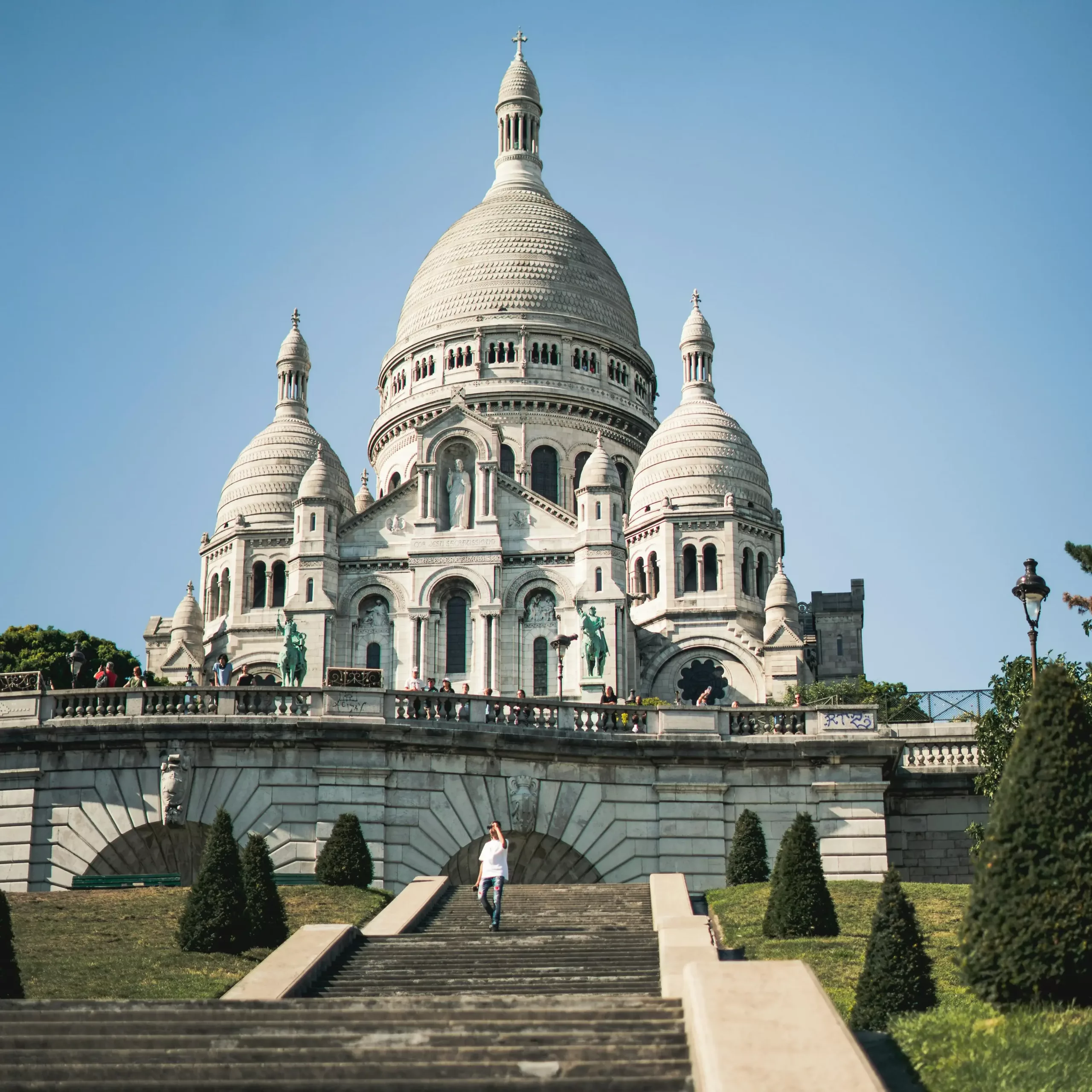
The Basilica of the Sacred Heart dominates the hill since 1914, visible from almost everywhere in Paris, an absolute landmark for millions of visitors each year. But Montmartre is also Saint-Pierre de Montmartre, one of the oldest churches in the capital, whose Romanesque capitals predate the construction of Notre-Dame by several centuries. It is the Romantic cemetery where Degas, Stendhal, Berlioz, and Dalida rest. It is the vine, the last agricultural remnant of a territory that produced wine long before Paris existed.
Exploring Buttes without a guide is like traversing a palimpsest without reading its layers. With a GTS speaker guide, each facade becomes a narrative, each staircase an anecdote, each square a theater stage restored in its historical and human truth.
La Butte Montmartre: A Village Suspended Above Paris
A hill, Quarries, and Gypsum: The Secret Geography of the Butte
What visitors don't see as they climb Rue Lepic or the endless funicular stairs is that Montmartre rests on a largely hollowed-out basement.. The hill is largely composed of gypsum, a sedimentary rock extracted since antiquity and massively quarried from the Middle Ages to produce the famous plaster of Paris — so named because the quarries of the Butte were its main source for all of Europe. This intense exploitation dug a network of galleries under the hill, some of which, now consolidated, still run under the foundations of buildings.
Visit Geology of Montmartre explain partly its very particular topography. Unlike the rest of Paris, built on relatively stable Lutetian limestone, the Butte features subsidences, irregular slopes, and micro-valleys that have long made dense construction difficult. It is this natural ground resistance Who preserved Montmartre from the great Haussmannian transformation — while Baron Haussmann was aligning and piercing 19th-century Paris, the Butte preserved its medieval alleys, its terraced gardens, its low houses of one or two stories.
Visit Montmartre Bohemian has a characteristic color, slightly ochre and luminous in full sun, which is found in the retaining walls of old gardens and in some preserved facades at the bottom of the Butte. It is this same material that gives some corners of Rue Lepic or Rue Caulaincourt this mineral heat so different from the blond limestone in the center of Paris. A detail that only a discerning eye—or an attentive tour guide—knows how to point out at the right moment.
La Butte also had, until the 19th century, several Sources and streams supplying washhouses and market gardens. The water flowed on the surface in paved channels that can still be guessed in the winding layout of certain alleys. This forgotten hydraulics is one of the keys to understanding the establishment of the first mills and the agricultural and artisanal vocation that long characterized the village — before Paris, by annexing it in 1860, gently, begins to progressively transform its face. A basement that GTS guides systematically mention during any guided tour of Montmartre.
Mills, vineyards, and taverns: Montmartre before the bohemian era
Long before Picasso settled into the Bateau-Lavoir, Montmartre was a rural village administratively attached to Seine-et-Oise, producing wine, flour, and plaster for a capital from which it remained officially separate. The village at its peak counted more than thirty windmills, whose silhouettes dominated the Butte and formed a familiar visual landmark for Parisians looking northward. Only two remain today: the Moulin Radet and the Moulin de la Galette, the latter having given his name to the famous painting by Pierre-Auguste Renoir painted in 1876, depicting an outdoor ball under acacia trees.
Visit Moulin de la Galette is actually the fusion of two distinct mills—the Blute-fin and the Radet—brought together on the same property by the family Debray at the beginning of the 19th century. The Debray family had transformed the site into a popular guinguette where people danced on Sunday afternoons, drank wine from the nearby vineyard, and ate the miller's galette – a round brioche whose recipe has been lost. Renoir immortalized this Light and bourgeois festive atmosphere in one of the brightest paintings of Impressionism, now housed at the Musée d'Orsay.
Visit Montmartre vineyards dating back at least to the 12th century, the time when Benedictine Nuns of the Royal Abbey — founded around 1133 on the site of the current Saint-Pierre church — cultivated the hill to produce altar wine consumed locally. At its peak, the Montmartre vineyard covered several hectares and supplied some of the cabarets and guinguettes at the bottom of the butte. The progressive urbanization of the 19th century reduced this vineyard to a symbolic parcel Rue Saint-Vincent, which still exists today and whose annual harvest takes place every October with the Grape Harvest Festival, one of the most anticipated popular events on the Parisian calendar.
Before bohemianism and artist studios, Montmartre was therefore a work and play territory — a place where Parisians would come to unwind on Sundays, dance in the open-air taverns, drink light wine, and look out over Paris from its heights. This memory, less spectacular than the artistic legend, is nonetheless essential to understanding Why did the artists choose the Butte? because she was cheap, cheerful, free, and already on the margins—exactly what they needed. A popular memory that the Guided tour of Montmartre GTS returns accurately.
The Golden Age of Art: From Toulouse-Lautrec to Picasso
The Bateau-Lavoir: a key stop on the Montmartre guided tour
At number 13 Place Émile-Goudeau, a rickety, poorly heated wooden building changed the history of world art. Bateau-Lavoir — thus nicknamed by the poet Max Jacob Referring to the laundry boats moored on the Seine, whose unsteady silhouette evoked that of the building—was originally a piano factory converted into workshops rented at very low prices to penniless artists. Pablo Picasso settles in 1904, gradually joined by Juan Gris, Georges Braque, Kees van Dongen and a constellation of poets, including Guillaume Apollinaire and Max Jacob himself, who revolve around the workshops like satellites of a celestial body in formation.
It is in this uncomfortable studio, cluttered with canvases, empty bottles, and stray cats, that Picasso paints between 1906 and 1907 a work that will shatter the artistic conventions of its time: The Young Ladies of Avignon. The painting, inspired by the African and Iberian masks that Picasso studied at the Trocadéro and the formal lesson of Paul Cézanne, with any illusionistic representation of space and the human body. Forms are deconstructed, planes are simultaneous, faces are distorted according to an internal logic that is no longer that of the eye but that of thought. The Cubism is in gestation — and it will be born here, on the Butte, in the smell of turpentine and coal stove of the Bateau-Lavoir.
The original building burned in 1970, leaving only the street-facing facade. It was rebuilt and today houses artists' studios that are still active, in a symbolic continuity that touches those who know what these walls have sheltered. commemorative plaque affixed to the east facade, is sober—almost insufficient given what happened there. It's one of those places where the presence of a tour guide makes all the difference: without context, it's an ordinary building on a cobbled square. With context, it's one of the founding places of 20th-century art.
Juan Gris, long overshadowed by Picasso's fame, nevertheless produced some of the movement's most rigorous and colorful Cubist works at the Bateau-Lavoir. Amedeo Modigliani, who stayed in Montmartre before settling in Montparnasse, frequented the same circle and developed his distinctive style during those years—portraits with elongated necks, almond-shaped eyes, and a subdued melancholy. The Artistic geography of the Butte is dense, layered, and each address tells a story of a journey, a meeting, a breakup. It is one of the essential stops on a guided tour of Montmartre with GTS.
The Moulin Rouge, the Black Cat, and the Birth of the Parisian Cabaret
If the Bateau-Lavoir is the mecca of erudite Montmartre art, the bottom of the hill sparked another revolution, less academic but just as decisive: that of popular entertainment and cabaret culture. It was in the years 1880-1900 that Montmartre is becoming the world capital of nightlife, attracting a mixed clientele of bourgeois with a taste for transgression, artists, journalists, and foreigners coming to find what their respective capitals did not offer them.
Visit Cat Noir, founded in 1881 by Rodolphe Salis On Boulevard Rochechouart, it is the first of the great Montmartre cabarets. Salis invented a then-unprecedented concept: a place where one drinks, recites poetry, plays music, exhibits paintings, and where the owner insults the customers with a carefully cultivated aristocratic aplomb. Aristide Bruant, the singer in the black cape and wide-brimmed hat forged his reputation there before opening his own establishment—and it was that Henri de Toulouse-Lautrec who will immortalize his image in lithographed posters whose graphic style revolutionizes the art of advertising.
Toulouse-Lautrec is inseparable from Montmartre. Located in the neighborhood since 1884, he assiduously frequents the balls, cabarets, and brothels, not out of exclusive debauchery but out of an ethnographic fascination with the margins and bodies in motion. His posters for Moulin Rouge — opened on 1889 boulevard de Clichy by Joseph Oller and Charles Zidler are masterpieces of graphic economy: flat colors, synthetic silhouettes, lettering integrated into the composition. La Goulue, Valentin the Boneless, Jane Avril — these dancers of the naturalist quadrille become under his brush icons of an urban and popular modernity that no other artist has been able to capture with such acuity.
Visit Moulin Rouge it still exists, on Boulevard de Clichy, with its rotating red wings visible from afar. It has weathered fires, reconstructions, and economic shifts to become one of the most famous shows in the world – now very far removed from its original rebellious and transgressive spirit. But its walls hold the memory of Toulouse-Lautrec drawing on the tablecloths, of La Goulue lifting her leg to shoulder height, from an era when Montmartre invented something every night that the rest of the world would only see later. An era that all guided tour of Montmartre with GTS, it returns accurately.
Place du Tertre: Myth, Reality, and the Painter's Perspective
No place in Montmartre concentrates as many paradoxes as the Place du Tertre. Technically, it is one of the oldest squares in the village – it existed even before the annexation of Montmartre by Paris, lined with low houses and a communal gallows whose memory has since faded. Today, it is the most frequented and most photographed spot on the Butte, invaded from the morning by painters' easels and restaurant terraces, and thronged all day by streams of visitors from all over the world.
The tension between the Artistic myth and the commercial reality of Place du Tertre is one of the richest subjects a tour guide can tackle. Most of the painters who set up there today are portrait artists and painted souvenir vendors whose activity is overseen by the 18th arrondissement town hall through a system of licenses and assigned spots. Some are true artists; others are skilled artisans; all participate in a staging of La Bohème what visitors come looking for and what the place provides them with mechanical regularity.
What few visitors know is that the Great names of Montmartre art For the most part, they never painted Place du Tertre. Utrillo painted his deserted alleyways from postcards in his studio due to increasing agoraphobia. Picasso worked at the Bateau-Lavoir, a few hundred meters away. Suzanne Valadon, one of the few recognized women painters of that era, lived on Rue Cortot with her son Utrillo and her partner André Utter — in a house that today houses the Montmartre Museum, one of the most beautiful on the Butte, with its terraced gardens overlooking the vineyards.
Looking at the Place du Tertre through the eyes of a tour guide means seeing simultaneously several layers of time the medieval village, the Belle Époque bohemianism, the 20th-century touristification, and today's commercial vitality. It is understanding that the myth is not false—it is simply out of sync, and that the real Montmartre of the artists is hidden in the adjacent streets, thirty seconds' walk from the rows of easels. That is the perspective that a GTS tour guide brings to each Guided tour of Montmartre.
The Sacré-Cœur and the Architecture of the Butte: Montmartre Guided Tour
The Sacré-Cœur Basilica: travertine stone, domes, and light
From the parvis of the Sacré-Cœur, Paris stretches out as far as the eye can see in a light that changes with the hours and seasons—gray and pearly in winter, golden and almost Mediterranean on beautiful summer days. Basilica of the Sacred Heart is one of the most photographed monuments in France, and yet one of the least understood in its architectural and political genesis. Its construction was spread over forty-four years, of 1875 to 1914, on a project by the architect Paul Abadie — the same one who had supervised the restoration of the Saint-Front Cathedral in Périgueux, whose Byzantine silhouette clearly fueled his imagination.
Choosing the style Romano-Byzantine is not insignificant. The basilica was voted for by the National Assembly in 1873, in a context of military defeat against Prussia and deep trauma left by the Paris Commune — Montmartre had been one of the main centers. It is conceived as an act of’national expiation and a Catholic reaffirmation, which earned it fierce opposition from the republican and anti-clerical left from the very beginning. This political dimension, often ignored by visitors, is essential to understanding why the basilica still provokes such contrasting reactions today.
The material used for its construction is a Pierre Travertine extracted from the quarries of Château-Landon in Seine-et-Marne, chosen for a remarkable property: in contact with rain and humidity, it secretes calcite which whitens the surface instead of blackening it. It is this natural chemical process that explains the persistent white discoloration of the Sacré-Cœur, so striking compared to the grayish limestone of other Parisian monuments. A century and a half of Parisian rains has only enhanced the facade's brilliance—a mineral paradox that visitors generally do not suspect, and that the GTS guides explain systematically during the Guided tour of Montmartre.
The interior of the basilica holds several architectural surprises. The central dome culminate in 83 meters and houses one of the largest mosaics in the Christian world — 480 square meters representing Christ in majesty, work by Luc-Olivier Merson completed in 1922. The crypt, accessible by a side staircase, houses the heart of’Alexandre Legentil, one of the initiators of the national vow that led to the construction. The Savoyard bell, melted in 1895 and weighing 18,835 kilograms, is one of the heaviest in France — its deep, resonant tone can be heard for several kilometers on a clear day.
Saint-Pierre de Montmartre, the oldest church in Paris
Just a few meters from the parvis of the Sacré-Cœur, hidden behind a gate and preceded by a small cemetery with leaning tombstones, Saint-Pierre de Montmartre is one of the oldest churches in Paris—and certainly one of the least visited given its historical importance. Its foundation dates back to 1133, during the reign of Louis VI the Fat, who established there with the queen Adelaide of Savoy a Royal Benedictine Abbey during which the community of nuns occupied the Butte for more than six centuries, until the Revolution.
The current building combines several construction campaigns covering the 12th to 18th centuries, making it a rare and rich architectural document. The four marble columns which support the organ loft are of Gallo-Roman origin — they would come from an earlier temple whose existence on the Butte is still debated by historians, but whose presence of these shafts attests to a cultural continuity dating back to Roman times. The Romanesque capitals The choir, dating from the 12th century, is among the most beautiful examples of Romanesque sculpture preserved in Paris.
The nave was rebuilt in the 15th century in a flamboyant Gothic style, then revamped several times. The church nearly disappeared during the Revolution, transformed into a Temple of Reason and then a depot, before being returned to worship under the Consulate. A major renovation operations in the 20th century made it possible to consolidate the structure and reveal the Romanesque parts, long hidden by successive alterations. The contemporary stained glass, carried out by Max Ingrand in the 1950s, bathe the interior in a blue and gold light that stands in stark contrast to the sobriety of the medieval stone.
Few visitors take the time to push open the door of Saint-Pierre — the overwhelming proximity of Sacré-Cœur captures most of the attention. That is precisely what the presence of a guide-lecturer : restore each building to its rightful place in the Architectural chronology of the Butte, and reveals that the most modest-looking church is often the one most steeped in history. A stage that GTS naturally integrates into its tours of guided tour in Montmartre.
The alleys and stairs: topography of the Montmartre guided tour
Montmartre resists the fast walk. Its outdoor stairs — there are about thirty recorded series, some with over two hundred steps — impose a slow rhythm, a step-by-step progression that forces you to look up, to pause, to observe. It is in these interruptions of pace that the Butte reveals itself: a Millstone facade covered with wisteria, a small garden overflowing onto a gypsum retaining wall, a sudden view of the roofs of Paris appearing between two buildings.
Visit Lepic Street is the main artery of the Butte—a lively, slightly winding shopping street that rises from Place Blanche, following the location of the old mills. It is there that Vincent van Gogh lived with his brother Theo at number 54, of 1886 to 1888, in an apartment whose windows looked out onto the roofs and gardens of the Butte. It was from this street that Van Gogh painted several views of Montmartre, now housed in major European museums, which show a still semi-rural district, dotted with vegetable gardens and vacant lots.
Visit Abreuvoir Street, which Maurice Utrillo painted dozens of times in his variations of white and gray stone, is one of the most photogenic on the Butte—lined with low facades, walled gardens, and a quietness that seems to belong to another era. The Passage of the Witch, the Suzanne Buisson Square with its statue of Saint Denis holding his severed head, the Villa Léandre and its improbable Anglo-Norman houses in the heart of Paris—every turn offers an architectural or historical surprise that only intimate knowledge of the terrain allows programming in a coherent path.
Visit Norvins Street, which connects Place du Tertre to Place Jean-Baptiste-Clément, runs alongside the former Benedictine abbey, of which almost nothing remains above ground. It is, however, on this route that the oldest couches of Montmartre's history—the medieval village, the royal abbey, the nuns' gardens—lies beneath the uneven cobblestones that visitors tread without suspecting their depth. To wander these alleys with a GTS speaker guide, it is to walk simultaneously through several centuries, with eyes open to what the stone has retained of time.
Montmartre Today: Guided tour between memory and creation
Montmartre Cemetery: A Romantic Pantheon Beneath the Acacias
In Paris, there are three great romantic cemeteries—Père-Lachaise, Montparnasse, and Montmartre Cemetery— and the least frequented of the three is often the most moving. Carved into an ancient gypsum quarry disused at the foot of the Butte, it has occupied since 1825 a plot of land below Caulaincourt Street, whose bridge spans the lanes at a striking height, creating a funeral topography unique to Paris — one literally walks above graves without knowing it. This layering of the living and the dead, of passage and rest, is one of the first things a tour guide points out to visitors who have never looked up from the bridge.
Visit names engraved on the tombstones constitute a true atlas of French cultural life in the 19th and 20th centuries. Hector Berlioz, whose tomb, sober in contrast to the intensity of her work, has rested here since 1869. Heinrich Heine, the German poet who spent the last twenty-five years of his life in Paris, was buried there in 1856. Stendhal — born Henri Beyle — and rests beneath an epitaph he himself wrote in Italian: Arrigo Beyle, Milanese, wrote, loved, lived. Edgar Degas, whose workshop on Rue Victor-Massé was a few hundred meters away, has been resting there since 1917 in the discretion that characterized his entire life.
The Montmartre Cemetery is also the final resting place of Dalida — born Yolanda Gigliotti in Cairo in 1933, death in Montmartre in 1987 — whose gilded tomb and bronze bust have become a site of popular pilgrimage permanent, flourishing year-round, drawing admirers from all over the world. A few aisles away rests François Truffaut, whose films have so often filmed Paris and its inhabitants with the tenderness of a loving entomologist. The Proximity to graves — a German Romantic composer next door to a French-speaking Egyptian singer next door to a New Wave filmmaker — says something essential about what Paris has always been able to do: welcome, mix, transform.
Taking a walk through Montmartre Cemetery in Autumn, When the acacias and chestnut trees cover the paths with a carpet of russet leaves and the low late-afternoon light casts shadows on the white marble steles, it is one of the quietest and most profound experiences the Butte can offer. The Silence is never total—the city rumbles softly, a crow hops from tomb to tomb, a family stops before a name—but it has this Special quality places where many lives have been laid to rest, and where the duration is measured differently than elsewhere. A step proposed in some paths of Guided tour of Montmartre with GTS.
The Montmartre Vineyard and the Grape Harvest Festival
At the turn of the Saint-Vincent Street, between the Musée de Montmartre and the Au Lapin Agile cabaret, a plot of vines clinging to the slope of the Butte constitutes one of the last urban vineyards from Paris. His 1,762 feet of vine — mainly of Pinot Noir and of small — produce a few hundred bottles each autumn of a wine modest in volume but considerable in symbolism, sold at auction for the benefit of social institutions in the 18th arrondissement. Montmartre vineyard is not a folkloric curiosity: it is a living fragment of an agricultural history that the city almost swallowed up for good.
The history of this plot of land is tied to the fierce determination of a few Montmartre residents to resist Real estate speculation 1930s. Threatened with development, the land was bought by the City of Paris in 1933 at the initiative of the painter Francisque Poulbot — known for his depictions of street children — and several notable figures from the neighborhood, who planted the first vines the same year. This foundational act combined rural nostalgia, attachment to the land, and a keen sense of what Montmartre had to preserve to stay Montmartre.
Visit Montmartre Grape Harvest Festival, organized every year on the first weekend of October since 1934, has become one of Paris's most popular festivals. For four days, the neighborhood is transformed: parades in historical costumes, concerts, street entertainment, tastings, and sales of bottles from the annual harvest. The season The harvest is also, for Montmartre, the most beautiful chromatically—the vine leaves turn red and gold, the October light is soft and oblique, and the Butte regains for a few days a village atmosphere that the summer months, saturated with visitors, tend to make us forget.
Visit Lapin Agile, border of the vineyard on Rue des Saules, is itself a living vestige of Montmartre’s bohemian past. This cabaret, founded in the 19th century—its name comes from a sign painted by André Gill representative of a rabbit jumping out of a pot — welcomed Picasso, Apollinaire, Verlaine, and Mac Orlan in its early decades. It still offers French song nights today in a setting that has remained almost intact for a century, with its walls covered in paintings and its oil lamp on the counter. It is one of the few places in Montmartre where the Continuity between legend and the present is not a reconstruction—it is simply there, weathered by time. A stop that GTS willingly incorporates into its guided tours of Montmartre in autumn.
Guided tour Montmartre with GTS: customized tour for all audiences
Montmartre is best discovered on foot, slowly, through successive detours — but you still need to know which ones to take. The Guided tour Montmartre with GTS is designed as a tailor-made journey, adapted to the group's expectations and composition, unlike any marked trail. The guide-lecturer does not follow a fixed itinerary: they read the group, adjust the pace, delve into subjects that capture attention, and open doors—sometimes literally—that a solo visitor might not have thought to push. A Montmartre private tour With GTS, Montmartre is restored in all its complexity—artistic, historical, architectural, and human—by someone who knows every layer of it.
Visit Standard visit duration is adaptable to your wishes: a two-hour approach covers the essential points of the Butte in depth, while a half-day allows for the inclusion of the cemetery, the vineyard, the Montmartre museum, and the less frequented alleys of the north slope. GTS offers its tours in all languages, which makes this Walking Tour of Montmartre, Paris an experience accessible to an international clientele — English-speaking families, corporate groups, independent travelers from New York, London, or Tokyo who wish for a Expert reading of the Butte in their own language.
Visit professional clients — agencies, tour operators, concierges at Parisian palaces — find in GTS a solution to requests that standardized tours cannot satisfy: a group of fifteen people wanting a thematic visit focused on the history of Impressionism, a family with young children asking for a fast-paced and interactive tour, a company wishing to organize a Team-building evening around the artistic discovery of the Butte. Each request receives a personalized quote, developed according to time constraints, interests, and the group's knowledge level. GTS is available 7 days a week, all year round, whatever the season Montmartre under the January snow or under the April wisteria are two equally striking experiences.
Visit Montmartre Museum, installed in the house where they lived Suzanne Valadon, Maurice Utrillo and André Utter, constitutes a privileged step in certain paths GTS. Its terraced gardens overlooking the vineyard, its collection of Montmartre posters and canvases, and the Reconstruction of Valadon's studio offering an intimate look into the artistic life of the Belle Époque that no other Parisian museum space offers with such density. It's the kind of stop that only a tour guide Montmartre Paris artists storytelling Valadon, Utrillo, and Utter — their complex family history, their intertwined artistic trajectories — can transform into a memorable moment.
Nini the Grasshopper's Treasure: GTS's Exclusive Investigation for Families
Montmartre is also a territory of adventure for the younger ones—provided that you offer them an introduction to its history that is suited to their level. This is precisely the purpose of the Nini the Grasshopper's Treasure, an exclusive family investigation designed by GTS for children of 5 to 10 years, with a duration of two hours, which transforms the Butte into a historical and narrative playground. Nini Sauterelle is a character from the universe of Toulouse-Lautrec, whose sketchbook mysteriously disappeared somewhere in the alleys of Montmartre.
investigation that draws children—and their parents—into a Butte trail punctuated with clues to decipher, riddles to solve, and discoveries to be made about the neighborhood's history and its artists. Each stage of the game is designed to be both Playful and educational : the children learn without realizing it who Toulouse-Lautrec was, what the Moulin Rouge was like during the Belle Époque, why artists from all over the world chose to live on this hill. The GTS tour guide animates the investigation with a energy and precision that hold the attention of young children while also nurturing the curiosity of adults.
What type of Montmartre private tour family format is particularly popular with English-speaking families Visiting Paris — American or British parents with children aged 6-10 who want a genuine, non-patronizing cultural experience, led in English by a guide who knows how to engage both generations simultaneously. GTS propose this survey in French and English, which makes it one of the few truly bilingual Parisian activities for families. two hours is calibrated to match the attention span of children of this age — not too short to be frustrating, nor too long to become grueling.
Visit Nini the Grasshopper's Treasure GTS distinguishes itself from general tour operators by its ability to create experiences. 100% Exclusives, thoughts created entirely for a specific audience, rooted in a real story and territory. The Butte de Montmartre becomes, for the children who lived through this investigation, a place they remember – not as a backdrop photographed from the parvis of Sacré-Cœur, but as a narrative space that they have gone through in searching, finding, and understanding. To obtain the detailed program and book, GTS provides a personalized quote tailored to the composition and wishes of each family — our guided tour service in Montmartre is available all year round, for groups as well as individuals.
Conclusion: Why Choose GTS for Your Guided Tour of Montmartre
Montmartre can't be summarized. You can walk around it in an hour, photograph Sacré-Cœur from the parvis, buy a portrait in Place du Tertre, and head back down to the metro with the feeling of having seen something. But the real Montmartre—the one of gypsum quarries and vanished mills, that of Bateau-Lavoir and the Cubist Revolution, that of the alleys where Van Gogh looked at Paris from his window — That Montmartre doesn't reveal itself on the first visit. It must be earned, learned, and read layer by layer with someone who knows. decipher the strata.
A GTS speaker guide doesn't show Montmartre—he restores it. He restores the special light of Sacré-Cœur travertine stone under a winter sky, the coolness of the cobblestone streets in the shadow of the millstone facades, the Strange silence from the cemetery when the acacias shed their leaves in October. It restores the voices—those of Toulouse-Lautrec sketching on a tablecloth, of Apollinaire reciting his first poems at the Chat Noir, of Picasso working at night in the smell of turpentine at the Bateau-Lavoir. It restores what Eight centuries of artistic and popular history They were placed on every street corner, every staircase, every little garden spilling over a retaining wall.
Montmartre can be visited by all seasons — each Montmartre guided tour with GTS adapts to what the Butte offers at the precise moment you cross it. The vines in autumn, russet and golden under the October light. The Glycine and hollyhocks that spill out of gardens in the spring. The unusually dense silence from the Butte on a January morning in the snow, when visitors haven't yet invaded the alleys and the cobblestones glisten in the cold. The’smell of hot stone In summer, the terraces of the cafés on Rue Lepic, cats sleeping on the low walls — Montmartre has a sensory presence that no other district in Paris possesses to the same degree.
GTS takes care of everything — the route, the pace, the language, adapting to the group and current desires. Whether you are a Family with children, a group of art-loving travelers, a company seeking an original cultural experience, or a concierge wishing to offer their clients something they won't find anywhere else, GTS builds the tour that perfectly matches what you're looking for — even if you don't know quite precisely what that is yet. Contact GTS for a custom quote The Butte awaits you, and it has much to tell.
FAQ
How long should I allow for a guided tour of Montmartre?
The duration of a Guided tour Montmartre with GTS is adapted to the group's wishes and composition. A visit to two hours covers the essential points of Montmartre—Place du Tertre, Sacré-Cœur, historic alleyways, Bateau-Lavoir—with the level of depth and anecdotes that distinguishes a tour guide from a regular escort. A half-day allows for the integration of Montmartre Cemetery, the vineyard on Rue Saint-Vincent, the Montmartre Museum, and the less-frequented slopes of the Butte. For families with children, the Montmartre private tour in survey format Nini the Grasshopper's Treasure — is calibrated to two hours, the ideal duration to maintain the attention span of 5-10 year olds without exhausting them. GTS creates the program based on your time constraints and interests — each itinerary is custom-built.
The best season to visit Montmartre is spring or autumn.
Montmartre is one of the few neighborhoods in Paris that reveals itself differently — and equally attractively — each season. The spring It is the season for wisteria and hollyhocks overflowing from gardens and gypsum retaining walls, offering a floral palette that photographers particularly seek out.’summer is the busiest season—the alleyways are bustling, the terraces are full, but a tour guide knows how to take their group into the passages and alleyways that remain off the beaten tourist path. The’Autumn is perhaps the most beautiful season on the Butte: the vineyard on Rue Saint-Vincent turns red and gold, the Grape Harvest Festival The neighborhood in the first week of October, and the slanted late afternoon light slices the millstone facades with photographic precision. The’winter offers a rare experience — Montmartre under the snow or in the January cold regains a silence and density which the summer months don't readily allow. Whatever the chosen season, GTS adapts the itinerary and pace – that's the whole advantage of a customized Montmartre guided tour.
Is the guided tour of Montmartre suitable for children?
Montmartre is a particularly rich for families, as long as an age-appropriate approach is offered to them. GTS has designed for the 5-10 years an exclusive family investigation — the Nini the Grasshopper's Treasure — who transforms the Butte into a narrative adventure terrain for two hours. The children follow in the footsteps of a character inspired by the universe of Toulouse-Lautrec, solve puzzles and discover the artistic history of the neighborhood in a fun and participatory way. This activity is offered in French and English, making it an ideal option for English-speaking families visiting Paris – a true Walking Tour of Montmartre, Paris designed for both generations simultaneously. For younger or older children, the GTS guide-lecturer adapts the content and pace of the standard tour according to the group. GTS advises planning the visit in the morning, before the alleyways of the Butte were overrun by the afternoon crowds.
Can we visit Montmartre in English with GTS?
GTS offers guided tours of Montmartre in all languages, and English is naturally one of the most in-demand – particularly by American, British, and Australian families and groups who make up a significant portion of the agency's clientele. Montmartre private tour led in English by a GTS guide-lecturer, is the assurance of a Expert reading of the Butte in its own language — art history, architecture, artist anecdotes, historical and political context — without losing any of the richness of the content. GTS is available 7 days a week, all year round, for individuals and professionals alike — agencies, tour operators, concierges at Parisian palaces wishing to offer their clients an experience Montmartre Paris artists first level. For any visit request in English or another language, contact GTS to receive a personalized quote as soon as possible.