
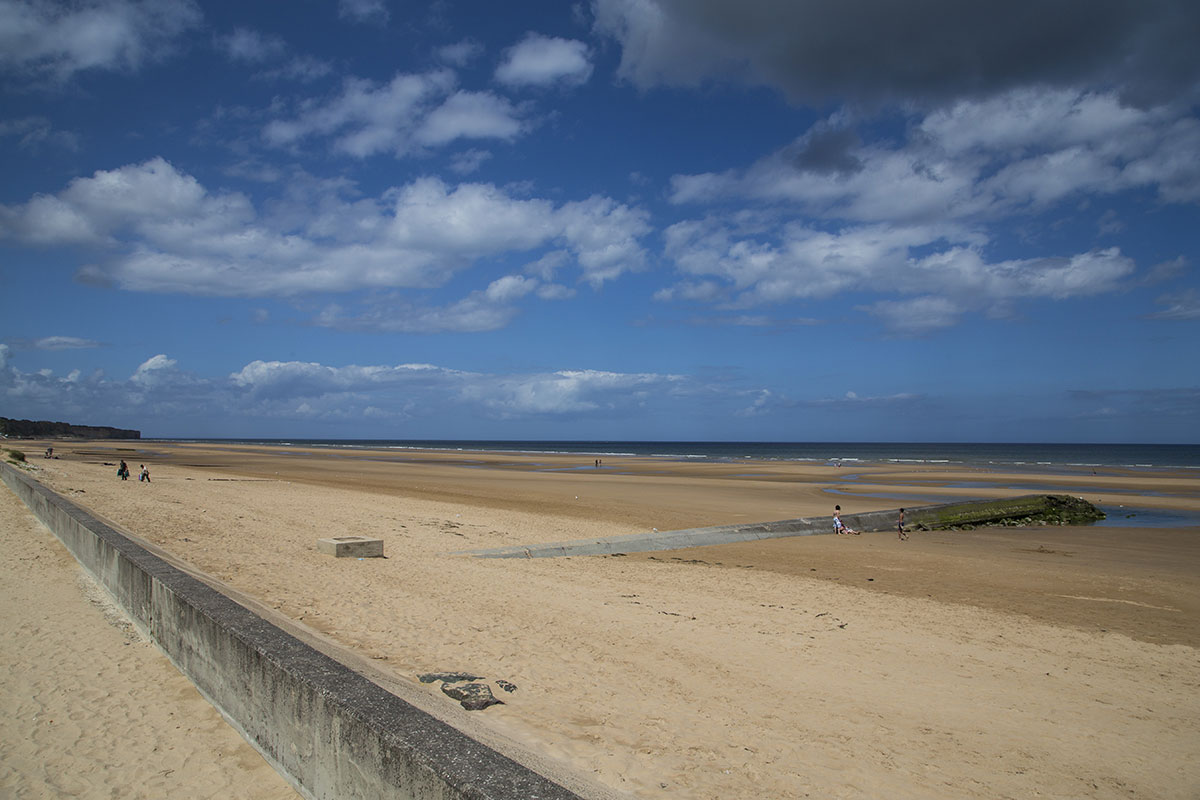
Visiting the D-Day landing beaches requires a bit of preparation. The coastline in question stretches over several dozen kilometers and brings together beaches, museums, batteries, military cemeteries, and memorial sites. To understand the events of June 6, 1944 without spending your day on the road, it is best to organize your itinerary according to the time you have available and your areas of interest.
How much time should I allow to visit the D-Day landing beaches?
One day is enough to discover a part of the area, provided you are willing to make choices. The five beaches, Utah, Omaha, Gold, Juno and Sword, are far from each other. Around them are also many museums and historical sites.
For a first one-day visit, focus on one area. Around Omaha Beach, for example, you can combine the beach, the American Cemetery in Colleville-sur-Mer, and Pointe du Hoc. On the British side, Arromanches and Gold Beach form a cohesive package.
Two days already offer more freedom. You can spend a day on the American sectors, then another on the British and Canadian beaches. With three days or more, Sainte-Mère-Église, Utah Beach, and several museums fit in much more easily without turning the trip into a race against the clock.
Where to start to build a coherent itinerary?
Start by choosing what you would like to understand. Some visitors are mainly interested in US operations, others want discover the role of Canadians or follow the British advance. You might also prefer a more general approach to the D-Day Landings and the Battle of Normandy.
Geography then helps to construct the route. From west to east, Utah Beach, Omaha Beach, Gold Beach, Juno Beach, and Sword Beach follow one another. The first two correspond to the American sectors, Gold and Sword to the British, and Juno to the Canadians.
Crossing the entire zone from Utah to Sword in a single day while planning several museums leaves not much time there. Instead, group nearby stops together. A museum at the start of the day can provide the necessary historical context before heading to the beaches; you can also start directly in the field and then put the events into perspective in a museum setting.
Understanding the Five D-Day Landing Beaches to Help You Choose Your Stops
Each beach corresponds to an assault sector assigned to Allied forces on June 6, 1944. The objectives, the units deployed, and the conditions encountered vary greatly from one sector to another. That is precisely what makes the choice of steps crucial.
Utah Beach and Omaha Beach: the American sector
Utah Beach is located on the eastern coast of the Cotentin Peninsula. American forces landed there with the goal of establishing a bridgehead and, in particular, to facilitate the advance toward Cherbourg. The Utah Beach D-Day Museum, located right on the site, puts the operation into context and details how it unfolded.
The area combines well with Sainte-Mère-Église and sites related to American airborne operations. If you are particularly interested in this part of history, allow a full day.
Omaha Beach offers a different experience. Fighting there was particularly difficult during the first hours of the D-Day landings. Once there, the width of the beach, the terrain behind the shoreline, and the access routes to the heights help to understand the obstacles encountered by the soldiers.
The American Cemetery at Colleville-sur-Mer overlooks Omaha Beach. It is one of the area’s most significant memorial sites and is well worth a separate visit.
Gold Beach, Juno Beach and Sword Beach: the British and Canadian sectors
Gold Beach extends around Asnelles and Arromanches. This part of the coastline reveals a sometimes less-known aspect of the D-Day landings: the necessary logistics to transport troops, vehicles, and supplies after the assault. In Arromanches, the remains of the Mulberry artificial harbor are still visible offshore, while the D-Day Museum traces its construction and operation.
Further east, Juno Beach corresponds to the Canadian sector. Courseulles-sur-Mer is a key stop thanks to the Juno Beach Centre and the nearby remains.
Sword Beach marks the eastern end of the plan. British operations carried out in this sector are closely linked to the advancing towards Caen. The surroundings of Pegasus Bridge complement this visit well to understand the role of British airborne troops.
Which sites should be prioritized around the D-Day landing beaches?
It all depends on how much time you have and what interests you most: military history, veterans’ stories, logistics, or the major D-Day landing sites.
Around Omaha Beach, The American Cemetery at Colleville-sur-Mer integrates naturally into the route. Pointe du Hoc offers another perspective with its cliffs, fortifications, and the traces left by the bombings. Restoration work that may occasionally modify access to certain areas is planned until 2027.
Toward Arromanches, the artificial harbor and its museum recount the events immediately following the D-Day landings. In Courseulles-sur-Mer, the Juno Beach Centre places the Canadian contribution within the broader context of World War II.
You generally benefit from limiting the number of stops. A beach, a well-chosen museum, and a memorial site already make for a packed day.
Bayeux or Caen: which base to choose for your stay?
Bayeux is particularly well-suited for itineraries focused on Omaha Beach, Gold Beach, Arromanches, and the sectors further west. Its location limits travel times to several major sites, and the city frequently serves as Starting point for guided tours.
Caen is becoming more practical for a stay including the Caen Memorial, Juno Beach or Sword Beach. The city also works well as train arrival point, with the possibility of continuing afterwards by rental car or organized transport.
Your choice depends mostly on your itinerary. For Omaha and the western coast, Bayeux is often more logical. For Sword, Juno, and the Memorial, Caen offers a better-located base.
Car, public transport, or organized tour: how to get between sites?
The car remains the most flexible solution. The beaches, museums and memorials are scattered, sometimes far from train stations and major urban centers. With your own vehicle, you can easily adjust the duration of visits and add a stop along the way.
Public transport provides access to certain areas from Caen, Bayeux, or Carentan. During the summer season, seasonal lines may also serve several D-Day landing sites. However, timetables and connections require careful planning, especially to fit in multiple visits during the same day.
An organized excursion avoids this constraint. Transportation and the sequence of steps are already planned, with possible departures from cities like Bayeux or Caen. This option works well if you are traveling without a car or prefer to focus your attention on the locations rather than organizing the travel logistics.
Visit the D-Day beaches alone or with a tour guide?
You can easily visit the D-Day landing beaches on your own. Museums, maps, and interpretive panels provide plenty of guidance, especially for a visitor already familiar with the history of June 6, 1944.
On the ground, however, certain situations remain complex to contextualize. The landscapes have evolved, some structures have disappeared and the operations involve numerous units engaged across multiple sectors. One guided tour of the D-Day landing beaches helps then to connect the places, events, and chronology.
What a guided tour brings to the understanding of the field
At Omaha Beach, a map localizes the positions, but a guide's explanations give more meaning to the terrain, the access routes inland, and the German positions. The same logic applies at Pointe du Hoc or around Arromanches: the topography becomes more concrete as soon as it is linked to military operations.
The tour guide also adapts the level of explanation. A family with young children, a group of military history enthusiasts, or foreign visitors will not have the same expectations.
When should you choose a private tour guide?
A private tour guide is well-suited for visitors who wish to spend more time in certain areas or follow the tour in their language. The itinerary can also be adjusted to the pace of a family, a group of friends, or travelers with a particular interest in a specific unit or zone.
Guides Tourisme Services work with professional guide-lecturers capable of ensuring tours in different languages, including at historical sites such as the D-Day landing beaches. This organization makes it possible, in particular, to adapt the commentary and the itinerary to the visitors' profile.
How to prepare your visit to museums, memorials, and military cemeteries?
Check the official schedules before your departure. They vary by establishment and time of year, as do booking or access conditions.
Plan for that too enough time for each museum. Utah Beach, like the Arromanches D-Day Museum, indicates an average visit duration of about 1 hour 30 minutes, or even longer depending on your interest in the collections.
Military cemeteries require a different pace. These are places of remembrance where people generally take more time. Also, keep a few free moments between visits: staying on a beach or observing a site from the heights often helps to put the information given in museums into perspective.
Visiting with children: how to adapt the tour and explanations?
A family visit mainly requires to adjust the content to the children's age. The D-Day landings refer to war, combat, and death; it is better to start from concrete landmarks rather than accumulating military details.
A map, a bunker, a vehicle or a photograph quickly provide a foothold for explaining what happened. Some museums also offer features specially designed for young visitors. The Juno Beach Centre has family-friendly modules, while the Arromanches D-Day Museum offers an audioguide intended for children aged 6 to 10.
Think about the rhythm of the day. Two long museum visits in a row can quickly wear people out. Alternating an indoor space with a beach or an outdoor site makes the itinerary more enjoyable and gives children time to process what they have just heard.
What time of year is best to visit the D-Day landing beaches?
The D-Day beaches remain accessible year-round, but your program will not be the same depending on the season. In spring and summer, the longer days make it easier to multi-stop itineraries. Tourist transport is also more numerous during this period.
Around June 6th, the commemorations attract many visitors and can modify traffic or access to certain places. Advance booking of accommodation and tours then becomes particularly useful.
Autumn and winter offer a quieter atmosphere on the coast, with shorter days and sometimes more challenging weather. Check the seasonal opening hours of the museums before you leave and bring a wind- or rain-resistant jacket, especially for exposed sites like Omaha Beach, Utah Beach, or Pointe du Hoc.